Grade 12 Intermediate Algebra Help — Video Lessons & Practice
Get clear explanations for any Intermediate Algebra problem and build exam-ready confidence.

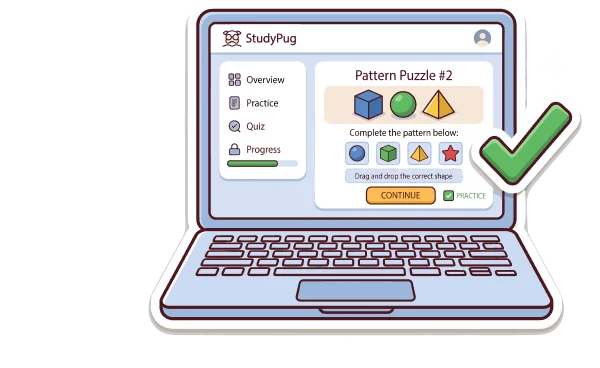
Value vs. Private Tutor
Expert instruction at a fraction of the price.

Multi-Subject
Struggling with algebra? Switch free.
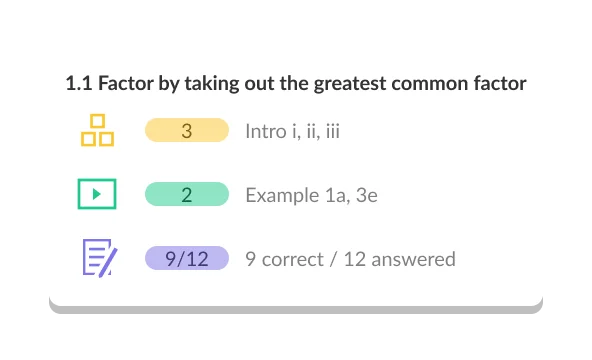
Build Mastery
Master one topic before the next.
Try It Now
Test your knowledge
Our approach aligns with the evidence
Exam Scores
Better Recall
Less Anxiety
Intermediate Algebra Topics
1. Adding and Subtracting Integers
2. Multiplying and Dividing Integers
3. Operations with Decimals
4. Adding and Subtracting Fractions
5. Multiplying and Dividing Fractions
6. Introduction to Variables and Expressions
7. Coordinates, Quadrants, and Transformations
8. Number System
9. Set Theory
10. Solving Linear Equations
11. Introduction to Relations and Functions
12. Linear Functions
13. Linear Equations
14. Absolute Value
15. Systems of Linear Equations
16. Inequalities in One Variable
17. Inequalities in Two Variables
18. Functions
19. Exponents
20. Operations with Polynomials
21. Factoring
22. Quadratic Functions
23. Solving Quadratic Equations
24. Radicals
25. Rational Expressions
26. Polynomial Functions
27. Exponential Functions
28. Logarithmic Functions
30. Imaginary and Complex Numbers
31. Sequences, Series, and Binomial Theorem
31 Chapters · 194 Topics · 1415 Videos

Ready to practice Intermediate Algebra?
Try practice questions on every Intermediate Algebra topic — with instant feedback and step-by-step video solutions when you get stuck.
Discover Our Learning Areas
Explore key subjects and start learning with interactive content.







What Is Intermediate Algebra?
Intermediate Algebra is a high school mathematics course that bridges the gap between foundational Algebra 1 and more advanced coursework like Precalculus and College Algebra. It deepens your understanding of algebraic structures — equations, functions, polynomials, and rational expressions — and develops the problem-solving fluency you need for college-level math and standardized tests.
At the Grade 12 level, Intermediate Algebra is often taken by students who want to strengthen their math foundation before moving into Calculus, or by those working to improve their SAT or ACT math scores. The course covers both procedural skills and conceptual reasoning, preparing you to handle a wide range of algebraic problems with confidence.
What Topics Are Covered in Intermediate Algebra?
Intermediate Algebra spans a broad range of interconnected topics. The major areas you will work through include:
- Linear equations and inequalities — solving, graphing, and interpreting one- and two-variable equations
- Systems of equations — solving by substitution, elimination, and graphing
- Polynomials — operations, factoring techniques, and applications
- Rational expressions and equations — simplifying, adding, subtracting, multiplying, and dividing
- Radical expressions and equations — simplifying and solving
- Quadratic equations — factoring, completing the square, and the quadratic formula
- Functions — notation, evaluation, domain and range, and graphing
- Exponential expressions — rules of exponents and exponential growth
Each topic builds on the last, so a strong understanding of earlier concepts makes later ones much easier to work through.
Is Intermediate Algebra Hard?
Many students find Intermediate Algebra challenging — not because any single concept is impossibly difficult, but because the course demands that you hold several ideas together at once. Factoring a polynomial correctly, for example, requires you to recognize patterns, apply rules, and check your work simultaneously.
The topics that trip up the most students are rational expressions, factoring by grouping, and the quadratic formula. These are not just abstract rules — they connect directly to SAT and ACT test questions, so getting comfortable with them pays off in multiple ways.
The most effective approach is to watch a clear, step-by-step explanation of the method first — not just the answer — and then practice similar problems until the process feels automatic. Students who do this consistently find that concepts they once thought were impossible start to feel straightforward.
How Does Intermediate Algebra Connect to Other Math Courses?
Intermediate Algebra sits at an important junction in the high school math sequence. It follows Algebra 1 (and sometimes Algebra 2 or Geometry) and leads into Precalculus, College Algebra, or directly into Calculus depending on your school's pathway.
The skills you build here — working with functions, solving equations, factoring, and graphing — are the exact skills that Precalculus and Calculus depend on. Students who have a strong Intermediate Algebra foundation tend to find the transition to higher-level math significantly smoother.
It is also worth noting that Intermediate Algebra topics represent a large share of both the SAT Math section and the ACT Mathematics section. Spending time here directly improves your standardized test performance.
Why StudyPug for Intermediate Algebra?
StudyPug is built for exactly the kind of student who needs Intermediate Algebra help — someone who is stuck on a specific topic, falling behind, or preparing for a high-stakes test and needs to fill gaps fast.
Start with a diagnostic. Instead of watching lessons at random, StudyPug's diagnostic assessment identifies which Intermediate Algebra topics need your attention right now. You study smarter, not harder — no wasted time on material you already know.
Learn from certified teachers, not scripts. Every video lesson is made by a certified teacher who teaches the method step by step. The goal is not just to show you the answer — it is to show you how to get the answer so you can handle similar problems on your own. These are not AI-generated videos; they are made by real educators who understand where students get stuck and how to explain their way through it.
Practice that adapts to you. StudyPug's adaptive practice adjusts difficulty based on your performance. If you get a concept right consistently, the system moves you forward. If you are struggling, it gives you more support. This keeps practice productive and builds genuine confidence rather than false security.
Exam prep built in. SAT, ACT, and AP exam-style practice is included in your subscription. The practice questions are based on real exam formats, so you are not just learning Intermediate Algebra in the abstract — you are practicing it the way it will actually be tested.
Available anywhere, anytime. Whether you are doing homework at 11pm or reviewing the night before a test, StudyPug is available on any device. Every topic, every video, every practice problem — accessible whenever you need it.
What You Learn: Intermediate Algebra Curriculum Coverage
StudyPug's Intermediate Algebra content is aligned to US state standards and covers the full scope of what Grade 12 students are expected to know. The curriculum includes all major topic areas: linear equations and systems, polynomials and factoring, rational and radical expressions, quadratic equations, functions and graphing, and exponential expressions.
Each topic is broken into focused lessons so you can target exactly what you need. If you are preparing for a chapter test on factoring polynomials, you can go straight to that section. If you are doing a full SAT prep review, you can work through the curated exam-prep pathway. The structure is designed to give you flexibility without making you wade through content you do not need.
Note: No validated internal topic links are available for this page in the current sitemap index. All topic navigation is available directly through the Intermediate Algebra course page and its on-page topic module.
How to Use StudyPug for Intermediate Algebra
Step 1 — Take the diagnostic. Start by running the diagnostic assessment. It takes a few minutes and tells you exactly which Intermediate Algebra topics to focus on. This is the single best way to make your study time efficient.
Step 2 — Watch the concept video. For each topic you need to work on, watch the certified-teacher video lesson first. Pay attention to the method, not just the final answer. Pause, rewind, and re-watch as needed — there is no rush.
Step 3 — Practice with adaptive problems. After the video, move into practice. The adaptive system will adjust difficulty based on how you do. Work through enough problems that the method feels automatic, not effortful.
Step 4 — Use Photo Search when you get stuck. If you encounter a specific problem type you cannot identify, use StudyPug's Photo Search feature — it finds matching lessons so you can get back on track without losing momentum.
Step 5 — Run through exam-style practice. Before any major test — chapter exam, midterm, SAT, or ACT — work through the exam-style practice questions. These are based on real exam formats and give you an accurate picture of where you stand.
Every plan comes with a 30-day money-back guarantee, so you can start with zero risk and see the results for yourself.
Intermediate Algebra FAQ
Unsure how StudyPug works? Need help with setting up? Check our frequently asked questions or contact us for help.
What do you learn in Intermediate Algebra, and what topics does it cover?
Intermediate Algebra builds on foundational algebra by covering linear equations and inequalities, systems of equations, polynomials and factoring, rational expressions, radical expressions, quadratic equations, and an introduction to functions. You also work with exponential expressions and graphing. These topics prepare you for Precalculus, College Algebra, and standardized tests like the SAT and ACT. The course ties together procedural skills and conceptual understanding, so by the end you can solve a wide range of algebraic problems with confidence.
What is the difference between Intermediate Algebra and College Algebra?
Intermediate Algebra is typically the bridge between basic algebra and more advanced coursework. It focuses on building fluency with equations, functions, polynomials, and rational expressions at a high school or early college level. College Algebra extends those ideas further — covering more complex functions, conic sections, sequences and series, and deeper work with exponential and logarithmic functions. If you are solid in Intermediate Algebra, you are well positioned to move into College Algebra or Precalculus. Many students take Intermediate Algebra in Grade 11 or 12 before entering college-level math.
Is Intermediate Algebra hard, and where do students struggle most?
Intermediate Algebra can feel challenging because it requires you to hold multiple concepts together at once. The topics students struggle with most are rational expressions (adding and dividing fractions with variables), factoring polynomials (especially by grouping or when the leading coefficient is not 1), solving quadratic equations using the quadratic formula, and understanding function notation. Students who struggled with basic algebra often find those gaps catch up with them here. The good news is that every one of these topics becomes manageable with clear, step-by-step instruction and consistent practice.
What should I take before Intermediate Algebra, and what comes after it?
Before Intermediate Algebra you should be comfortable with Algebra 1 essentials: solving one- and two-step equations, working with integers and fractions, and basic graphing. Some students also take a pre-algebra review. After Intermediate Algebra, the typical next step is Precalculus or College Algebra, which introduce trigonometry, advanced function analysis, and sequences. From there, students move into Calculus. Strong Intermediate Algebra skills are also directly tested on the SAT and ACT math sections, making this course important for college readiness regardless of your next math course.
Is Intermediate Algebra on the SAT or ACT, and how is it tested?
Yes — Intermediate Algebra topics make up a significant portion of both the SAT and ACT math sections. The SAT Math section tests linear equations, systems of equations, polynomials, and functions heavily. The ACT Mathematics section also includes rational expressions, quadratic equations, and graphing. On both exams, questions are multiple choice and grid-in, and they test whether you understand the method — not just whether you can recall a formula. Practicing Intermediate Algebra problems in an exam-style format is one of the best ways to raise your SAT or ACT math score.
What is one of the hardest concepts in Intermediate Algebra, and how do you tackle it?
Rational expressions are consistently the toughest concept in Intermediate Algebra. Adding, subtracting, multiplying, and dividing expressions with variables in the denominator requires you to find common denominators, factor correctly, and simplify — all in one problem. The key to tackling rational expressions is to slow down and treat them exactly like numerical fractions, but with factoring as the first step. Write out every step, factor both numerator and denominator fully before cancelling, and practice a variety of problem types. Working through several examples with a step-by-step video walkthrough helps you see the pattern and builds the fluency you need.





Written by the StudyPug Team
Last updated June 5, 2026
3 M+
students
★★★★★
4.8 average
K–12
all grades