4th Grade Math Help — Step-by-Step Video Lessons & Practice
Help your child understand every 4th grade math topic and build confidence, one lesson at a time
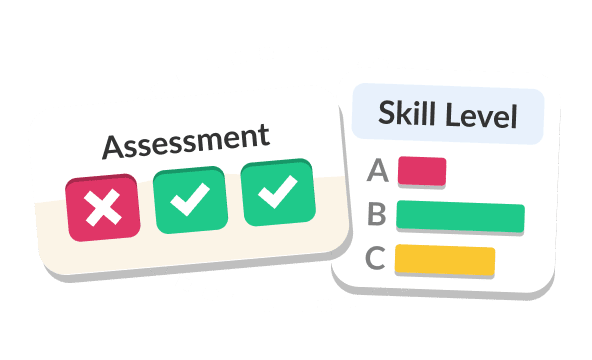
Find Your Weak Spots
See exactly where your child needs help.
Expert Video Solutions
Real teachers explain until it clicks.

Matches School Work
Matches your child's state standards exactly.
Try It Now
Test your knowledge
Our approach aligns with the evidence
Exam Scores
Better Recall
Less Anxiety
4th Grade Math Topics
1. Fractions
2. Introduction to Decimals
3. Adding and Subtracting Numbers
4. Multiplying and Dividing Numbers
5. Place Value
6. Patterns
7. Angles and Lines
8. 2D Shapes and Planes
9. 3D Shapes
10. Perimeter and Area
12. Time
13. Organizing Data
14 Chapters · 76 Topics · 1224 Videos

Ready to practice 4th Grade Math?
Try practice questions on every 4th Grade Math topic — with instant feedback and step-by-step video solutions when you get stuck.
Discover Our Learning Areas
Explore key subjects and start learning with interactive content.













What Is 4th Grade Math?
4th grade math is the year multiplication becomes fluent, fractions get serious, and number sense expands into the millions. Under Common Core State Standards — the framework most US states follow — fourth graders work across five core domains: multi-digit whole number operations, fraction understanding, decimal introduction, geometry, and measurement and data. It is the grade where children transition from learning basic facts to applying them in multi-step problems, and that shift is where many students first find math genuinely challenging.
What Do Children Learn in 4th Grade Math?
The 4th grade math curriculum covers a broad and interconnected set of skills. Here is what your child is expected to work through across the year:
Multiplication and Division: Students extend multiplication to four-digit numbers using the standard algorithm and develop long division with remainders. Fluency with multiplication facts through 12 is expected by the end of the year.
Fractions: This is the heart of 4th grade math. Children work with equivalent fractions, compare fractions using benchmarks, add and subtract fractions with like denominators, and are introduced to mixed numbers. Understanding why fractions work — not just how to compute them — is the key goal.
Decimals: Students meet decimal notation for the first time in earnest, learning to read, write, compare, and connect decimals to their fraction equivalents (e.g., 0.5 = 1/2).
Geometry: Fourth graders classify two-dimensional shapes by their properties, measure and draw angles using a protractor, and identify lines of symmetry.
Measurement and Data: Children convert units within a measurement system (feet to inches, kilograms to grams), calculate area and perimeter, and interpret data from line plots and multi-step word problems.
Is 4th Grade Math Hard? Common Struggles and How to Help
Many parents are surprised when children who were confident in 3rd grade suddenly hit a wall in 4th. This is normal, and it happens for a clear reason: the cognitive demands jump significantly.
The most common sticking points are fractions, multi-digit multiplication, and word problems. Fractions are abstract — children often struggle to see why 1/2 and 2/4 are the same, or why you cannot just add the bottom numbers when adding fractions. Multi-digit multiplication requires students to hold a procedure in working memory while also managing place value. Word problems are harder because sentences now include multiple steps and require children to decide which operation to use.
If your child is struggling, the most effective approach is to go back to the concept — not just repeat the procedure. A certified teacher walking through the visual meaning of a fraction, for example, is far more useful than drilling the algorithm again. That is exactly the approach StudyPug's video lessons take: the teacher explains why the method works before showing how to use it.
Why StudyPug for 4th Grade Math Help?
StudyPug is built around three things that actually move the needle for 4th graders: finding the gaps fast, teaching the concept properly, and making practice feel achievable.
The diagnostic assessment starts your child off by identifying precisely which 4th grade math topics need attention — whether that is equivalent fractions, long division, or angle measurement. There is no guesswork, and your child is not sitting through lessons on topics they already know.
Every concept is taught by a certified teacher in a step-by-step video lesson — not AI-generated content, but real teaching from real educators who know where children get stuck in 4th grade math. The videos are short, clear, and focused on one idea at a time, so your child does not lose the thread.
After each video, adaptive practice adjusts the difficulty to your child's current level. If they answer a few problems confidently, the next set steps up slightly. If they hesitate, the practice stays supportive. This builds genuine confidence rather than frustration.
For parents, the parent dashboard gives a clear, topic-by-topic view of your child's progress — so you always know where they are improving and where they still need a push. And with the Family Plan covering up to 5 children at all grade levels and subjects for one price, the whole family benefits.
All content is aligned to Common Core State Standards and state curricula, so StudyPug matches what your child is actually learning in class — not a parallel curriculum they have to mentally translate.
What Your Child Will Learn: 4th Grade Math Curriculum Coverage
StudyPug covers every topic in the 4th grade math curriculum, organised into clear topic sequences your child can follow at their own pace. Key areas include:
- Place value through millions and rounding
- Multi-digit addition, subtraction, multiplication, and long division
- Equivalent fractions, comparing fractions, and mixed numbers
- Adding and subtracting fractions with like denominators
- Decimal notation and fraction-decimal equivalence
- Angles, lines, rays, and 2D shape classification
- Measuring and drawing angles with a protractor
- Area, perimeter, and unit conversion
- Line plots and multi-step word problems
- Factors, multiples, and number patterns
Coverage is aligned to 4th grade Florida math standards and California 4th grade math standards, two of the most widely referenced state frameworks in the US. If your state follows Common Core closely, you will find nearly complete overlap with what your child's teacher assigns.
How to Use StudyPug for 4th Grade Math Practice
The most effective way to use StudyPug for 4th grade math is to integrate it with what your child is already doing in school — not to replace their classroom learning, but to reinforce and extend it.
Start with the diagnostic. It takes only a few minutes and gives you an immediate picture of where your child stands across all 4th grade math topics. Use that report to set your child's starting point.
Watch the concept video before practicing. When a new topic comes home in homework, have your child watch the relevant StudyPug video first. Certified teachers explain the method clearly, so your child understands the concept before attempting problems. This prevents the frustrating cycle of trying to memorise a procedure without understanding it.
Use adaptive practice to build fluency. After watching, move straight into the practice set. The questions adjust to your child's level — short sessions of 10–15 minutes on school evenings are enough to build real fluency over a few weeks.
Check progress in the parent dashboard. Log in weekly to see which topics your child has completed and which ones show lower confidence scores. Use that information to have positive, specific conversations — "I saw you worked on fractions this week — do you want to try another video on that before your test?"
Prepare for tests with practice tests. Before classroom assessments, your child can use the built-in practice test to get comfortable with question formats and timing — based on real exam styles, not random questions.
All of this is available on any device — desktop, tablet, or phone — so your child can get 4th grade math help whenever they need it, not just during homework time. And with a 30-day money-back guarantee, there is no risk in getting started today.
4th Grade Math FAQ
Unsure how StudyPug works? Need help with setting up? Check our frequently asked questions or contact us for help.
What does my child learn in 4th grade math, and what topics does it cover?
In 4th grade math, children build on foundational skills across five major areas: multi-digit multiplication and division, fractions (equivalent fractions, comparing and ordering, adding and subtracting), decimals, geometry (angles, lines, and 2D shapes), and measurement and data (area, perimeter, converting units). Under Common Core and most state standards, 4th grade is when multiplication fluency and fraction reasoning take center stage. By year's end, students should confidently multiply four-digit numbers, work with fractions as parts of a whole, and interpret data from graphs and tables.
Is 4th grade math hard, and where do children commonly struggle?
Fourth grade math is a significant step up for many children, and it's very common to hit a wall. The two biggest sticking points are fractions — especially adding fractions with unlike denominators and understanding equivalence — and multi-digit multiplication, where students are expected to use the standard algorithm. Long division also trips up many kids because it requires holding multiple steps in mind at once. Word problems grow more complex too, demanding stronger reading and reasoning skills. If your child is finding any of these areas tough, they are not alone — and targeted practice with clear video explanations makes a big difference.
What should my child know before 4th grade math, and what comes next?
Before starting 4th grade math, children should be comfortable with multiplication tables up to 10, basic place value (hundreds, tens, ones), simple fractions, and telling time and measuring length. If any of those foundations are shaky, StudyPug's diagnostic will flag them so you can fill the gaps quickly. After 4th grade, children move into 5th grade math, where they work with larger decimals, fraction multiplication and division, and introductory algebra thinking. A strong 4th grade year sets up real confidence heading into 5th.
How does StudyPug 4th grade math map to what my child learns at school?
StudyPug's 4th grade math content is aligned to Common Core State Standards, which form the foundation for math curricula across most US states. Lessons cover every major domain — Operations and Algebraic Thinking, Number and Operations in Base Ten, Number and Operations — Fractions, Measurement and Data, and Geometry — in the sequence your child's teacher follows. For state-specific coverage, you can explore the 4th grade Florida math standards or the California 4th grade math standards to see exactly how lessons map to your state's requirements.
What is one of the trickiest 4th grade math concepts, and how is it taught on StudyPug?
Fractions with unlike denominators is consistently one of the hardest concepts in 4th grade math. Children often try to add numerators and denominators separately — getting 1/2 + 1/3 = 2/5 — because they don't yet see why a common denominator is needed. On StudyPug, a certified teacher walks through the concept visually, using fraction bars and number lines so the idea makes intuitive sense before any procedure is introduced. The lesson then moves to worked examples, followed by adaptive practice problems that adjust to your child's level, building confidence step by step until the method sticks.
How much math practice should my child do at 4th grade?
For 4th grade, most educators recommend around 15–20 minutes of focused math practice on school days, in addition to assigned homework. Consistency matters more than length — short daily sessions produce better retention than occasional long sessions. A good routine is to watch one StudyPug concept video when a new topic is introduced at school, then complete a set of practice problems to reinforce it. During test prep weeks, adding a practice test session helps your child get comfortable with the format and pacing they'll face in class assessments.





Written by the StudyPug Team
Last updated June 5, 2026
3 M+
students
★★★★★
4.8 average
K–12
all grades