Online 4th Grade English Help for Your Child
Strengthen reading comprehension, grammar, and vocabulary with real teachers and practice that adapts to your child's level.
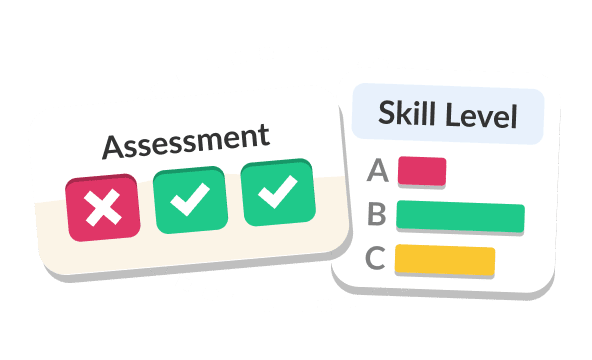
Finds the Gaps
Spot exactly where your child needs help.
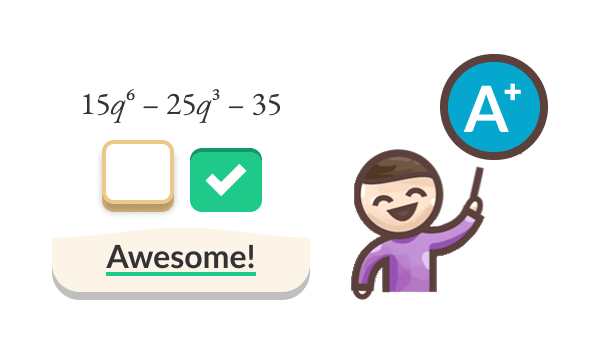
Expert Video Solutions
Teachers show kids how to solve problems.

School-Aligned
Matches your child's exact class standards.
Try It Now
Test your knowledge
Our approach aligns with the evidence
Exam Scores
Better Recall
Less Anxiety
4th Grade ELA Topics
1. CCSS.ELA-LITERACY.L.4.1.A
2. CCSS.ELA-LITERACY.L.4.1.B
3. CCSS.ELA-LITERACY.L.4.1.C
4. CCSS.ELA-LITERACY.L.4.1.D
5. CCSS.ELA-LITERACY.L.4.1.E
6. CCSS.ELA-LITERACY.L.4.1.F
7. CCSS.ELA-LITERACY.L.4.1.G
8. CCSS.ELA-LITERACY.L.4.2.A
9. CCSS.ELA-LITERACY.L.4.2.B
10. CCSS.ELA-LITERACY.L.4.2.C
11. CCSS.ELA-LITERACY.L.4.2.D
12. CCSS.ELA-LITERACY.L.4.3.A
13. CCSS.ELA-LITERACY.L.4.3.B
14. CCSS.ELA-LITERACY.L.4.3.C
15. CCSS.ELA-LITERACY.L.4.4.A
16. CCSS.ELA-LITERACY.L.4.4.B
17. CCSS.ELA-LITERACY.L.4.4.C
18. CCSS.ELA-LITERACY.L.4.5.A
19. CCSS.ELA-LITERACY.L.4.5.B
20. CCSS.ELA-LITERACY.L.4.5.C
21. CCSS.ELA-LITERACY.L.4.6
22. CCSS.ELA-LITERACY.SL.4.1.A
23. CCSS.ELA-LITERACY.SL.4.1.B
24. CCSS.ELA-LITERACY.SL.4.1.C
25. CCSS.ELA-LITERACY.SL.4.1.D
26. CCSS.ELA-LITERACY.SL.4.2
27. CCSS.ELA-LITERACY.SL.4.3
28. CCSS.ELA-LITERACY.SL.4.4
29. CCSS.ELA-LITERACY.SL.4.5
30. CCSS.ELA-LITERACY.SL.4.6
31. CCSS.ELA-LITERACY.W.4.1.A
32. CCSS.ELA-LITERACY.W.4.1.B
33. CCSS.ELA-LITERACY.W.4.1.C
34. CCSS.ELA-LITERACY.W.4.1.D
35. CCSS.ELA-LITERACY.W.4.2.A
36. CCSS.ELA-LITERACY.W.4.2.B
37. CCSS.ELA-LITERACY.W.4.2.C
38. CCSS.ELA-LITERACY.W.4.2.D
39. CCSS.ELA-LITERACY.W.4.2.E
40. CCSS.ELA-LITERACY.W.4.3.A
41. CCSS.ELA-LITERACY.W.4.3.B
42. CCSS.ELA-LITERACY.W.4.3.C
43. CCSS.ELA-LITERACY.W.4.3.D
44. CCSS.ELA-LITERACY.W.4.3.E
45. CCSS.ELA-LITERACY.W.4.4
46. CCSS.ELA-LITERACY.W.4.5
47. CCSS.ELA-LITERACY.W.4.6
48. CCSS.ELA-LITERACY.W.4.7
49. CCSS.ELA-LITERACY.W.4.8
50. CCSS.ELA-LITERACY.W.4.9.A
51. CCSS.ELA-LITERACY.W.4.9.B
52. CCSS.ELA-LITERACY.W.4.10
53. CCSS.ELA-LITERACY.RF.4.3.A
54. CCSS.ELA-LITERACY.RF.4.4.A
55. CCSS.ELA-LITERACY.RF.4.4.B
56. CCSS.ELA-LITERACY.RF.4.4.C
57. CCSS.ELA-LITERACY.RI.4.1
58. CCSS.ELA-LITERACY.RI.4.2
59. CCSS.ELA-LITERACY.RI.4.3
60. CCSS.ELA-LITERACY.RI.4.4
61. CCSS.ELA-LITERACY.RI.4.5
62. CCSS.ELA-LITERACY.RI.4.6
63. CCSS.ELA-LITERACY.RI.4.7
64. CCSS.ELA-LITERACY.RI.4.8
65. CCSS.ELA-LITERACY.RI.4.9
66. CCSS.ELA-LITERACY.RI.4.10
67. CCSS.ELA-LITERACY.RL.4.1
68. CCSS.ELA-LITERACY.RL.4.2
69. CCSS.ELA-LITERACY.RL.4.3
70. CCSS.ELA-LITERACY.RL.4.4
71. CCSS.ELA-LITERACY.RL.4.5
72. CCSS.ELA-LITERACY.RL.4.6
73. CCSS.ELA-LITERACY.RL.4.7
74. CCSS.ELA-LITERACY.RL.4.9
75. CCSS.ELA-LITERACY.RL.4.10
75 Chapters · 121 Topics · 47 Videos
Discover Our Learning Areas
Explore key subjects and start learning with interactive content.


What is 4th Grade English?
4th grade English is the bridge between early reading foundations and independent academic literacy. At this stage, your child moves beyond sounding out words and begins reading to understand, analyze, and think critically. They tackle longer informational and literary texts, study how authors craft meaning, and apply increasingly detailed grammar rules in their own writing. For many students, 4th grade is where reading gets harder before it gets easier — and where the right practice makes all the difference.
What reading skills does my 4th grader need to build?
Reading comprehension in 4th grade goes well beyond answering basic questions about a story. Students learn to identify the main idea and supporting details in informational texts, make inferences, compare and contrast characters or ideas, and understand how text structure (cause and effect, problem and solution, chronological order) affects meaning. They also practice reading strategies — like using context clues for unfamiliar vocabulary — that help them become more independent readers.
If your child finds it hard to explain what a passage was about, or reads the words but cannot connect them to a bigger idea, targeted reading comprehension practice is the most direct fix. StudyPug's certified-teacher video lessons walk through each strategy step by step, so your child sees exactly how to approach a passage before practicing on their own.
How does grammar fit into 4th grade English?
Grammar in 4th grade moves into territory that trips up a lot of students: relative pronouns, progressive verb tenses, modal auxiliaries, correct use of commas and quotation marks, and the difference between frequently confused words. These rules matter because they are tested directly and because weak grammar undermines reading comprehension — when students cannot parse a complex sentence, they lose meaning.
The good news is that grammar is one of the fastest skills to improve with focused practice. A short diagnostic assessment identifies which specific rules your child has not yet secured, and adaptive practice then targets exactly those gaps. Parents often notice measurable grammar improvement within just a few weeks of consistent sessions.
What vocabulary skills matter at this grade?
4th grade vocabulary work centers on understanding words in context rather than memorizing definitions in isolation. Students learn to use context clues, root words, prefixes, and suffixes to figure out unfamiliar words in both literary and informational texts. Academic vocabulary — the language of school subjects — also expands significantly at this level.
Strong vocabulary underpins everything else in 4th grade English. A child who stumbles over vocabulary in a reading passage loses comprehension, loses confidence, and loses time on assessments. Building vocabulary through regular reading and targeted practice pays dividends across every other skill area.
What is text analysis, and why does it start in 4th grade?
Text analysis means going beyond the surface of what a text says to ask how and why it was written that way. In 4th grade, students begin examining an author's point of view, how word choice shapes meaning, how illustrations or headings support an informational text, and how different parts of a story or argument connect. These are the analytical skills that high school and beyond demand — and 4th grade is where they are introduced systematically for the first time.
Many children find text analysis unfamiliar and a little abstract at first. Video lessons that model the thinking process — showing a student how to read a passage, ask the right questions, and find textual evidence — make the skill feel concrete and learnable rather than mysterious.
Why StudyPug for 4th Grade English?
StudyPug combines three things that rarely appear together in one platform: certified-teacher video lessons that teach the method, a diagnostic assessment that finds gaps before your child wastes time on skills they already have, and adaptive practice that adjusts difficulty as skills improve. For 4th grade English — where the learning curve is real — that combination is particularly powerful.
The diagnostic assessment is the starting point. In a short session, it identifies which reading comprehension strategies, grammar rules, and vocabulary skills are secure and which need work. Your child then practices those specific areas, not everything at once. As skills improve, practice gets appropriately more challenging. The parent dashboard shows progress week over week so you always know where your child stands.
All content is aligned to state standards, which means the video lessons and practice problems mirror what your child's teacher is covering in class. One subscription also covers up to five children across all grades and subjects, and every subscription comes with a 30-day money-back guarantee. There is no risk in trying it.
What topics does 4th Grade English cover?
The 4th Grade English course on StudyPug covers the full range of skills students encounter at this level:
- Reading comprehension — main idea and details, inference, text structure, compare and contrast
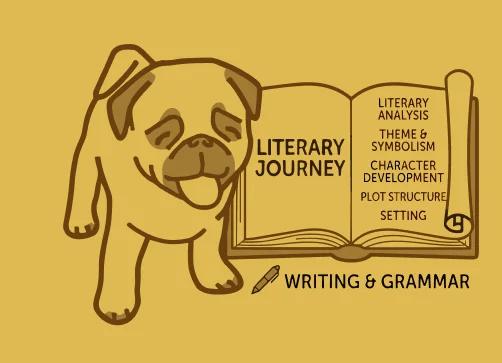
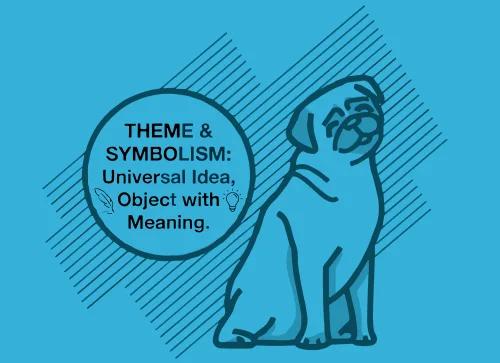
- Literary analysis — character, setting, plot, theme, author's point of view, word choice
- Informational text — text features, cause and effect, summarizing nonfiction passages
- Grammar — relative pronouns, verb tenses, modal auxiliaries, commas, quotation marks, commonly confused words
- Vocabulary — context clues, root words, prefixes and suffixes, academic vocabulary
- Sentence structure — combining sentences, avoiding run-ons and fragments, varying sentence types
For state-specific curriculum alignment, see the florida 4th grade curriculum and the new york grade 4 ela curriculum — both map the course content directly to state standards so you can see exactly what your child will practice.
Using StudyPug for 4th Grade English practice
Getting started takes a few minutes. Your child takes a short diagnostic assessment that produces a personalized practice path focused on their actual gaps. From there, they can watch a certified-teacher video lesson before each practice session, work through adaptive questions that adjust to their responses, and replay any section until the concept is secure.
Sessions work best when kept to 20–30 minutes on a consistent schedule — three or four times a week produces steady, visible improvement. The parent dashboard lets you check in on progress without interrupting your child's flow. If a particular skill is proving stubborn, the video lesson for that topic is always one click away.
Photo Search is also available as a supporting tool: if your child brings home a homework question they cannot place, they can snap a photo and get directed to the relevant lesson instantly. It is a helpful shortcut, though the video lessons and adaptive practice are where the real skill-building happens.
92% of StudyPug students report improved grades. For 4th grade English — where reading, grammar, and vocabulary all compound on each other — consistent, targeted practice is the most reliable path to lasting improvement. Get started today and see the difference focused practice makes.
4th Grade English FAQ
Unsure how StudyPug works? Need help with setting up? Check our frequently asked questions or contact us for help.
What's included in the subscription?
Full access to all 4th Grade English video lessons, practice problems, assessments, and progress tracking. One subscription covers up to 5 children and all grades, subjects, and courses on StudyPug.
Can I sign up free to try it?
Yes! You can sign up free to explore sample lessons and practice materials. When you're ready to subscribe, we offer a 30-day money-back guarantee — if it's not right for your child, we'll refund you.
How much does it cost?
Plans start with one low monthly payment, with annual options for the best value. One plan covers up to 5 children and all subjects. 30-day money-back guarantee. [See all plans →]
What does 4th grade English actually cover?
4th grade English builds on early reading foundations with text analysis, reading strategies for informational and literary texts, parts of speech, sentence structure, and vocabulary in context. Students begin analyzing how authors use craft to shape meaning and practice reading longer, more complex passages independently.
How do the diagnostic assessments work?
Short diagnostic assessments identify exactly which 4th grade reading comprehension, grammar, and vocabulary skills need attention. Instead of practicing everything randomly, your child gets a focused path that targets real gaps — saving time and reducing frustration.
Is 4th grade English hard for most kids?
4th grade is often where reading shifts from learning to read to reading to learn. Passages get longer, vocabulary grows more complex, and grammar rules become more detailed. Many children find this transition challenging, but consistent targeted practice builds the skills needed to keep up and move ahead confidently.





Written by the StudyPug Team
Last updated June 5, 2026
3 M+
students
★★★★★
4.8 average
K–12
all grades