Kindergarten Math Help — Step-by-Step Video Lessons & Practice
Help your child understand every kindergarten math topic and build confidence, one lesson at a time.
Find Learning Gaps
See exactly what skills to practice next.
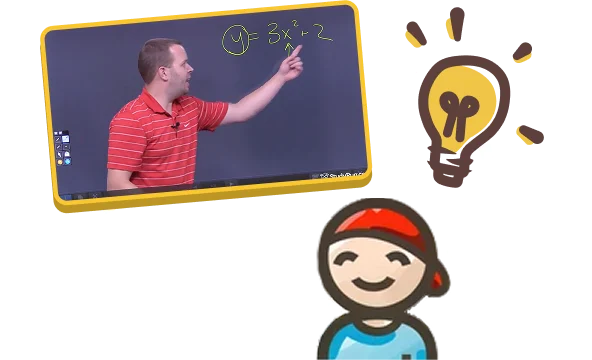
Step-by-Step Videos
Your child learns the method and solves alone.
Adaptive Practice
Questions adapt to keep kids confident.
Try It Now
Test your knowledge
Our approach aligns with the evidence
Exam Scores
Better Recall
Less Anxiety
Kindergarten Math Topics
1. Counting Up to 5
2. Counting and Sequences Up to 20
3. Adding Up to 5
4. Adding Up to 10
5. Subtracting Up to 5
6. Subtracting Up to 10
7. Comparing Numbers
9. 3D Shapes
Discover Our Learning Areas
Explore key subjects and start learning with interactive content.









What Is Kindergarten Math?
Kindergarten math is the structured introduction to numbers, shapes, and early problem-solving that prepares children for a lifetime of mathematical thinking. In the United States, kindergarten math follows the Common Core State Standards — a framework that sets out the counting, operations, geometry, and measurement skills every five- and six-year-old should develop before entering first grade. It is not simply learning to count to 10; by the end of the year, children are expected to add and subtract within 10, compare groups of objects, describe shapes in their environment, and understand that a number represents a specific quantity no matter how a group of objects is arranged.
What Topics Are Covered in Kindergarten Math?
Kindergarten math spans five main strands. Counting and cardinality is the backbone: children learn to count to 100 by ones and tens, count objects reliably, and connect numerals to the quantities they represent. Operations and algebraic thinking introduces addition as putting groups together and subtraction as taking apart — always with concrete objects or drawings before moving to symbols. Number and operations in base ten builds early place-value understanding, showing that the numbers 11 through 19 are composed of one group of ten and some ones. Measurement and data teaches children to compare objects by length, weight, and capacity and to sort and classify by attributes. Geometry rounds things out with two-dimensional shapes (circles, squares, rectangles, triangles, hexagons) and three-dimensional shapes (cubes, cones, cylinders, spheres), including how shapes can be composed to make new shapes.
Where Do Kindergartners Commonly Struggle With Math?
Even though the content seems straightforward to adults, several kindergarten math concepts are genuinely tricky for young children. One-to-one correspondence — the discipline of touching exactly one object for each count and stopping at the right moment — breaks down when children count too fast or skip objects. Cardinality (understanding that the last number counted tells you the total) is a conceptual leap that many children need weeks to internalize. Number decomposition, or knowing that 7 can be 5 + 2 or 3 + 4, is abstract and requires many visual models before it clicks. Numeral formation (writing numbers without reversals) takes fine-motor practice. Parents often notice these gaps when homework comes home and their child freezes. A good strategy is to catch the specific gap early rather than drilling randomly — which is exactly why a diagnostic that maps where your child is can be so powerful at this age.
What Comes Before and After Kindergarten Math?
Before kindergarten, children benefit from informal counting experiences — counting steps, counting toys, matching one cookie to one plate. Recognizing numerals 0–10 and naming basic shapes gives a strong head start. These pre-K skills are not tested as prerequisites, but children who arrive with them tend to progress faster through the cardinality and decomposition work early in the year. After kindergarten, first-grade math extends every strand: addition and subtraction move from within 10 to within 20, place value expands to two-digit numbers (tens and ones), measurement adds length with units, and time and money appear for the first time. Children who finish kindergarten with solid number sense — fluid counting, confident comparison, beginning decomposition — typically find the first-grade jump manageable rather than jarring.
Why StudyPug for Kindergarten Math Help?
StudyPug is built around three things that matter most for kindergarten learners: knowing where to start, explaining clearly, and practicing at the right level. The diagnostic assessment — available from kindergarten onwards — takes just a few minutes and identifies exactly which skills your child has and which need work. That means you are never wasting practice time on topics your child already knows, and you are never skipping ahead of a gap that will cause problems later.
Every concept is taught by a certified teacher in short video lessons — not AI-generated content. These teachers explain the method behind the answer, using visual models like ten-frames, number lines, and base-ten blocks. When your child watches a lesson on number bonds, they are not just seeing a worked example; they are learning a strategy they can use independently on any similar problem.
Adaptive practice then reinforces what the videos teach. Questions adjust to your child's level in real time — easier when they need to build confidence, more challenging once a concept is secure. For kindergarten math specifically, printable worksheets with answer keys are included, giving your child meaningful screen-free practice at the kitchen table. The Parent Dashboard lets you see progress by topic for each child on your account, so you always know what is going well and where a little extra attention would help. All lessons align to the Common Core State Standards for kindergarten, mirroring the sequence your child's teacher follows in class.
What Your Child Will Learn — Kindergarten Math Curriculum Coverage
StudyPug covers the full scope of kindergarten math that US students encounter at school. Counting lessons start with one-to-one correspondence and build to counting to 100 by ones and by tens. Addition and subtraction lessons use concrete models first, then pictorial representations, then abstract equations — following the progression that research shows works best for young learners. Shape lessons cover naming, sorting, and composing both flat and solid shapes. Measurement lessons introduce comparison language (longer, shorter, heavier, lighter) and data lessons show children how to sort objects into categories and answer simple questions about the groups.
To see how this content connects to your state's specific curriculum sequence, you can explore the Florida kindergarten math curriculum or the New York kindergarten math curriculum — both show how individual topics map to state standards. The underlying Common Core alignment means the core content is consistent across nearly all US states, even where state-branded standards are used.
How to Use StudyPug for Kindergarten Math
The best approach for kindergarten is short, regular sessions rather than long occasional ones. Start by running the diagnostic — it takes only a few minutes and gives you a clear picture of which skills are solid and which need work. Then choose one topic at a time: watch the video lesson together the first time, pausing to ask your child questions, and then let them try the practice questions on their own. Use the printable worksheets for screen-free reinforcement, especially on weekends or during homework time at the table. Check the Parent Dashboard weekly to see which topics have turned from struggling to confident — that progress view is often the clearest signal of where to focus next. Free practice content is available immediately so you can see how it works before committing to a subscription. Every paid plan comes with a 30-day money-back guarantee, so there is no risk to getting started today.
Kindergarten Math FAQ
Unsure how StudyPug works? Need help with setting up? Check our frequently asked questions or contact us for help.
What does my child learn in kindergarten math, and what topics does it cover?
Kindergarten math builds the foundations your child will use throughout school. Topics include counting and cardinality (numbers 1–100), number sense and place value, basic addition and subtraction, comparing numbers and quantities, recognizing and describing 2D and 3D shapes, measurement concepts like longer and shorter, and sorting and classifying objects. By the end of kindergarten, children should recognize written numerals, count objects reliably, and solve simple addition and subtraction problems within 10.
Is kindergarten math hard, and where do children commonly struggle?
Most kindergartners find the pace manageable, but a few concepts trip children up regularly. One-to-one correspondence — touching each object exactly once while counting — is a common stumble. Decomposing numbers (knowing that 7 is 5 + 2 or 4 + 3) can feel abstract at first. Writing numerals correctly and understanding that the last number said when counting equals the total are also frequent sticking points. With short, consistent practice sessions and clear explanations, most children gain confidence quickly.
What should my child know before kindergarten math, and what comes next?
Children entering kindergarten benefit from being able to count objects to at least 10, recognize a few written numbers, and name basic shapes like circles and squares. These pre-K skills give them a running start. After kindergarten, first-grade math builds directly on this foundation — adding and subtracting within 20, understanding tens and ones (place value), measuring length, and telling time. Strong kindergarten number sense makes first-grade concepts far easier to absorb.
How does StudyPug kindergarten math map to what my child learns at school?
StudyPug's kindergarten math lessons are aligned to the Common Core State Standards, which guide math instruction in most US states. Topics covered match the counting, operations, geometry, and measurement strands your child's teacher follows. If your state uses its own standards framework, the core kindergarten concepts remain very closely aligned. You can also browse the Florida kindergarten math curriculum and the New York kindergarten math curriculum to see exactly how lessons connect to your child's classroom.
What is one of the trickiest kindergarten math concepts, and how is it taught?
Number decomposition — understanding that a number like 8 can be broken into pairs such as 3 + 5 or 6 + 2 — is one of the most conceptually demanding skills in kindergarten. It underpins addition and subtraction for years to come. StudyPug's certified-teacher videos teach decomposition using visual models like number bonds and ten-frames, walking children through each combination step by step. Practice questions then adjust to your child's level, reinforcing the concept with immediate feedback until it sticks.
How much kindergarten math practice should my child do each day?
Education guidelines generally suggest 10–15 minutes of focused math practice per day for kindergartners — short enough to keep attention, long enough to build habits. Consistency matters more than duration. A brief diagnostic on StudyPug identifies exactly which topics need the most attention, so those minutes are spent where they count most. Printable worksheets (included for kindergarten math) also give your child meaningful screen-free practice they can do at the table alongside you.