StudyPug Learning has taught in Canada for 25 years. We treat a Canadian university application as something that begins in Grade 10, not as homework due in Grade 12. Course selection, marks, extracurriculars, language results, written materials, interviews — one advisor stays with the same student through all of it.

What "local" actually means here
What parents see: one plan that names the year, the task, the deadline and what is still missing — and that you can check any time.

Our advisors work with BC and Ontario high-school course loads and transcripts every day, so they know which courses a university reads, and which transcript it reads them from.

Ontario applications run through OUAC, BC applications through EPBC. The two differ in when they open, how documents are submitted and when they close, so each target school is scheduled on its own system.

When the gap is a mark rather than a document, our Math, English and AP Programs classes pick it up. You do not need a second company for it.
Grades: Grade 9 through Grade 12. Grades 9 and 10 are for planning and course selection. Grades 11 and 12 are for school selection, written materials and submission. StudyPug Learning's planning and application services run from Kindergarten through secondary school, secondary school into university, and university into work (K-12-University). This page covers the Canadian university stage of that span.
Fields our students apply to most: business and computer science. Local offers include the University of Toronto (Rotman School of Business) and the University of British Columbia (Sauder School of Business). Students applying in computer science usually take our Coding class alongside the application work.
Families who need us most:

Applying to Ontario universities (OUAC) or BC universities (EPBC), and unsure which step comes first.

Target schools clustered around UBC, the University of Toronto, the University of Waterloo, McGill University and Simon Fraser University (SFU).

Planning to apply online yourselves, and stuck on school choice, program choice or the written materials.

Starting in the first term of Grade 12, with a timeline that now has to be tightened.
What parents see: after one consultation you leave with your child's to-do list for their current grade, and the next deadline on it.
What parents see: the three levels set out side by side, chosen by your child's grade and how many target schools are on the list.


The steps, as our application advisors set them out
Open the online application accounts — OUAC, EPBC and each university's own account — and fill in the student's details.
Choose the universities and programs to apply to.
Submit the application documents: institutions attended, transcripts, proof of extracurricular activity, IELTS or TOEFL results, personal statement and references.
Send updated documents on time, such as the second-term Grade 12 transcript.
Watch the application accounts and each university's admissions notices, and prepare for interviews.
Read the admission decisions as they arrive, and decide whether to accept.
Confirm the final choice and pay the tuition.
OUAC (ouac.on.ca) is the hub between high schools, students and Ontario's universities. A student selects universities and programs through OUAC, and OUAC forwards the student's details, program choices and high-school marks to each university.
EPBC — Education Planner BC — is the BC Ministry of Education's platform for graduating high-school students and adult learners, covering education planning and university applications, with information on studying, working and finances in BC. UBC announced in 2021 that it would receive applications through EPBC.

Apply on each university's own site. The steps are much the same — create an account on the university site, enter the student's details, submit the documents, pay the application fee, submit.
When applications open and close
Canadian university applications generally open between September and October. UBC and McGill University open in early September. Ontario universities open together in late September. Simon Fraser University (SFU) and the University of Alberta usually open in early October. Closing dates differ by university, and some publish no single deadline at all, assessing applications across a window instead — usually between December and February.
What parents see: this timeline turned into real dates for your child's own target-school list and written into the plan, so you are not checking each university yourself.
What parents see: a table of target school × required courses × language result, with every gap visible at a glance.
Both are Ontario universities, so the application runs through OUAC. Ontario universities generally open together in late September, and closing dates differ by school. What to prepare: the Grade 12 course load and transcript, proof of extracurricular activity, IELTS or TOEFL results, a personal statement and references. Each university adjusts its required courses and language thresholds from year to year, and the version published on that university's own site for that year is the one that counts.
Official sites: University of Toronto · University of Waterloo.
UBC is in BC, usually opens in early September, and announced in 2021 that it would receive applications through EPBC. Simon Fraser University (SFU) usually opens in early October.

The requirements that count are the ones each university publishes for that year on its own site. What we do is take those official requirements and check them line by line against your child's courses and marks: which course is missing, how far off a mark is, written down plainly. Then we schedule Math, English or AP Programs to close it. A strong provincial English result carries real weight in a Canadian application.
Rankings are re-published every year, and different tables weigh different things, so a ranking is useful for a rough sense of where a university sits — not as the only basis for a school list. The order we suggest: first find which universities are strong in your child's target program and have the courses to support it, then use rankings as a reference.
Our Canadian university rankings page sets out how the main tables are built and what each one measures.
What parents see: a school list split three ways — reach, target and safety — with the reason each school is on it written down.

Our university planning advisors act as each student's own application advisor. They set goals from that student's strengths, then schedule every step and follow it through. They work alongside a large team of experienced subject teachers, so marks improve while academics and extracurriculars both move forward. A strong AP result strengthens a university application.
Our North American application-writing team looks for what is genuinely distinctive about each student, and works through drafts as a team until the written materials show it. Our background-development advisors plan alongside them, so every student has something in the application that is theirs alone.

We invite you to regular parent meetings to go through where the application stands: what your child is learning with us, how the plan is tracking, and what the application still needs. Every student has their own application and planning advisor.
Names, subjects and credentials for the teaching team are on the Teachers page.
What parents see: the same advisor from the first meeting to submission. No handovers.
| University | Student |
|---|---|
| University of Toronto (Rotman School of Business) | A.G. |
| University of British Columbia (Sauder School of Business) | D.L. |
Talk to us about how these applications were put together.
What parents see: offers are published by year. For 2025-2026 the Canadian university count is 212, and you can ask to see it any time.
English, math, science and coding - every academic need covered


Elementary fundamentals through AP Calculus and competition coaching.

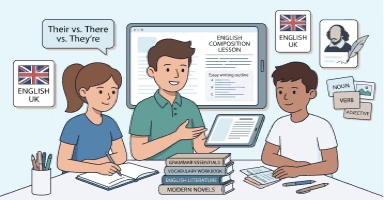
Reading, writing, and analysis from K-12 through AP English.

Build confidence with professional public speaking and presentation training.

Professional English skills for adult learners — fast, guaranteed results.
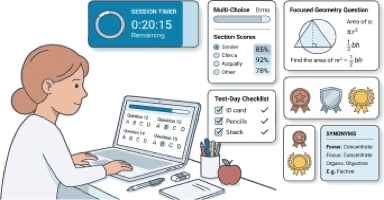

Targeted preparation for the standardized exams your child needs.

University planning, extracurricular strategy, and exam consultations for every grade.

SSAT tutoring, interview coaching, and admissions support for private schools.
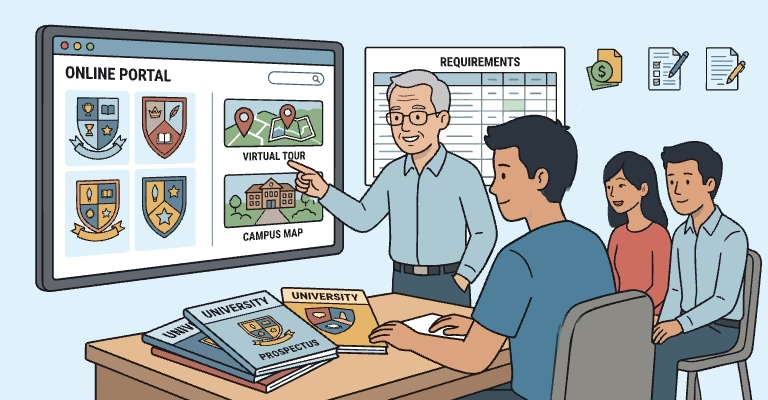
Application essays and a proven strategy for Canadian and US university admissions.
These are the steps our application advisors set out for students applying to Canadian universities.
We recommend starting the planning in Grade 10 of a Canadian high school. The earlier the planning starts, the more time there is, and the more complete the preparation.
Want the whole process and the things to watch for? Planning to apply online yourselves, but unsure where to begin? Our university application and planning team has the full route mapped — the key dates, choosing a university and a program, and preparing the documents. Ask us and an advisor will walk you through it step by step.
Applications generally open between September and October. UBC and McGill University open in early September. Ontario universities open together in late September. Some universities, such as Simon Fraser University (SFU) and the University of Alberta, usually open in early October.
Closing dates differ by university. Some publish no single deadline at all and assess applications across a window instead, usually between December and February.
Requirements for the written materials differ by university and by program, so work from what your target school publishes for that year.
Two central application services matter most: OUAC and EPBC.
OUAC is the hub between high schools, students and Ontario's universities. A student chooses universities and programs through OUAC, and OUAC forwards their details, program choices and high-school marks to each university.
EPBC — Education Planner BC — is the BC Ministry of Education's platform for graduating high-school students and adult learners, covering education planning and university applications and carrying information on studying, working and finances in BC. Students can look up BC universities there — location, student profile, popular programs — along with how to apply and when applications close. EPBC has taken on a larger role in BC applications in recent years, and UBC announced in 2021 that it would receive applications through it.
For universities outside Ontario and BC, apply on each university's own site: create an account, enter the student's details, submit the documents, pay the application fee, submit.
OUAC. It is the hub between high schools, students and Ontario's universities: a student selects universities and programs through OUAC, and OUAC forwards the student's details, program choices and high-school marks to each university.
For students graduating in the year they apply, OUAC and EPBC both require the list of universities and programs to be confirmed before a mid-January cut-off in the year of entry. Students who graduated in an earlier year are not held to that date and follow each university's own deadline instead.
Deadlines themselves differ by university, and some publish no single date at all, assessing applications across a window that usually runs from December to February.
| University of Toronto (Rotman School of Business) | A.G. |
| University of British Columbia (Sauder School of Business) | D.L. |
| University of Southern California | C.G. |
| Duke University | D.Y. |
| Dartmouth College | E.C. |
| Harvard University | T.C. |
| University of Pennsylvania | E.C. |
| Cornell University | T.C. |
| Columbia University | P.X. |
| Harvard University | P.X. |
Book a consultation. Tell us your child's grade, the schools they are aiming at and their current marks, and we will come back with the to-do list and the next deadline.
Places in the VIP planning service are limited, and Ontario universities generally open together in late September with closing dates running from December into February. To be in this cycle, now is the time to start.
In 2025-2026 our students received 212 Canadian university offers.
What parents see: after one call or one message you have a written next step with a date on it.
