The hardest part of a private school application is not any single document. It is the calendar. In Greater Vancouver most private schools open the following year's applications after school starts in September, and publish the materials they want at that point. But the work that decides the outcome — school marks, the SSAT, a record of activities, and one clear strength written out in the essays — starts one to two years before that. StudyPug Learning has taught in this community for 25 years. Our private school planning and application advisors break that calendar into steps a parent can follow, from the first shortlist through to tracking the decision.

We do not fill in forms for you. We split one application into five stages, and each stage has someone responsible for it:
The grade splits, exam requirements and dates above are our own — they come from the private school application guide our team built out of years of case files, reproduced in full further down this page.

the intake years, the number of places and the admission rules at each target school, turned into your own family's timeline.

applications for JK to Grade 3 are assessed by the school itself; from Grade 4 up, most schools ask for an SSAT score.

the document checklist, referees and reference forms, the student statement and the parent statement.

the school's in-house assessment, the Assessment Date, and the family interview.

the current report card goes in after January, and we track the decision with you.
Grades covered: Junior Kindergarten (JK) and Senior Kindergarten (SK) through Grade 12. Our planning and application team works across kindergarten into secondary school, secondary into university, and university into employment (K-12-University).
The three most common situations:
We will look at the type of school with you as well. Girls' schools, boys' schools and co-ed schools in Greater Vancouver run to different admission rhythms, and the well-known independent schools of Vancouver's West Side, West Vancouver, Surrey, Richmond, Delta and Toronto are all inside the service.

The school's intake year is kindergarten itself, so the shortlist needs one to two years of thought. There is no SSAT at this stage — the school runs its own assessment, broadly English and math.

Most schools ask for an SSAT score, which means all four sections: verbal, reading, writing and math (algebra and geometry).

The application form's open questions have to be answered by the student, and the parent writes a parent statement at the same time.
Three services, each with its own lead — the written work, the timeline, and the exam and interview.

Focus: Working from each school's published application requirements and essay prompts for the current year, we take the student statement and the parent statement question by question. The team works over the drafts together until the student's own strength reads as one story an admissions officer can follow.
Who it's for: Students applying at Grade 5 and above, who answer the open questions themselves, and the parents who have to write the parent statement.
The edge: Our advisors work from a document checklist built out of years of private school case files, and every set of written materials goes through at least four to five rounds of checking and polishing before it is submitted.
Marks in English and math carry the application too: English Class · Math Class.

Focus: Working from each school's published intake years, number of places and admission rules, we lay out one timeline per family — first shortlist through to the decision — and the advisor follows it through with you step by step.
Who it's for: Families who want to start one to two years ahead, including JK entry, which has to start earliest of all.
The edge: Every student has their own private school application and planning advisor, working alongside StudyPug Learning subject teachers so that marks and activities move at the same time.
Two advisory tiers already run: private school planning for a top 3 shortlist, and private school planning for a top 10 shortlist (VIP service, limited places).
Focus: Working from the published exam specifications. The SSAT is taught by section — verbal, reading, writing and math (algebra and geometry). For JK to Grade 3, the school's own assessment is prepared by grade, in two parts, English and math.
Who it's for: Students who need an SSAT score before the application season (September to December), and applicants sitting a school's in-house assessment and a family interview.
The edge: A teacher is with the student for registration, preparation and the exam itself, and test prep, including SAT and SSAT can sit on the same timeline as the application.
What parents see: a finished document checklist, a preparation schedule with dates on it, written work that is ready to submit, and a child who knows what the next step is.
One advisor owns your timeline; the specialists own their part of it.
Each student has one private school application and planning advisor, from the shortlist through to the decision.

The planning advisor owns the timeline, the essay team owns the written materials, the profile-building mentor owns activities, and subject teachers own marks.
We invite parents to progress meetings to go through how their child is doing, what they are covering with us, and where the application stands.

Meet your advisor at the Richmond centre, or run the engagement online.
Our private school planning team becomes each student's own application advisor. They set the target around what that student is actually like, write the academic plan, and schedule each step of it. The essay team's job is to find what is genuinely distinctive about a student; with the profile-building mentor alongside them, the aim is a student who stands out both academically and outside class.
StudyPug Learning also teaches locally in Vancouver, Surrey and Toronto, and works on private school applications across Canada.
96% of our planning and application students go on to post-secondary study.
StudyPug Learning has helped nearly 10,000 students reach the results they were aiming for.
The StudyPug online learning platform has served millions of students and is used by school districts across Canada.
Canadian university offers
| University | Student |
|---|---|
| University of Toronto (Rotman School of Business) | A.G. |
| University of British Columbia (Sauder School of Business) | D.L. |
U.S. university offers
| University | Student |
|---|---|
| University of Southern California | C.G. |
| Duke University | D.Y. |
| Dartmouth College | E.C. |
| Harvard University | T.C. |
| University of Pennsylvania | E.C. |
| Cornell University | T.C. |
| Columbia University | P.X. |
| Harvard University | P.X. |
English, math, science and coding - every academic need covered


Elementary fundamentals through AP Calculus and competition coaching.

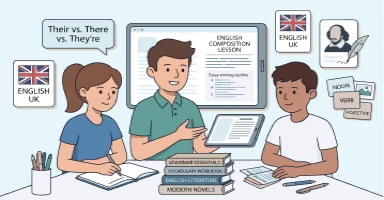
Reading, writing, and analysis from K-12 through AP English.

Build confidence with professional public speaking and presentation training.

Professional English skills for adult learners — fast, guaranteed results.
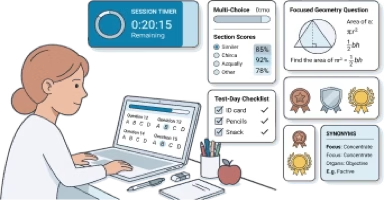

Targeted preparation for the standardized exams your child needs.

University planning, extracurricular strategy, and exam consultations for every grade.

SSAT tutoring, interview coaching, and admissions support for private schools.
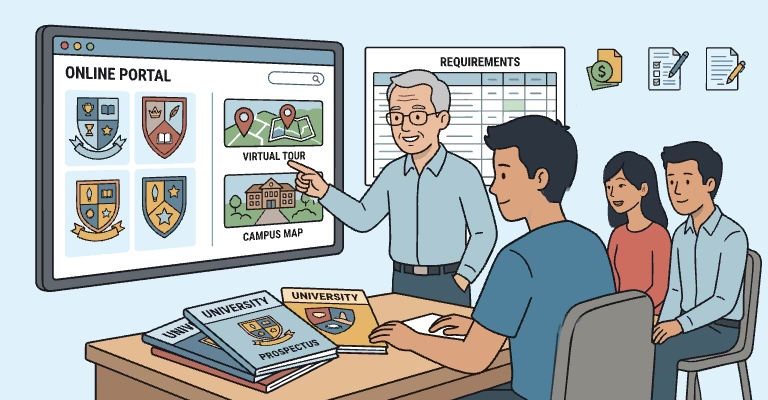
Application essays and a proven strategy for Canadian and US university admissions.
In Greater Vancouver most private schools open the next year's applications after school starts in September, and publish the materials they want at that point. You do not have to wait for September to begin. Our private school advisors recommend starting earlier than that. This is the checklist our application team keeps, built out of years of private school applications:
Knowing a school's intake years and how many places it takes in each of them is the most basic step in planning an application, and one of the most important. Crofton House, for example, takes:
Our Greater Vancouver private school guide lists intake years and place numbers school by school; it is published in Chinese. If you are not sure where your family should start, talk to one of our private school advisors and they will map out the steps with you.
Every school includes open questions in the application form for the student to answer. They are usually set for applicants in Grade 5 and above, and the student has to answer them personally. The questions differ from school to school. Take a common one: *Outside of school, what does a typical week look like for you?* Some ways into an answer like that:
A private school application is not just submitting documents and a fee before a deadline. It is a planned piece of work that takes long-term preparation. Many parents want one clear, complete academic plan for their child's application, with experienced teachers and advisors seeing each step through. This is the timeline our private school application team put together out of years of applications:
Greater Vancouver has a number of leading private schools, most of them concentrated in Vancouver's West Side. Girls' schools include Crofton House, Little Flower and York House. Boys' schools include St. George's School and Vancouver College. Co-ed schools include West Point Grey and St. John's. West Vancouver, Surrey, Richmond and Delta have several strong independent schools too, among them Collingwood, Southridge, Mulgrave and Southpointe. Our own Greater Vancouver private school article goes further into where these schools sit and how to approach each of them; it is published in Chinese.
A private school application has a number of dates that matter — Open House, the Assessment Date, the Family Interview date. The most important of them is the application deadline itself.
Deadlines are set school by school. For the current deadlines across Greater Vancouver, our private school guide lists them school by school; it is published in Chinese. Your advisor will walk you through the ones that apply to your shortlist.
Private school entrance assessment goes by several names — in-house assessment, school assessment, placement exam, SSAT. Depending on the grade applied for and the school's own arrangements, a student sits an assessment the school runs, or takes the SSAT and sends the school that score. A small number of schools ask for both.
Broadly by grade: students applying for JK to Grade 3 sit an assessment the school arranges. Its content changes with the grade, but it covers English and math. At the youngest levels that means reading, letter recognition and drawing; a little higher up, English vocabulary and reading, and arithmetic. Many families ask an experienced teacher to prepare a child at home beforehand.
Students applying at Grade 4 and above are generally asked for an SSAT score. The SSAT covers verbal, reading, writing and math, and each part has its own sub-areas — math, for instance, splits into algebra and geometry. Registration, preparation and sitting the exam are all unfamiliar territory for most families, which is why our private school application team recommends starting at least a year ahead. Having a teacher who has done it before run the registration and the preparation makes a real difference to the application as a whole.
The parent statement is the part of the written work most parents find hardest. Many feel there is nothing much to write, or write a few general lines. Both are mistakes on a private school application form: the parent statement's open questions deserve to be taken seriously. Take a common one — *How do you think your child would benefit from a XXX (school name) education* — and some ways into it:

In the 2025-2026 school year, StudyPug Learning students received 54 private school offers.
Ask us for the private school document checklist, or talk to us: call 604-288-8081, WhatsApp +1 (888) 881-6249, or email contact@studypuglearning.com. Meet us at 5831 Cedarbridge Way #102, Richmond, BC V6X 2A8.
Places: VIP planning places are limited, and applications open each September for the following year — school selection and the SSAT need one to two years' run-up.
