SAT Prep: Practice Tests & Video Solutions
Step-by-step video solutions from certified teachers, full-length practice tests, and a diagnostic that pinpoints exactly where to focus.

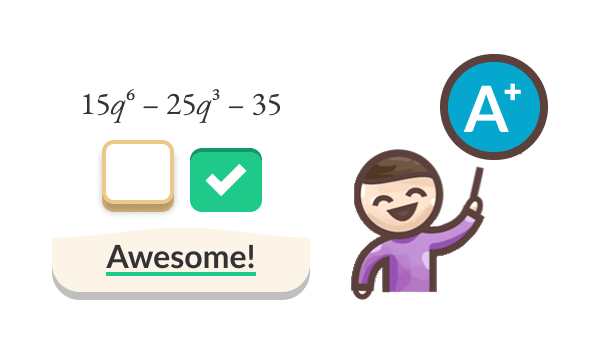
Step-by-Step Videos
Watch once and solve the next one alone.
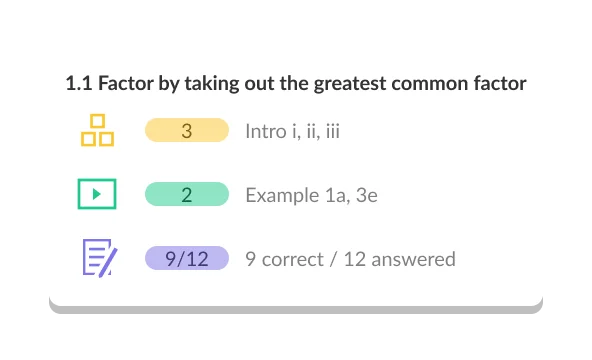
Unlimited Practice
Practice until it truly sticks.

Test Prep Included
Practice real SAT questions in your plan.
Try It Now
Test your knowledge
Our approach aligns with the evidence
Exam Scores
Better Recall
Less Anxiety
SAT Test Prep Topics
1. Understanding Integers
2. Adding and Subtracting Integers
3. Multiplying and Dividing Integers
4. Number Theory
5. Adding and Subtracting Fractions
6. Multiplying and Dividing Fractions
7. Operation with Decimals
8. Fractions, Decimals, and Percents
9. Ratios, Rates, and Proportions
10. Introduction to Variables and Expressions
11. Solving Linear Equations
12. Linear Inequalities
13. Measuring Systems
14. Number System
15. Radicals
16. Exponents
17. Operations of Polynomials
18. Introduction to Relations and Functions
19. Linear Functions
20. Systems of Equations
21. Factoring Polynomials
22. Quadratic Functions
23. Solving Quadratic Equations
24. Rational Expressions
25. Function Notation
26. Transformations of Functions
27. Polynomial Functions
28. Direct and Inverse Variation
29. Trigonometry with Right Triangles
30. Trigonometric Ratios and Angle Measure
31. Law of Sines and Cosines
32. Imaginary and Complex Numbers
33. Angles, Lines, and Transversals
34. Circles
35. Surface Area and Volume
37. Data and Graphs
38 Chapters · 219 Topics · 1657 Videos
Discover Our Learning Areas
Explore key subjects and start learning with interactive content.















What Is the SAT?
The SAT is a standardised college admissions exam developed by the College Board and widely used by universities in the United States and internationally. For students in Singapore aiming at US-based universities — or global programmes that accept SAT scores — it is one of the most important assessments in Grade 12. The exam measures skills in Math and Evidence-Based Reading and Writing that predict academic readiness for higher education.
The current digital SAT is section-adaptive, shorter than earlier paper versions, and administered at authorised test centres across Singapore multiple times each year. Understanding its structure, scoring, and content is the essential first step in building an effective preparation plan.
SAT Format and Sections
The digital SAT consists of two main sections: Reading and Writing, and Math. Each section is split into two modules. The difficulty of your second module is determined by how well you perform in the first — meaning stronger students are automatically routed to harder questions that carry higher score potential.
The full exam takes approximately 2 hours and 14 minutes. There is no penalty for wrong answers, so leaving any question blank is never the right move. The Reading and Writing section features short, focused passages rather than the long multi-passage sets of the old paper SAT, while the Math section allows a calculator throughout.
SAT Scoring: What You Need to Know
The SAT is scored on a 400–1600 scale, combining a Reading and Writing score (200–800) and a Math score (200–800). The national average sits around 1010. Students targeting competitive US universities should aim for 1200 or above; highly selective schools typically see median scores of 1400–1550 from admitted students. Check the published score ranges of your specific target universities to set a realistic goal before you begin your SAT preparation.
What Content Areas Are Tested on the SAT?
The SAT Math section is divided into four content domains:
- Algebra — linear equations, systems of equations, inequalities
- Advanced Math — quadratics, polynomials, exponential functions, and nonlinear equations
- Problem-Solving and Data Analysis — ratios, percentages, unit conversions, probability, and interpreting graphs and statistics
- Geometry and Trigonometry — area, volume, angle properties, the unit circle, and right-triangle trigonometry
The Reading and Writing section tests comprehension across informational and literary passages, Standard English Conventions (grammar, punctuation, sentence structure), and Craft and Structure (author's purpose, vocabulary in context, rhetorical analysis).
What Is the Hardest Part of the SAT?
Survey data and performance patterns consistently point to two areas that challenge students most. In Math, the Advanced Math domain — particularly nonlinear equations, quadratic word problems, and function notation — is where many students lose the most points. In Reading and Writing, Craft and Structure questions require you to analyse why an author made a specific rhetorical choice, which demands a different kind of thinking than standard reading comprehension.
The good news: both areas respond well to targeted practice. Watching certified-teacher video solutions that show the method — not just the final answer — is the fastest way to close these gaps. StudyPug's SAT prep covers every question type in both sections with step-by-step explanations built around the reasoning the College Board rewards.
Why StudyPug for SAT Preparation
StudyPug is built specifically for students who want to improve their score efficiently without guesswork. Here is what makes it different from working through a static textbook or a generic tutoring programme:
- Diagnostic assessment — start with a short diagnostic that identifies exactly which SAT topics and question types need the most attention, so you spend your study time where it counts.
- Certified-teacher concept videos — every lesson is taught by a certified teacher who walks you through the method step by step. These are not AI-generated explanations; they are carefully crafted to teach you how to solve a problem type, not just the answer to one question.
- Adaptive practice — as you work through quizzes and practice questions, the difficulty automatically adjusts to your current level, keeping you in the productive zone between too easy and overwhelmingly hard.
- Unlimited practice tests and retakes — take full-length SAT practice tests based on real exam structure as many times as you need, and retake topic quizzes until you have genuinely consolidated each concept.
- Progress tracking — your dashboard shows you exactly which topics you have covered, where your accuracy stands, and what to work on next.
- 30-day money-back guarantee — start with complete access and, if StudyPug is not the right fit within the first 30 days, you receive a full refund. No questions asked.
Students across Singapore use StudyPug to prepare for the SAT alongside their regular school commitments. The flexible, on-demand format means you can fit a focused 30-minute session into a busy school week rather than waiting for a fixed tutoring slot.
Discover how a structured, diagnostic-led approach changes the way you prepare — explore SAT prep on StudyPug and see which topics your diagnostic flags first.
What You Will Learn: SAT Coverage on StudyPug
StudyPug's SAT preparation covers every topic tested across both sections of the digital SAT. In Math, that means a complete progression through Algebra fundamentals, Advanced Math concepts including quadratics and functions, Problem-Solving and Data Analysis, and Geometry and Trigonometry. In Reading and Writing, you will build skills in passage comprehension, grammar and sentence editing, and the rhetorical analysis questions that distinguish top scorers.
Each topic includes a concept video, worked examples, and a quiz you can retake until it is solid. The content is organised so you can follow the full structured path from diagnostic to exam day, or jump directly to the specific topics your diagnostic flags as priorities.
The practice questions on StudyPug are based on real SAT exam style and question formats — not invented drills that bear no resemblance to what you will see on test day. Every video solution teaches the method behind the answer so that when a similar question appears in a different form on the real exam, you know exactly how to approach it.
How to Build Your SAT Study Plan
A well-structured SAT preparation plan has four phases:
Phase 1 — Baseline (Week 1): Take a full-length diagnostic practice test under timed conditions. Review your results to understand which sections and content domains need the most work. This single step saves hours of unfocused studying.
Phase 2 — Concept Building (Weeks 2–6): Work through your flagged topics systematically using StudyPug's video lessons and adaptive quizzes. Focus on the method: watch the teacher solve a problem type, try similar questions yourself, retake the quiz until your accuracy is consistent.
Phase 3 — Timed Practice (Weeks 7–10): Begin taking full-length timed SAT practice tests. After each test, identify new gaps and return to the relevant concept videos. Pacing and stamina improve dramatically during this phase.
Phase 4 — Final Review (Weeks 11–12): Focus on your remaining weak spots, review Craft and Structure and Advanced Math strategies, and take one final full-length practice test three to four days before your real exam date. Rest the day before.
Most students in Singapore preparing for a US university application start this plan 8–12 weeks before their target test date, with an earlier start (3–6 months out) giving room for a retake if needed. The College Board's published test calendar for Singapore test centres typically opens registration about 4–6 weeks before each sitting — check collegeboard.org and register early to secure your preferred centre.
SAT Test Prep FAQ
Unsure how StudyPug works? Need help with setting up? Check our frequently asked questions or contact us for help.
What does the SAT cover, and how is it structured?
The SAT is a college admissions exam with two main sections: Evidence-Based Reading and Writing (EBRW) and Math. The digital SAT (administered globally, including Singapore) is section-adaptive: the first module of each section determines the difficulty of the second. The full test takes about 2 hours and 14 minutes. There is no penalty for wrong answers, so it pays to attempt every question. The format tests reasoning and skills you have built over years of school rather than isolated memorisation.
How is the SAT scored, and what counts as a good score?
The SAT is scored on a scale of 400–1600, combining a Reading and Writing section score (200–800) and a Math section score (200–800). The average score in recent administrations has been around 1010. For competitive universities in the US — and for US-university-bound students sitting the exam in Singapore — a score of 1200 or above is generally considered strong, with 1400+ placing you in the top tier. Your target score should be benchmarked against the typical ranges published by your target schools.
What subjects and content areas are tested on the SAT?
The SAT Math section covers Algebra, Advanced Math (quadratics, polynomials, functions), Problem-Solving and Data Analysis (ratios, percentages, statistics), and Geometry and Trigonometry. The Reading and Writing section tests reading comprehension across informational and literary passages, grammar and editing (Standard English Conventions), and rhetoric or craft and structure. The digital SAT presents mostly short, focused passages rather than long multi-passage sets, making close reading and precise reasoning essential.
How should I prepare for the SAT, and how long does it take?
Most students benefit from 8–12 weeks of structured preparation, though starting 3–6 months before your test date gives you more flexibility. Begin with a diagnostic practice test to identify weak areas, then work systematically through those topics using concept videos and targeted quizzes. Build up to full-length timed practice tests in the final weeks to improve pacing and stamina. StudyPug's adaptive practice adjusts difficulty to your performance, helping you study smarter by focusing effort where it matters most.
When should I take the SAT, and how do I register?
The SAT is offered multiple times per year at test centres in Singapore. Most students sitting for US university applications take the SAT in Grade 11 or early Grade 12, allowing time for a retake if needed. Registration is done through the College Board website (collegeboard.org). Test dates and registration deadlines are published on the College Board site — registration typically closes about a month before the test date. Check the current schedule early, as seats at popular Singapore centres can fill quickly.
What is the hardest part of the SAT, and how do I tackle it?
Most students find the Advanced Math module (quadratics, functions, and nonlinear equations) and the Data Analysis questions the most challenging in the Math section. In Reading and Writing, Craft and Structure questions — which ask about an author's purpose, tone, and rhetorical choices — trip up many test-takers. The best approach is to practise these question types in isolation first, watch step-by-step solution videos to understand the method behind each answer, then move to timed full-section practice. Identifying your personal hardest section early through a diagnostic lets you allocate study time efficiently.





Written by the StudyPug Team
Last updated June 5, 2026
3 M+
students
★★★★★
4.8 average
K–12
all grades