Grade 11 Chemistry Help — Video Lessons & Practice
Get clear explanations for any Chemistry problem and build exam-ready confidence for your GCE assessments.

Value vs. Private Tutor
Expert Singapore curriculum without the price tag.
Multi-Subject
Struggling in Chemistry? Switch subjects anytime.
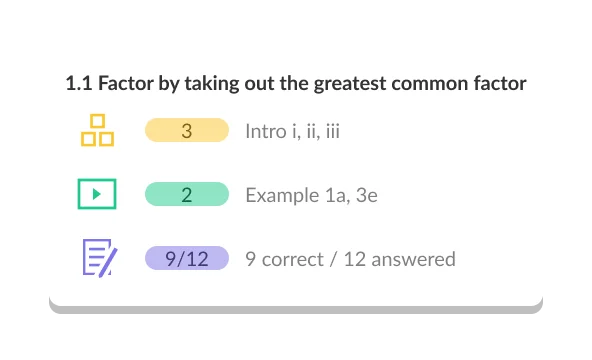
Build Mastery
Move on only when you truly know it.
Chemistry Topics
1. Introduction to Chemistry
2. The Atom
3. The Periodic Table and Elements
4. Compounds and Bonding
5. Chemical Reactions and Groups
6. Stoichiometry
7. Basic Organic Chemistry
8. Solution Chemistry
9. Energetics, Kinetics and Reaction Rate
10. Equilibrium
11. Acid-Base Theory
12. Solubility Equilibria
13 Chapters · 84 Topics · 695 Videos
Discover Our Learning Areas
Explore key subjects and start learning with interactive content.
What is Grade 11 Chemistry?
Grade 11 Chemistry is the study of matter — its composition, structure, properties, and the reactions that transform it. At this level, students move beyond the introductory concepts of lower secondary science and engage with the quantitative and mechanistic principles that form the backbone of university-level Chemistry. In Singapore, Grade 11 Chemistry corresponds to the Junior College Year 1 (JC1) curriculum, with students working towards either H1 or H2 Chemistry under the GCE A-Level syllabus set by the Singapore Examinations and Assessment Board (SEAB).
The course bridges the concrete world of observable chemical reactions and the abstract world of atoms, orbitals, and energy landscapes. Whether you are aiming for medicine, pharmacy, engineering, or the pure sciences, a strong foundation in Grade 11 Chemistry is essential for any competitive university application in Singapore and beyond.
What topics does Grade 11 Chemistry cover?
Grade 11 Chemistry in Singapore spans several interconnected content areas. Physical Chemistry introduces atomic structure, chemical bonding (ionic, covalent, metallic, and intermolecular forces), stoichiometry and the mole concept, energetics and thermochemistry, chemical equilibrium (including Kc and Kp), acid-base chemistry, and electrochemistry. Inorganic Chemistry covers the Periodic Table trends, the chemistry of Period 3 elements and Group 17 halogens. Organic Chemistry begins with the nomenclature and reactions of alkanes, alkenes, halogenoalkanes, and alcohols.
Each area builds on the previous, so a gap in understanding stoichiometry will compound when you reach equilibrium calculations. Strong algebraic skills and clear logical reasoning are as important as memorising reaction conditions. StudyPug's certified-teacher videos are organised topic by topic, allowing you to address gaps systematically without working through material you already know.
Is Grade 11 Chemistry hard?
Grade 11 Chemistry is widely regarded as one of the more challenging JC1 subjects in Singapore. The difficulty comes from several directions at once: the volume of content is large, the mathematical demands are significant, and many concepts require students to reason at the molecular level about things they cannot directly observe.
The topics students find hardest most consistently are stoichiometry and mole calculations, chemical equilibrium (particularly interpreting changes in Kc versus the position of equilibrium), organic reaction mechanisms, and electrochemical cell diagrams. Many students also struggle with the energetics topic — specifically Hess's law and bond-energy calculations — because errors in sign convention cascade through the working.
The good news is that Grade 11 Chemistry rewards methodical problem-solving. Once you understand the underlying logic of a topic, the same approach applies to a wide range of exam questions. StudyPug's videos teach you that underlying method, step by step, so you learn how to solve a class of problems rather than memorising individual answers.
What comes before and after Grade 11 Chemistry?
Students entering Grade 11 Chemistry in Singapore typically come from O-Level Combined Science or Pure Chemistry at the secondary level. A confident grasp of atomic structure, basic bonding, writing and balancing chemical equations, simple organic nomenclature, and the mole concept is assumed at the start of JC1. Mathematics at O-Level Additional Mathematics or higher is strongly beneficial — logarithms (for pH and equilibrium), simultaneous equations, and algebraic manipulation all appear regularly.
After Grade 11, students advance into Grade 12 (JC2), which extends and deepens every major topic: advanced organic chemistry (carbonyl compounds, nitrogen compounds, polymerisation), transition metals, further electrochemistry, and reaction kinetics. Grade 12 culminates in the GCE A-Level examinations. The conceptual and procedural fluency built in Grade 11 is a direct predictor of Grade 12 performance, making early investment in understanding — rather than rote learning — the smartest strategy.
Why choose StudyPug for Grade 11 Chemistry in Singapore?
StudyPug is built around three things that make a measurable difference for GCE Chemistry students: a diagnostic assessment that shows you exactly where to start, certified-teacher concept videos that teach the method behind every problem, and adaptive practice that adjusts to your level as you improve.
The diagnostic assessment takes the guesswork out of revision. Rather than working through an entire topic chapter by chapter, you find out immediately which specific concepts are your weak points — and you start there. No time is wasted reviewing material you already know.
The concept videos are recorded by certified Chemistry teachers, not generated by AI. Each video teaches you how to reason through a problem type, so that when you see a slightly different question on your GCE paper — and you will — you have the technique to handle it. This is the core difference between understanding Chemistry and simply recognising familiar questions.
Adaptive practice means that as you answer questions correctly, the difficulty increases to keep pushing your skills forward. If you struggle on a question type, the system gives you more practice at that level until you build the required fluency. This mirrors the way a good private tutor would work with you — but available at any hour, without travel time, and at a fraction of the cost of one-to-one tuition in Singapore.
All content is aligned to the GCE A-Level Chemistry syllabus (H1 and H2) as set by SEAB. Every practice test, every video, and every worked example is relevant to what you will actually be examined on. There is also a Photo Search feature that lets you photograph a Chemistry problem and instantly find the matching lesson — useful when you are stuck on homework and need a fast starting point.
StudyPug also offers free practice problems so you can get a feel for the platform before committing. When you are ready to subscribe, every paid plan comes with a 30-day money-back guarantee — the only guarantee StudyPug makes. If it is not working for you within 30 days, you get your money back.
What you will learn: Grade 11 Chemistry curriculum coverage
StudyPug's Grade 11 Chemistry content covers all major SEAB syllabus topics for both H1 and H2, including:
- Atomic structure and the Periodic Table
- Chemical bonding and intermolecular forces
- Stoichiometry and the mole concept
- Energetics and thermochemistry (Hess's law, bond enthalpies)
- Chemical equilibrium (Kc, Kp, Le Chatelier's principle)
- Acids, bases, and pH calculations
- Electrochemistry and electrochemical cells
- Inorganic chemistry of Period 3 and the halogens
- Introductory organic chemistry (alkanes, alkenes, halogenoalkanes, alcohols)
Each topic is broken into individual lessons so you can navigate directly to the concept you need. No validated internal topic links are available for the Singapore Chemistry page at this time; the full topic browser is accessible directly from the StudyPug course page.
How to use StudyPug for Grade 11 Chemistry
Getting started is straightforward. When you first log in, take the diagnostic assessment — it takes only a few minutes and immediately surfaces the Chemistry topics where you need the most work. This becomes your personalised study roadmap.
From there, watch the certified-teacher concept video for the topic the diagnostic flags. Pause, rewind, and replay as many times as you need — unlike a classroom lesson, the video waits for you. Once the concept makes sense, move into adaptive practice. Answer questions, review the step-by-step worked solutions for any you get wrong, and watch your confidence grow as the difficulty adjusts to match your improving skill level.
In the weeks before your GCE assessments, use StudyPug's GCE-aligned practice tests to simulate exam conditions. These are based on real exam-style questions, so you build familiarity with the format, the command words, and the typical ways each topic is examined. Track your scores over time to see clear, measurable progress.
StudyPug works on desktop, tablet, and mobile — so whether you are revising at home late in the evening or squeezing in a quick practice session on the MRT, your Chemistry help is always with you. Cancel anytime, and if you are not satisfied within 30 days, request a full refund. Start with the free practice content today and see the difference a structured, syllabus-aligned approach makes to your Grade 11 Chemistry results.
Chemistry FAQ
Unsure how StudyPug works? Need help with setting up? Check our frequently asked questions or contact us for help.
What do you learn in Grade 11 Chemistry, and what topics does it cover?
Grade 11 Chemistry covers the foundational and intermediate concepts that underpin all advanced study. Core topics include atomic structure, chemical bonding, stoichiometry, the mole concept, energetics (thermodynamics), chemical equilibrium, acids and bases, electrochemistry, and organic chemistry fundamentals. In Singapore, these topics align with the GCE A-Level and O-Level syllabuses, preparing students for both H1 and H2 Chemistry assessments. Understanding these areas provides the essential building blocks for university-level science and engineering programmes.
What is the difference between Chemistry and Physics at Grade 11 level?
Chemistry focuses on the composition, structure, and properties of matter and the changes it undergoes during chemical reactions. It deals with atoms, molecules, bonds, and energy changes at a molecular level. Physics, by contrast, examines forces, motion, energy transfer, and the laws governing the physical world — from mechanics to electricity to waves. At Grade 11 in Singapore, Chemistry involves more qualitative and quantitative analysis of substances and reactions, while Physics concentrates on mathematical models of physical phenomena. Both are demanding; Chemistry tends to require strong memory for mechanisms alongside calculation skills.
Is Grade 11 Chemistry hard, and where do students struggle most?
Grade 11 Chemistry is considered challenging by many students, particularly those taking H2 Chemistry for the GCE A-Levels. The most common struggle points are stoichiometry and mole calculations (balancing equations and converting between units), organic chemistry reaction mechanisms, and equilibrium concepts (applying Le Chatelier's principle quantitatively). Students also find thermodynamic calculations and electrochemical cell diagrams difficult. The key is breaking each topic into small, logical steps rather than memorising entire processes — which is exactly how StudyPug's certified-teacher videos are designed to help.
What should I take before Grade 11 Chemistry, and what comes after it?
Before Grade 11 Chemistry, students should have a solid foundation in O-Level Combined or Pure Chemistry — covering atomic structure, bonding, chemical equations, and basic organic chemistry. Good maths skills, especially algebra and logarithms, are also essential for calculations. After Grade 11, students in Singapore progress to the full GCE A-Level H2 Chemistry curriculum in Grade 12, which deepens organic chemistry, physical chemistry, and analytical techniques. Strong Grade 11 performance directly supports university applications in medicine, pharmacy, engineering, and the sciences.
Is Grade 11 Chemistry on the GCE exam, and how is it tested?
Yes. In Singapore, Grade 11 Chemistry is assessed through the GCE A-Level examinations administered by the Singapore Examinations and Assessment Board (SEAB). Students may sit H1 or H2 Chemistry. H2 Chemistry consists of three papers: Paper 1 (multiple choice), Paper 2 (structured questions), and Paper 3 (free-response and planning). There is also a School-Based Science Practical Assessment (SPA). Questions test conceptual understanding, data analysis, and the ability to apply knowledge to unfamiliar contexts — all skills built through StudyPug's GCE-aligned practice tests and concept videos.
What is one of the hardest concepts in Grade 11 Chemistry and how do you tackle it?
Chemical equilibrium — and in particular applying the equilibrium constant Kc and Le Chatelier's principle to predict the direction of reactions — is consistently rated as one of the hardest Grade 11 Chemistry concepts. Students often confuse the effect of a change in conditions on the position of equilibrium with its effect on the equilibrium constant itself. The best approach is to work through many varied examples step by step, clearly distinguishing cause and effect. StudyPug's video lessons walk through each type of equilibrium problem methodically, showing exactly which steps to apply and why, so you build a reliable technique rather than guessing.




Written by the StudyPug Team
Last updated June 5, 2026
3 M+
students
★★★★★
4.8 average
K–12
all grades