Integral Calculus Help: Video Lessons & Practice
Work through every topic with clear solutions. Start your free practice test now!

Value vs. Private Tutor
Expert integral calculus help without the price tag.
Multi-Subject
One subscription unlocks all subjects.
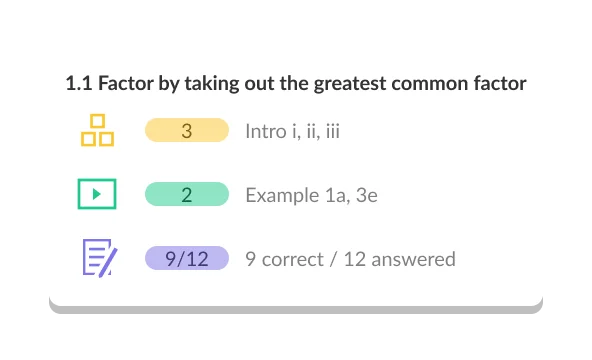
Unlimited Practice
Practice until it truly clicks.
Try It Now
Test your knowledge
Our approach aligns with the evidence
Exam Scores
Better Recall
Less Anxiety
Integral Calculus Topics
1. Integrals
2. Integration Techniques
3. Integration Applications
4. Differential Equations
5. Sequence and Series
6. Parametric Equations and Polar Coordinates
6 Chapters · 49 Topics · 346 Videos
Discover Our Learning Areas
Explore key subjects and start learning with interactive content.









What is Integral Calculus?
Integral Calculus is the branch of mathematics concerned with integration — the process of finding accumulated quantities such as areas, volumes, and totals. It is the counterpart to Differential Calculus, and together they form the foundation of calculus as studied at university level. The central idea is the integral: given a function, the integral measures how much of something accumulates over an interval. Integral Calculus is compulsory for students in engineering, mathematics, physics, computer science, economics, and data science programmes at NUS, NTU, SMU, and other Singapore universities.
What topics are covered in Integral Calculus?
A typical Integral Calculus module at a Singapore university covers: indefinite integrals and the antiderivative, the Fundamental Theorem of Calculus, definite integrals and Riemann sums, the substitution rule (u-substitution), integration by parts, trigonometric integrals and trigonometric substitution, partial fraction decomposition, improper integrals, and applications including area between curves, volumes of solids of revolution (disc, washer, and shell methods), and arc length. Many modules also introduce sequences, infinite series, and convergence tests such as the ratio test and integral test. Each of these areas demands a different technique, which is why building systematic practice habits early is critical.
How does Integral Calculus differ from Differential Calculus?
Differential Calculus asks: at any point, how fast is this function changing? Integral Calculus asks: over an interval, how much has accumulated? Derivatives describe instantaneous rates — velocity, slope, marginal cost. Integrals describe totals — distance travelled, area, cumulative revenue. The Fundamental Theorem of Calculus bridges them: differentiation and integration are inverse processes. Practically, this means your differentiation skills are directly tested in reverse during integration problems. Students who struggle with Integral Calculus often benefit from revisiting their differentiation fluency first, then approaching integration as its mirror image.
Why do students find Integral Calculus difficult?
Unlike differentiation, where a clear set of rules (power rule, chain rule, product rule) handles most problems mechanically, integration has no single universal algorithm. You must recognise the structure of the integrand and decide which technique applies — and that decision requires pattern recognition that only comes from repeated, varied practice. The most common sticking points are: choosing between substitution and integration by parts; handling nested trigonometric expressions; setting up improper integrals and determining convergence; and constructing the correct integral for volume or arc-length problems. The only reliable path through these difficulties is working through a high volume of problems with full, step-by-step solutions — not just reading the theory.
How is Integral Calculus assessed at Singapore universities?
Most Integral Calculus modules at NUS, NTU, and SMU are assessed through a mix of continuous assessment and examination. Continuous assessment typically includes graded problem sets or online quizzes, which together may account for 20–40% of the final grade. One or two midterm tests usually contribute a further 20–30%. The final examination — typically a closed-book, two-to-three-hour paper held at the end of semester — carries the largest share, often 50–60%. Exam questions test both technique (applying the correct integration method) and application (setting up and solving real-world problems). Practising past-paper-style questions under timed conditions is one of the most effective ways to prepare.
What comes after Integral Calculus?
After Integral Calculus (commonly Calculus II), most students advance to Multivariable Calculus (Calculus III), which extends differentiation and integration to functions of two or more variables — partial derivatives, multiple integrals, and vector calculus including Green's theorem and Stokes' theorem. Many programmes also require Differential Equations, which uses integration and differentiation together to model physical, biological, and engineering systems. Linear Algebra is a co-requisite or immediate follow-on in most engineering and mathematics programmes. StudyPug covers all of these courses under one subscription.
Why use StudyPug for Integral Calculus help?
StudyPug is built for exactly the kind of learning that Integral Calculus demands: concept-first, technique-driven, and practice-intensive. Certified teachers — not AI — author every video lesson. Each lesson teaches the method behind the technique, not just the steps to a single answer, so you understand well enough to handle the variations that show up on midterms and finals. Three features make StudyPug particularly effective for Integral Calculus students.
First, the diagnostic assessment identifies precisely which topics need work. Rather than reviewing everything from the beginning, you focus your time where it matters. Second, adaptive practice adjusts the difficulty of questions in real time based on your performance — you are always working at the edge of your current ability, which is where learning is fastest. Third, the exam preparation tools — mock exams, practice tests, and full worked solutions — let you simulate the pressure of a real test before the actual date. You can watch solutions unlimited times until every step is clear.
All of this, including Integral Calculus, Differential Calculus, Linear Algebra, Differential Equations, Statistics, and every other course in the catalogue, is included in one subscription. There is no separate charge per course.
What you learn: Integral Calculus course coverage on StudyPug
StudyPug's Integral Calculus content is structured to match university-level coursework in Singapore and internationally. Lessons are organised by topic so you can go directly to the area where you are stuck. Coverage includes:
- Antiderivatives and indefinite integrals
- The Fundamental Theorem of Calculus (Parts 1 and 2)
- Definite integrals and Riemann sum approximations
- U-substitution (change of variable)
- Integration by parts (with the LIATE heuristic and repeated application)
- Trigonometric integrals (powers of sin, cos, sec, tan)
- Trigonometric substitution (√(a²−x²), √(a²+x²), √(x²−a²))
- Partial fraction decomposition (distinct linear, repeated, and irreducible quadratic factors)
- Improper integrals (infinite limits and discontinuous integrands, with convergence tests)
- Area between curves
- Volumes of revolution: disc, washer, and shell methods
- Arc length and surface area
- Sequences and series (including convergence tests: ratio, root, integral, comparison)
Because no validated topic-page URLs are available for this region at this time, all topic navigation is available directly within the StudyPug platform once you are logged in.
How to use StudyPug for Integral Calculus
The most effective workflow for Integral Calculus on StudyPug follows four steps. Start by taking the diagnostic assessment — it takes only a few minutes and immediately shows you which topics are solid and which need work. Next, watch the certified-teacher concept video for your target topic. Each video explains why the technique works, not just what the steps are, so you build the kind of understanding that transfers to unseen problems. After watching, work through the adaptive practice questions for that topic. The system increases difficulty as you improve, so you are always being challenged at the right level. Finally, use the mock exams and practice tests to consolidate everything under timed conditions before your midterm or final. The 30-day money-back guarantee means there is no financial risk in getting started — and free daily practice content is available right now, no subscription required.
Integral Calculus FAQ
Unsure how StudyPug works? Need help with setting up? Check our frequently asked questions or contact us for help.
What do you learn in Integral Calculus, and what topics does it cover?
Integral Calculus focuses on the theory and techniques of integration. Core topics include indefinite and definite integrals, the Fundamental Theorem of Calculus, substitution, integration by parts, trigonometric integrals, partial fractions, improper integrals, and applications such as area, volume, and arc length. Most university courses also introduce sequences, series, and convergence tests. By the end of the course, students can model and solve real-world problems involving accumulation and change across engineering, physics, economics, and data science.
What is the difference between Integral Calculus and Differential Calculus?
Differential Calculus studies rates of change — derivatives, gradients, and how functions behave locally. Integral Calculus studies accumulation — areas under curves, total quantities, and the reverse process of differentiation. The two are unified by the Fundamental Theorem of Calculus, which shows that integration and differentiation are inverse operations. Most students take Differential Calculus first (Calculus I) and then Integral Calculus (Calculus II), though some courses teach both together in a single semester.
What are the prerequisites for Integral Calculus, and what course comes after it?
You should be comfortable with Differential Calculus — limits, derivatives, and differentiation rules — before starting Integral Calculus. A solid grounding in algebra and trigonometry is also essential. After Integral Calculus, most students move on to Multivariable Calculus (Calculus III), which extends integration to functions of several variables, or to Differential Equations, which applies both differentiation and integration to model dynamic systems.
Is Integral Calculus hard, and where do students struggle most?
Integral Calculus is widely considered one of the more demanding first-year university math courses. The biggest difficulty is recognising which integration technique to apply — substitution, integration by parts, partial fractions, or trigonometric substitution — because there is no single algorithm that works for all integrals. Students also struggle with improper integrals, series convergence tests, and setting up volume or arc-length integrals correctly. Consistent practice with worked examples is the most reliable way to build fluency.
How is Integral Calculus assessed at university in Singapore?
At Singapore universities such as NUS, NTU, and SMU, Integral Calculus courses are typically assessed through a combination of graded assignments or problem sets, one or two midterm tests, and a final examination. The final exam usually carries the heaviest weighting, often 50–60% of the overall grade. Some modules include continuous assessment components such as online quizzes or tutorial participation. Check your specific module outline for the exact weightings, as they vary by faculty and course code.
What is one of the hardest topics in Integral Calculus, and how do you approach it?
Trigonometric substitution is consistently one of the hardest topics. It requires you to rewrite an integral containing expressions like √(a²−x²) by substituting x = a sin θ, then convert every part of the integral — including dx and the limits — into terms of θ, integrate, and convert back. The key approach is pattern recognition: identify which of the three standard substitutions applies, draw a reference triangle to convert back cleanly, and practise enough varied examples that the substitution step becomes instinctive rather than guesswork.





Written by the StudyPug Team
Last updated June 5, 2026
3 M+
students
★★★★★
4.8 average
K–12
all grades