Year 9 Maths Help — Step-by-Step Video Lessons & Practice
Help your child build real confidence in maths with lessons that match the NZ curriculum.

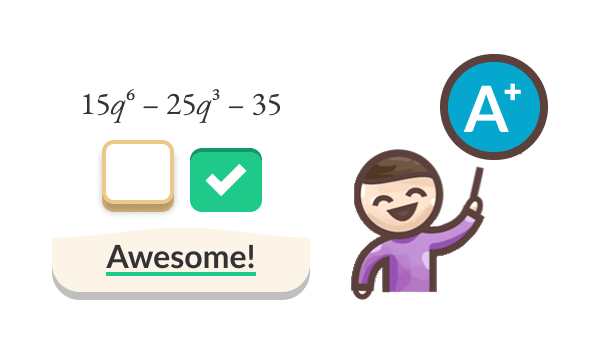
Expert Video Solutions
Watch it solved then solve one yourself.
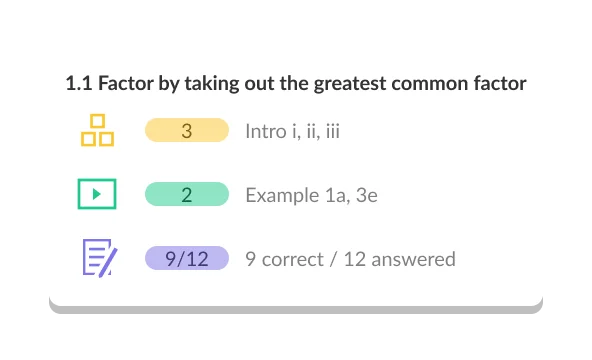
Unlimited Practice
Practice each topic until it sticks.
Real Exam Practice
Practice real exam questions to know what to expect.
Try It Now
Test your knowledge
Our approach aligns with the evidence
Exam Scores
Better Recall
Less Anxiety
Year 9 Maths Topics
1. Number Theory
2. Adding and Subtracting Integers
3. Multiplying and Dividing Integers
4. Rational Numbers
5. Powers and Exponents
6. Ratios, Rates, and Proportions
7. Proportional Relationships
8. Percents
9. Radicals
10. Measuring Systems
11. Coordinates, Quadrants, and Transformations
12. Angles, Lines, and Transversals
13. Symmetry and Surface Area
14. Properties of triangles
15. Circles
16. Scale Factors and Similarity
17. Pythagorean Theorem
18. Introduction to 3-Dimensional Figures
19. Volume
20. Linear Equations (Basic)
21. Solving Linear Equations
22. Linear Inequalities
23. Introduction to Relations and Functions
24. Linear Functions
25. Multiplication and Division of Polynomials
26. Data and Graphs
28 Chapters · 143 Topics · 1216 Videos

Ready to practice Year 9 Maths?
Try practice questions on every Year 9 Maths topic — with instant feedback and step-by-step video solutions when you get stuck.
Discover Our Learning Areas
Explore key subjects and start learning with interactive content.

















What Is Year 9 Maths?
Year 9 maths is the first year of secondary school mathematics in New Zealand, sitting within Level 5 of the New Zealand Curriculum (NZC). It marks a turning point for students — the shift from concrete arithmetic to abstract reasoning. Topics span five curriculum strands: Number and Algebra, Measurement, Geometry, and Statistics. Students work through linear equations, coordinate graphs, geometric properties, statistical investigations, and probability. Year 9 is the bridge between primary-school number skills and the NCEA pathway that begins in Year 11, making it one of the most important maths years in a student's schooling.
What Are the Key Topics in Year 9 Maths?
Year 9 maths covers a wide range of content. In Number and Algebra, students solve linear equations, work with indices, apply ratio and percentage reasoning, and begin graphing linear relationships on the coordinate plane. In Measurement and Geometry, they calculate areas and volumes of composite shapes, apply properties of triangles and quadrilaterals, and are introduced to trigonometry. In Statistics and Probability, students design statistical investigations, interpret data displays, and calculate simple probabilities. Each strand connects to real-world contexts — a deliberate feature of the NZC at this level — so students practise applying their skills, not just executing procedures.
Is Year 9 Maths Hard? Common Struggles and How to Overcome Them
Year 9 maths is where many New Zealand students first feel genuinely lost in maths class. The most common difficulty is algebra: moving from working with numbers to manipulating symbols requires a conceptual leap that does not come automatically. Multi-step equations, factorising, and graphing linear functions are consistently the topics where students fall behind. Geometry proofs and statistical reasoning are the next most reported challenges.
The key is identifying the gap early. Students who struggle with Year 9 algebra often have a shakier-than-expected grasp of Year 8 operations — particularly fractions and order of operations. A brief diagnostic that surfaces these gaps allows a targeted approach rather than reteaching everything. Once the specific weak spots are identified, focused practice with clear explanations closes them more quickly than general revision.
How Is Year 9 Maths Assessed in New Zealand?
In New Zealand secondary schools, Year 9 maths is typically assessed through internal school assessments rather than external NCEA standards, which begin in Year 11. Schools design their own assessment tasks aligned to the NZC Level 5 achievement objectives. Common formats include written tests, problem-solving tasks, and statistical investigations. End-of-year results contribute to progress reports (school reports) rather than a national qualification. However, the habits and understanding your child builds in Year 9 directly affect their readiness for NCEA Level 1 Mathematics in Year 11 — so strong Year 9 results are a meaningful indicator of NCEA readiness.
Why StudyPug for Year 9 Maths Help?
StudyPug is built around the way Year 9 students actually get stuck — and the way they best recover. Three features make a measurable difference at this level.
First, the diagnostic assessment. Rather than asking your child to sit through lessons on content they already know, StudyPug's diagnostic identifies precisely which Year 9 maths topics need attention. Parents tell us this alone saves hours of frustration — your child focuses where it actually matters.
Second, certified-teacher video lessons. Every Year 9 maths concept is explained by a qualified teacher in a short, clear video. The lessons teach the method — the reasoning behind each step — not just the worked answer. That means your child can handle a problem they haven't seen before, which is exactly what assessments test.
Third, adaptive practice. After watching a lesson, your child practises with questions that adjust to their current level. The system builds difficulty gradually so confidence grows alongside skill, rather than overwhelming students with problems they are not ready for.
All content is aligned to the New Zealand national curriculum, so every StudyPug lesson connects directly to what your child's teacher is covering this term. The parent dashboard gives you a topic-by-topic view of your child's progress, and the Family Plan covers up to five children for a single subscription price — strong value for families with more than one student.
What Your Child Will Learn: Year 9 Maths Curriculum Coverage
StudyPug covers the full Year 9 maths curriculum as set out in the New Zealand Curriculum Level 5 framework. Topic coverage includes:
- Linear algebra — solving one- and two-step equations, inequalities, substitution, and graphing linear functions on the coordinate plane.
- Number skills — indices and powers, standard form, fraction operations, ratio, rate, and percentage applications.
- Measurement and geometry — area and perimeter of composite shapes, surface area and volume, angle relationships, properties of triangles and quadrilaterals, and an introduction to trigonometric ratios.
- Statistics — designing and conducting statistical investigations, interpreting dot plots, histograms, and box-and-whisker plots, and comparing data sets.
- Probability — listing outcomes, calculating simple and complementary probabilities, and using probability trees for two-stage events.
Because this page's internal link map contains no validated Year 9 curriculum leaf URLs for New Zealand at the time of publication, specific curriculum-page links are omitted in line with our URL-validation policy. Your child can navigate to specific topics directly from the StudyPug Year 9 course page.
Using StudyPug for Year 9 Maths: A Practical Guide for Parents
Getting the most from StudyPug takes a few minutes of setup and then largely runs itself. Here is a straightforward approach for Year 9 families.
Start with the diagnostic. Have your child complete the short diagnostic assessment when they first log in. It takes around ten to fifteen minutes and produces a clear picture of which Year 9 topics are strong and which need work. Use this to set a starting focus rather than working through topics in random order.
Watch, then practise. For each identified weak topic, the workflow is simple: watch the certified-teacher video lesson first, then attempt the adaptive practice questions. Most Year 9 students find that one short video session followed by ten to fifteen minutes of practice is enough to make progress on a topic. Short daily sessions are more effective than one long weekly session.
Track progress through the dashboard. Log in to the parent dashboard periodically to see which topics your child has completed and where their practice scores are improving. This gives you real data to support conversations with their teacher and to identify if any topic needs a second pass.
Use free practice to build assessment confidence. In the weeks before a school assessment, free practice tests give your child a low-stakes way to consolidate their knowledge and identify any remaining gaps before the real thing.
StudyPug is available on desktop, tablet, and mobile — so your child can keep up with their Year 9 maths practice whether they are at home or on the go. The 30-day money-back guarantee means you can get started with complete confidence.
Year 9 Maths FAQ
Unsure how StudyPug works? Need help with setting up? Check our frequently asked questions or contact us for help.
What does my child learn in Year 9 maths, and what topics does it cover?
Year 9 maths in New Zealand covers a broad range of topics aligned to the NZ national curriculum. Students work on linear algebra including solving equations and inequalities, coordinate geometry, measurement, statistics and probability, number skills including fractions, ratios and percentages, and an introduction to trigonometry. The year builds on Year 8 foundations and prepares students for the more structured NCEA Level 1 programme in Year 11. StudyPug covers every one of these topic areas with practice problems and video lessons.
Is Year 9 maths hard, and where do students commonly struggle?
Year 9 maths is a significant step up for most students. The move to abstract thinking — particularly with algebra and solving multi-step equations — is where many students first hit a wall. Geometry proofs, working with indices, and interpreting statistical graphs also trip up a large number of Year 9 learners. The jump from primary-school arithmetic to symbol manipulation can feel sudden. Identifying the specific gap early, rather than hoping it resolves itself, is the most effective approach. A quick diagnostic makes it easy to find exactly where your child needs support.
What should my child know before Year 9 maths, and what comes next?
A solid grasp of Year 8 maths is the key prerequisite — especially number operations, basic fractions, introductory algebra expressions, and basic geometry. If those foundations are shaky, gaps tend to compound quickly in Year 9. Looking ahead, Year 9 leads into Year 10, which in turn prepares students for NCEA Level 1 Mathematics in Year 11. Students who build strong Year 9 habits — working through problems step by step and checking their reasoning — are much better placed for NCEA success. StudyPug supports both catch-up on Year 8 prerequisites and the full Year 9 curriculum.
How does Year 9 maths align to the New Zealand national curriculum?
Year 9 maths in New Zealand sits within Level 5 of the New Zealand Curriculum (NZC), which spans Years 9 and 10. It is structured around five strands: Number and Algebra, Measurement and Geometry, and Statistics. Schools have flexibility in how they sequence topics within this framework, but the core content — linear equations, geometric reasoning, statistical investigation, and probability — is consistent nationwide. StudyPug lessons are built to match this curriculum so your child is always practising content relevant to what their teacher is covering in class.
What is one of the trickiest maths concepts in Year 9, and how is it taught?
Linear algebra — particularly solving multi-step equations and graphing linear relationships — is consistently the concept Year 9 students find hardest. The challenge is that it requires both procedural skill (following steps correctly) and conceptual understanding (knowing why each step works). StudyPug's certified teachers explain both the method and the reasoning in short, clear videos. Rather than just showing the answer, each lesson teaches the approach so students can handle unfamiliar variations in assessments. Adaptive practice then reinforces the skill at each student's current level, building confidence before moving on.
How much maths practice should my child do at Year 9?
Most Year 9 students benefit from around 20 to 30 minutes of focused maths practice on three to four evenings per week, in addition to completing set schoolwork. Regular shorter sessions are more effective than infrequent long sessions, especially for building fluency with algebra and geometry. During assessment periods it is worth increasing practice on specific weak topics identified by the diagnostic. StudyPug's adaptive practice automatically adjusts difficulty as your child progresses, so even short daily sessions produce steady improvement without feeling overwhelming.





Written by the StudyPug Team
Last updated June 5, 2026
3 M+
students
★★★★★
4.8 average
K–12
all grades