SAT Prep: Practice Tests & Video Solutions
Pinpoint your weak areas fast and build real SAT skills with step-by-step video lessons from certified teachers.

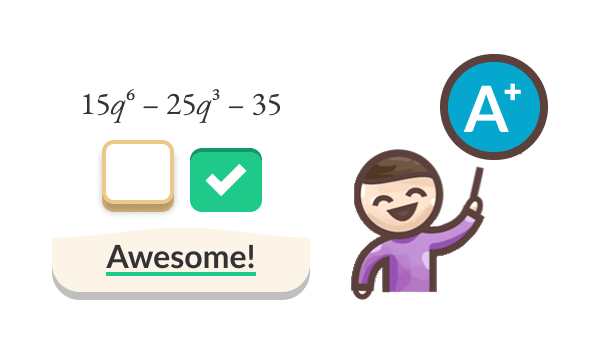
Step-by-Step Videos
Watch once and solve the next one alone.
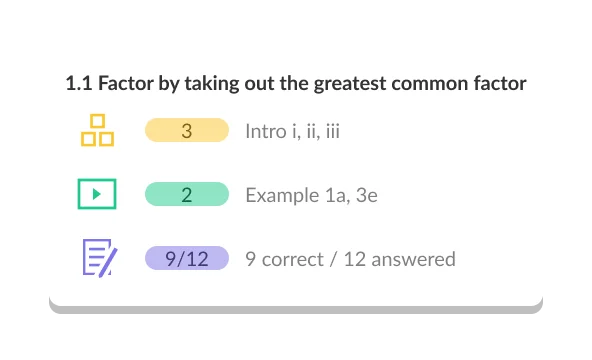
Unlimited Practice
Practice until it clicks not until timed out.

Test Prep Included
Practice real SAT questions in your plan.
Try It Now
Test your knowledge
Our approach aligns with the evidence
Exam Scores
Better Recall
Less Anxiety
SAT Test Prep Topics
1. Understanding Integers
2. Adding and Subtracting Integers
3. Multiplying and Dividing Integers
4. Number Theory
5. Adding and Subtracting Fractions
6. Multiplying and Dividing Fractions
7. Operation with Decimals
8. Fractions, Decimals, and Percents
9. Ratios, Rates, and Proportions
10. Introduction to Variables and Expressions
11. Solving Linear Equations
12. Linear Inequalities
13. Measuring Systems
14. Number System
15. Radicals
16. Exponents
17. Operations of Polynomials
18. Introduction to Relations and Functions
19. Linear Functions
20. Systems of Equations
21. Factoring Polynomials
22. Quadratic Functions
23. Solving Quadratic Equations
24. Rational Expressions
25. Function Notation
26. Transformations of Functions
27. Polynomial Functions
28. Direct and Inverse Variation
29. Trigonometry with Right Triangles
30. Trigonometric Ratios and Angle Measure
31. Law of Sines and Cosines
32. Imaginary and Complex Numbers
33. Angles, Lines, and Transversals
34. Circles
35. Surface Area and Volume
37. Data and Graphs
38 Chapters · 219 Topics · 1657 Videos
Discover Our Learning Areas
Explore key subjects and start learning with interactive content.

















What Is the SAT? An Overview for New Zealand Students
The SAT (Scholastic Assessment Test) is a standardised college admissions test developed by the College Board and widely used by universities in the United States and other English-speaking countries. For New Zealand students in Year 12 and Year 13 who are applying to US universities or international programmes that require a standardised test score, the SAT is one of the primary assessment pathways. It measures skills in mathematics and evidence-based reading and writing — areas that align closely with the analytical thinking developed through the New Zealand curriculum.
The SAT is scored on a 400–1600 scale. It is offered internationally several times per year, and New Zealand students can register and sit the test at approved international test centres. The digital SAT, now rolling out globally, uses an adaptive module format designed to measure the same skills more efficiently within a shorter testing window.
SAT Format and Sections
The SAT consists of two main sections: Evidence-Based Reading and Writing (EBRW) and Math. The Math section is further divided into a no-calculator module and a calculator-permitted module. In the digital SAT format, each section is split into two adaptive modules — your performance in the first module determines the difficulty level of the second. Total testing time is approximately 2 hours 14 minutes for the digital SAT.
Understanding the adaptive format is important for preparation. Strong performance early in a section unlocks higher-difficulty questions, which carry greater scoring weight. SAT preparation based on real exam formats — rather than generic maths drills — gives you the most accurate picture of what test day looks like.
How Is the SAT Scored, and What Is a Good Score for NZ Students?
Each of the two main sections (EBRW and Math) is scored from 200 to 800, combining for a total score between 400 and 1600. There is no penalty for incorrect answers, so leaving any question blank is never the right strategy. A score of approximately 1000 represents the 50th percentile. New Zealand students aiming for competitive US universities typically target 1300–1500 or above, depending on the institution. Always check the middle 50% SAT score range published by your target universities rather than relying on a single benchmark.
What Content Areas Does SAT Math Cover?
SAT Math is organised into four content areas, each appearing across the two math modules:
- Heart of Algebra — linear equations, inequalities, systems of equations, and interpreting linear relationships. This is the highest-weighted area.
- Problem Solving and Data Analysis — ratios, proportional reasoning, percentages, unit rates, statistics, probability, and reading data from graphs and tables.
- Passport to Advanced Math — quadratic and polynomial equations, function notation, exponential functions, and algebraic manipulation. Most students find this the most challenging area.
- Additional Topics in Math — geometry, trigonometry, complex numbers, and circle equations. These questions appear less frequently but are still tested.
Knowing which content area each practice question belongs to helps you allocate study time efficiently — a core principle behind StudyPug's adaptive practice path.
How Long Does SAT Prep Take, and When Should You Start?
Most students see meaningful improvement with 8–12 weeks of structured preparation. If you are aiming for a significant score increase, 16 weeks gives you more time to work through all content areas, complete multiple full-length practice tests, and address gaps identified by your diagnostic. New Zealand students applying to US universities for the following year's intake typically sit the SAT in October, November, or March — plan your prep window backwards from your target test date. Taking the SAT in Year 12 (around age 16–17) leaves room for a retake in Year 13 if needed.
Why Use StudyPug for SAT Preparation?
StudyPug is built around one core idea: knowing the method matters more than memorising answers. Every SAT Math topic is covered through certified-teacher video lessons that walk you through problem-solving step by step — not AI-generated explanations, but real teachers showing you the reasoning behind each solution. When you understand the method, you can handle similar questions on test day even when the numbers or phrasing change.
The preparation system starts with a diagnostic assessment that pinpoints exactly which SAT content areas — Heart of Algebra, Passport to Advanced Math, or Problem Solving and Data Analysis — need the most attention. Instead of studying everything at equal intensity, you focus where it counts. Adaptive practice then adjusts to your performance, progressively challenging you as your skills improve.
Unlimited practice tests mean you can simulate full SAT conditions and retake as many times as needed until you are consistently hitting your target score range. Every subscription is backed by a 30-day money-back guarantee — there is no risk in getting started. You can also explore free SAT practice content to see the approach before committing.
What You Will Learn: SAT Math Topic Coverage
StudyPug's SAT preparation covers all four Math content areas in depth. You will work through:
- Solving and graphing linear equations and inequalities (Heart of Algebra)
- Systems of equations — substitution, elimination, and word-problem applications
- Ratios, percentages, and data interpretation from tables and scatterplots (Problem Solving and Data Analysis)
- Quadratic equations — factoring, completing the square, and using the quadratic formula (Passport to Advanced Math)
- Polynomial operations, rational expressions, and function transformations
- Geometry — area, volume, similar triangles, and the Pythagorean theorem
- Trigonometry — sine, cosine, tangent, and their applications in right triangles
Each topic links directly to the SAT Math content framework, so every study session has a clear connection to your score. If you are also exploring other standardised test options, you may find our GED math prep course useful as a comparison or a foundation-building resource before stepping up to SAT-level content.
How to Use StudyPug: A Simple SAT Study Plan
Here is a practical approach to getting the most from StudyPug for your SAT preparation:
- Take the diagnostic. Spend around 30 minutes on the initial diagnostic assessment. It will identify which SAT content areas — Heart of Algebra, Passport to Advanced Math, Problem Solving and Data Analysis, or Additional Topics — are your current weak spots.
- Follow your personalised study path. StudyPug's adaptive practice system builds a focused study path based on your diagnostic results. Work through the recommended concept videos in order — watch how a certified teacher solves each problem type before you attempt similar questions yourself.
- Practice with topic quizzes. After each concept video, complete the accompanying topic-specific practice questions. Use the step-by-step solution breakdowns to understand every error before moving on.
- Run full-length timed practice tests. Approximately every two to three weeks, sit a complete timed SAT practice test under real exam conditions — no interruptions, no calculator in the no-calculator module. Review your results by content area and update your study focus accordingly.
- Track your progress. Use StudyPug's progress tracker to monitor improvement across each content area over time. Seeing consistent gains in your weakest areas is one of the clearest indicators that your preparation is working.
Consistent daily practice of 30–45 minutes compounds significantly over 8–12 weeks. The students who improve most are those who review every incorrect answer, understand exactly why it was wrong, and practise that question type again before their next session.
SAT Test Prep FAQ
Unsure how StudyPug works? Need help with setting up? Check our frequently asked questions or contact us for help.
What does the SAT cover, and how is it structured?
The SAT is a standardised college admissions test consisting of two main sections: Evidence-Based Reading and Writing (EBRW) and Math. The Math section is split into a no-calculator portion and a calculator-permitted portion. In total the test runs approximately 3 hours (or 3 hours 50 minutes with the optional Essay, now discontinued in the digital SAT). The digital SAT, rolling out globally, uses an adaptive module format where the difficulty of your second module adjusts based on your first-module performance. Understanding this structure is a key part of effective preparation.
How is the SAT scored, and what counts as a good score?
The SAT is scored on a scale of 400–1600, combining two section scores of 200–800: one for EBRW and one for Math. There is no penalty for wrong answers, so answering every question is always worthwhile. A score of 1000 sits around the 50th percentile nationally. For competitive New Zealand students applying to top US universities, a score of 1400 or above is generally considered strong. Your target score should align with the median SAT score at your chosen universities — check each institution's published data.
What subjects and content areas are tested on the SAT Math section?
SAT Math covers four main content areas: Heart of Algebra (linear equations, inequalities, and systems), Problem Solving and Data Analysis (ratios, percentages, statistics, and interpreting graphs), Passport to Advanced Math (quadratics, polynomials, and function manipulation), and Additional Topics in Math (geometry, trigonometry, and complex numbers). Heart of Algebra carries the most weight, making linear equations one of the highest-value topics to study. Practice tests based on real SAT exams help you see which content areas appear most frequently.
How should I prepare for the SAT, and how long does it take?
Most students benefit from 8–12 weeks of structured preparation. Start with a full-length diagnostic practice test to identify your weakest content areas, then focus your study time on those sections. Work through concept videos to build understanding, then reinforce with topic-specific quizzes and timed practice tests. Aim for at least two to three full-length timed practice sessions before your test date. Consistent daily practice — even 30–45 minutes — compounds quickly. Reviewing every incorrect answer and understanding why you got it wrong is the single most effective study habit.
When should I take the SAT, and how do I register?
The SAT is offered multiple times per year internationally, typically in March, May, August, October, November, and December. New Zealand students can register through the College Board website (collegeboard.org). It is advisable to register at least six to eight weeks before your chosen test date to secure your preferred international testing centre. Many students take the SAT for the first time in Year 12 (around age 16–17) to allow time for a retake in Year 13 if needed. Check College Board for current international test-centre availability in New Zealand.
What is the hardest part of the SAT Math section, and how do I tackle it?
Most students find Passport to Advanced Math — covering quadratics, polynomial functions, and function notation — the most challenging SAT Math content area. These questions require multi-step reasoning rather than simple recall. The best approach is to study the underlying method, not just memorise answer patterns. Watch step-by-step video solutions that show how to work through each problem type, then immediately practise similar questions. The no-calculator module also trips up students who rely heavily on calculators for basic algebra — building mental fluency with linear equations significantly reduces errors there.





Written by the StudyPug Team
Last updated June 5, 2026
3 M+
students
★★★★★
4.8 average
K–12
all grades