GED Math Prep: Practice Tests & Video Solutions
Pinpoint your weak areas with a diagnostic, then build skills with certified-teacher video lessons and unlimited practice tests.

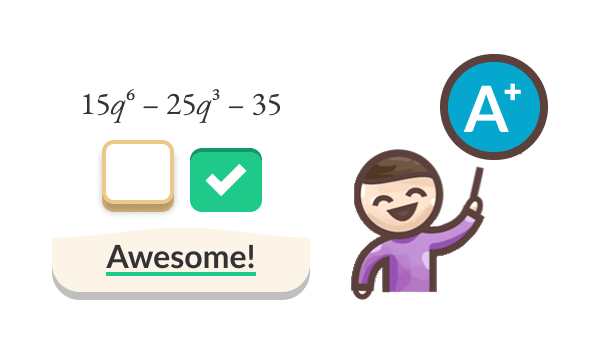
Step-by-Step Videos
Learn the method to solve it alone.
Unlimited Practice
Practice until you truly know it not just finish.

Real Exam Practice
Includes free practice with real GED questions.
Try It Now
Test your knowledge
Our approach aligns with the evidence
Exam Scores
Better Recall
Less Anxiety
GED Math Test Prep Topics
1. Understanding Integers
2. Adding and Subtracting Integers
3. Multiplying and Dividing Integers
4. Introduction to Variables and Expressions
5. Number Theory
6. Adding and Subtracting Fractions
7. Multiplying and Dividing Fractions
8. Operation with Decimals
9. Number System and Pattern
10. Ratios, Rates, and Proportions
11. Percents
12. Solving One- and Two- Step Equations
13. Solving Multi-Step Equations
14. Linear Inequalities
15. Pythagorean Theorem
16. Radicals
17. Exponents
18. Introduction to Relations and Functions
19. Linear Functions
20. Solving Linear Systems
21. Operations of Polynomials
22. Factoring Polynomials
23. Rational Expressions
24. Reciprocal Functions
25. Quadratic Functions
26. Solving Quadratic Equations
27. Symmetry and Surface Area
28. Scale Factors and Similarity
29. Angles, Lines, and Transversals
30. Properties of Triangles
31. Circles
32. Measuring Systems
33. Surface Area and Volume
34. Introduction to Probability
36 Chapters · 188 Topics · 1508 Videos
Discover Our Learning Areas
Explore key subjects and start learning with interactive content.





What Is the GED Mathematical Reasoning Test?
The GED Mathematical Reasoning test is one of four subject tests that make up the General Educational Development (GED) qualification. It assesses the mathematical skills and knowledge that are typically developed through secondary school, and is recognised by employers, universities, and training programmes across New Zealand and internationally. Passing the GED Mathematical Reasoning test — along with the other three subject tests — earns you a GED credential, which is widely accepted as equivalent to a secondary school certificate.
The test runs for approximately 115 minutes and contains around 46 questions. It uses a variety of question formats including multiple choice, drag-and-drop, hot spot, and fill-in-the-blank items — all based on real exam formats. A TI-30XS Multiview calculator is permitted for the majority of the test, with the first five questions completed without a calculator.
GED Math Format and Sections
The GED Mathematical Reasoning test is divided into two main content areas. The first is Quantitative Problem Solving, which accounts for approximately 45% of the test. This section covers number sense, operations, fractions, decimals, percentages, ratios, proportions, geometry (area, volume, surface area), and data analysis including interpreting tables and graphs. The second is Algebraic Thinking, which makes up roughly 55% of the test. This section includes algebraic expressions, equations, inequalities, linear equations, quadratic equations, and functions.
Questions across both sections are set in real-world contexts, so you are not simply solving abstract equations — you are applying mathematical reasoning to practical problems. Understanding this distinction is key to preparing effectively.
How Is the GED Math Test Scored?
The GED Mathematical Reasoning test is scored on a scale from 100 to 200. A score of 145 or above is considered passing. Scores between 165 and 174 indicate College Ready performance, and scores of 175 or above earn you College Ready + Credit status, which some tertiary institutions in New Zealand and internationally recognise for course placement or credit purposes. Knowing these score bands gives you a clear target to work toward from the very beginning of your preparation.
What Are the Hardest Sections of the GED Math Test?
Most students find the Algebraic Thinking section the most difficult part of the GED Mathematical Reasoning test. In particular, linear equations, quadratic equations, and functions trip up test-takers who have been out of formal study for several years. These topics require understanding the method behind solving a problem — not just memorising a formula. The non-calculator section also challenges many students, since it demands strong mental arithmetic and fraction skills under time pressure.
The good news is that these are exactly the areas where targeted practice and step-by-step instruction make the biggest difference. Working through concept videos that teach the reasoning process — not just the answer — is the most effective way to build lasting competence in these sections.
Why Use StudyPug for GED Math Prep?
GED math preparation works best when it is personalised, methodical, and built around your specific starting point. StudyPug is designed exactly for this. Here is what makes the StudyPug approach different:
Start with a diagnostic assessment. Rather than working through every topic from scratch, take a quick diagnostic that pinpoints your weakest areas. This tells you exactly which sections of the GED Mathematical Reasoning test need the most attention, so you study smarter from day one.
Learn with certified-teacher video solutions. Every GED math topic is covered by video lessons made by certified teachers — not AI-generated content. Each lesson teaches you the method behind solving a problem, so you can handle similar questions when you encounter them on test day. This is the difference between knowing an answer and knowing how to find it.
Practice adaptively. As you work through quizzes and practice questions, the difficulty adjusts to match your current performance level. This keeps you challenged without overwhelming you, and ensures you are always building on what you know.
Take unlimited practice tests. Full-length GED math practice tests based on real exam formats let you experience the test under realistic conditions. Retake them as many times as you need until your scores are consistently strong. There is no limit — keep going until you feel genuinely ready.
Free GED math practice. You can begin exploring GED math content and free practice before committing to a full subscription, making it easy to see the approach in action at no cost.
30-day money-back guarantee. Every StudyPug subscription comes with a 30-day money-back guarantee. Start your GED math prep with complete confidence.
What GED Math Topics Does StudyPug Cover?
StudyPug's GED Mathematical Reasoning prep covers every content area tested on the exam:
- Number sense and operations — whole numbers, fractions, decimals, and percentages
- Ratios, rates, and proportional reasoning
- Geometry — perimeter, area, volume, surface area, and coordinate geometry
- Data analysis — interpreting graphs, tables, mean, median, mode, and probability
- Algebraic expressions and equations
- Linear equations and inequalities
- Quadratic equations and functions
- Non-calculator arithmetic skills
Each topic includes concept videos, worked examples, quizzes, and practice questions. You can also explore related test prep resources — for example, if you are preparing for additional qualifications, our SAT prep content covers overlapping algebra and quantitative reasoning skills that reinforce your GED math preparation.
How to Prepare for the GED Math Test: A Study Plan
A structured study plan is the most reliable path to a passing score on the GED Mathematical Reasoning test. Here is a practical approach to organise your preparation:
Weeks 1–2: Diagnostic and foundation building. Begin with the StudyPug diagnostic assessment to identify your weakest areas. Then focus your first two weeks on closing foundational gaps — particularly in number sense, fractions, and basic algebraic operations. Short, targeted sessions of 30–45 minutes are more effective than long unfocused study blocks.
Weeks 3–6: Topic-by-topic skill building. Work systematically through the content areas identified in your diagnostic. Use certified-teacher video lessons to learn the method behind each problem type, then complete topic quizzes until you are scoring consistently well. Pay particular attention to the Algebraic Thinking section, which carries the highest weight on the test.
Weeks 7–10: Practice tests and review. Shift to full-length GED math practice tests under timed conditions. After each test, review every question you got wrong using video solutions to understand exactly where your reasoning broke down. Retake practice tests until you are consistently scoring above 145 — and ideally above 165 if you are aiming for College Ready status.
Final week: Consolidation and confidence. In the week before your test, avoid starting new topics. Instead, complete one final practice test, review your personal weak areas, and reinforce your calculator skills. Arrive on test day having already seen every major question format — prepared, practised, and ready.
GED Math Test Prep FAQ
Unsure how StudyPug works? Need help with setting up? Check our frequently asked questions or contact us for help.
What does the GED Mathematical Reasoning test cover, and how is it structured?
The GED Mathematical Reasoning test is one of four GED subject tests. It runs approximately 115 minutes and has around 46 questions covering two main content areas: Mathematical Reasoning/Algebraic Thinking (approximately 55%) and Quantitative Problem Solving (approximately 45%). Topics include number operations, ratios, linear equations, quadratic equations, geometry, statistics, and data analysis. A calculator (TI-30XS Multiview) is permitted for most of the test, but the first five questions must be completed without one.
How is the GED Math test scored, and what is a passing score?
The GED Mathematical Reasoning test is scored on a scale from 100 to 200 points. A score of 145 or higher is considered passing and earns your GED credential in that subject. Scores between 165 and 174 indicate College Ready performance, and scores of 175 or above indicate College Ready + Credit, which may allow you to skip certain college placement courses. Understanding these score bands helps you set a clear target when you begin your preparation.
What content areas and subjects are tested on the GED Math section?
The GED Mathematical Reasoning test assesses two broad content areas. Quantitative Problem Solving covers number sense, fractions, decimals, percentages, ratios, proportions, data analysis, and geometry including area, volume, and surface area. Algebraic Thinking covers expressions, equations, inequalities, linear equations, quadratic equations, and functions. Questions are presented in multiple formats including multiple choice, drag-and-drop, hot spot, and fill-in-the-blank, based on real exam formats.
How should I prepare for the GED Math test, and how long will it take?
Most students spend between 8 and 16 weeks preparing for the GED Mathematical Reasoning test, depending on their starting level. A strong preparation plan begins with a diagnostic assessment to identify your weakest areas, then moves into focused practice on those topics before broadening to full-length practice tests. Start with the concepts you find hardest, use step-by-step video solutions to learn the method behind each problem type, and build up to timed full-length practice tests in the final weeks before your exam.
When should I take the GED Math test, and how do I register in New Zealand?
In New Zealand, the GED is administered through Pearson VUE test centres. You can register at ged.com, create an account, and schedule your Mathematical Reasoning test at an available testing centre. There is no set academic calendar — you can schedule when you feel ready. Most students benefit from completing at least four to six full-length practice tests and consistently scoring at or above the passing mark before booking their test date. Check ged.com for current scheduling availability and testing fees in your region.
What is the hardest part of the GED Math test, and how do I tackle it?
Most test-takers find the Algebraic Thinking section the most challenging, particularly linear equations, quadratic equations, and interpreting functions. These questions require you to understand the method, not just recall a formula. The best approach is to work through algebraic topics systematically using step-by-step video solutions that teach you how to reason through each problem type. Practice the non-calculator section regularly so you build fluency with basic computation, and use timed practice tests to get comfortable with the question formats before test day.





Written by the StudyPug Team
Last updated June 5, 2026
3 M+
students
★★★★★
4.8 average
K–12
all grades