Year 9 Pre-Algebra Help — Step-by-Step Video Lessons & Practice
Clear video lessons and guided practice that make pre-algebra click for your child

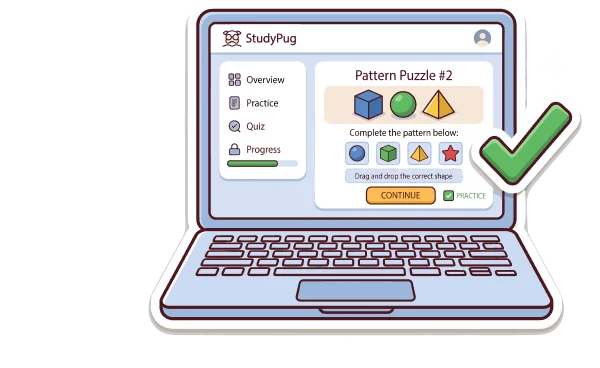
Value vs. Private Tutor
Expert teaching without the hourly rate.

Multi-Subject
Master pre-algebra and every subject.
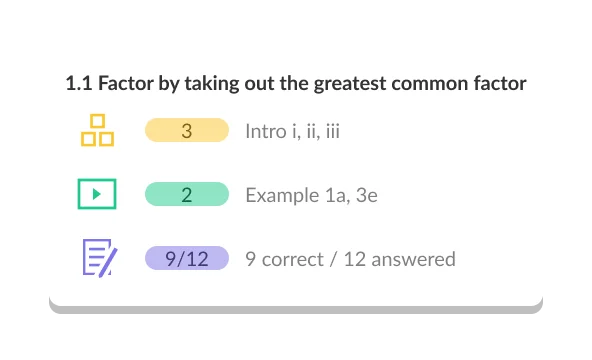
Unlimited Practice
Practice the skill until it truly sticks.
Try It Now
Test your knowledge
Our approach aligns with the evidence
Exam Scores
Better Recall
Less Anxiety
Pre-Algebra Topics
1. Integers
2. Factors and multiples
3. Decimals
4. Fractions
5. Ratios, rates, and proportions
6. Measuring Systems
7. Applying mathematical reasoning
8. Radicals
9. Exponents and Scientific Notation
10. Pythagorean Theorem
11. Surface Area of 3-Dimensional Shapes
12. Volume of 3-Dimensional Shapes
13. Function and Linear Relationships
14. Linear Equations
15. Linear Functions
16. Probability
17. Symmetry and Tessellations
18 Chapters · 77 Topics · 661 Videos
Discover Our Learning Areas
Explore key subjects and start learning with interactive content.
















What Is Year 9 Pre-Algebra?
Year 9 pre-algebra is the bridge course that connects the number work your child did in primary school with the formal algebra they will meet throughout secondary maths. It introduces variables, expressions, and equations alongside a deeper treatment of integers, ratios, and proportional reasoning. In New Zealand, these skills sit at Curriculum Level 4–5 and form the backbone of every maths strand — number, algebra, geometry, and statistics — your child will study from Year 10 onwards. Getting this right at Year 9 is one of the highest-leverage investments you can make in their maths education.
What Topics Are Covered in Year 9 Pre-Algebra?
Year 9 pre-algebra in New Zealand covers a broad range of interconnected topics. Students work with integers and rational numbers — adding, subtracting, multiplying, and dividing positives and negatives. They deepen their understanding of order of operations and apply it to increasingly complex expressions. Ratios, proportions, and percentages are explored in real-world contexts such as scaling, discount, and comparison problems. The algebraic strand introduces variables, simplifying expressions, and solving one- and two-step equations and inequalities. Basic coordinate geometry — plotting points, identifying quadrants, and understanding linear relationships — rounds out the curriculum at this level. Each of these strands links directly to what your child's teacher is covering in class under the New Zealand Curriculum.
Is Year 9 Pre-Algebra Hard? Common Struggles and How to Overcome Them
Pre-algebra is where maths starts to feel abstract for many students, and that shift can be genuinely challenging. The most common sticking points at Year 9 are negative number operations, especially when combined with fractions inside equations; order of operations errors that produce wrong answers despite correct method-recall; and the conceptual leap from arithmetic (finding a fixed answer) to algebra (solving for an unknown). Ratio and proportion problems in unfamiliar contexts also trip up a lot of learners. The good news is that all of these difficulties respond very well to structured practice and clear explanation. Students who watch a well-taught worked example and then immediately try a similar problem on their own consolidate the method far faster than those who only read a textbook. Identifying exactly which skill is causing trouble — rather than practising the whole topic broadly — is the fastest route from confusion to confidence.
Why StudyPug for Year 9 Pre-Algebra?
StudyPug is built around three principles that matter most at this stage of maths learning. First, a quick diagnostic assessment identifies precisely where your child's understanding breaks down — so the time they spend practising is always targeted at the right skill. Second, certified teachers explain every concept in step-by-step video lessons that teach the method, not just the answer. Your child learns to reason through a problem, which means they can handle variations they have never seen before. Third, adaptive practice questions adjust to your child's current level automatically — challenging them enough to build real fluency without the frustration of questions that are too hard too soon. Together, these three features produce the kind of steady, visible improvement that builds genuine confidence in maths.
The Family Plan makes StudyPug practical for busy New Zealand families. Up to five children can access every subject at every grade level under a single subscription. Each child has their own profile, and the parent dashboard shows you each child's progress separately — so you always know which topics are going well and where your child still needs a push. There is no free trial, but free daily practice content means your child can start immediately, and every paid plan is backed by a 30-day money-back guarantee.
What Your Child Will Learn in This Course
By the end of Year 9 pre-algebra, your child will be able to perform confident operations with integers and rational numbers, apply order of operations correctly in multi-step problems, set up and solve one- and two-step equations and inequalities, work with ratios and proportions in practical contexts, and read and plot points on a coordinate grid. These are the exact skills assessed in Year 9 school reports and internal assessments under the New Zealand Curriculum, and they are the prerequisites for the algebra, geometry, and statistics strands in Year 10. Because no validated internal topic links are available for this course in the current page map, all curriculum coverage is described here in plain text — your child's specific topics are listed inside the course itself once they log in.
How to Use StudyPug for Year 9 Pre-Algebra
The most effective way to use StudyPug at Year 9 is to start with the diagnostic. It takes only a few minutes and produces a personalised list of the specific pre-algebra skills your child needs to prioritise. From there, the workflow is simple: watch the certified-teacher video for the topic, follow the worked examples carefully, and then complete the adaptive practice problems immediately afterwards while the method is fresh. Four to five sessions of 20–30 minutes per week — timed around what the teacher is covering in class — will produce noticeable improvement within the first month. Parents can check in via the dashboard at any point to see progress across topics without needing to sit with their child for every session. StudyPug is available on any device, so your child can practise on a laptop at home or on a phone during a quiet moment at school. Photo Search is also available for Year 9 — if your child takes a photo of a problem they are stuck on, it finds the matching lesson instantly, so they spend less time searching and more time learning.
Pre-Algebra FAQ
Unsure how StudyPug works? Need help with setting up? Check our frequently asked questions or contact us for help.
What does my child learn in Year 9 pre-algebra, and what topics does it cover?
Year 9 pre-algebra in New Zealand builds the core number and algebraic skills students need for secondary maths. Topics include integers and rational numbers, order of operations, ratios and proportions, percentages, introduction to variables and expressions, solving one- and two-step equations, inequalities, and basic coordinate geometry. These concepts underpin algebra and statistics in Year 10 and beyond, so a solid grounding now makes a measurable difference to your child's maths trajectory throughout secondary school.
Is Year 9 pre-algebra hard, and where do students commonly struggle?
Many Year 9 students find pre-algebra manageable in the early weeks but hit difficulty when negative numbers, fractions, and variables appear together in the same equation. The shift from arithmetic thinking — where there is always a known answer — to algebraic thinking, where you solve for an unknown, trips up a lot of learners. Order of operations errors and misreading ratio problems are also common. Identifying these gaps early and practising the specific skill that is causing trouble makes a significant difference to confidence and results.
What should my child know before Year 9 pre-algebra, and what comes next?
Before starting Year 9 pre-algebra, students should be comfortable with whole numbers, basic fractions and decimals, multiplication and division, and simple percentages from primary and Year 7–8. If those foundations are shaky, StudyPug's diagnostic will flag them immediately so your child can patch the gaps first. After pre-algebra, students move into Year 10 algebra and geometry, where they work with linear functions, simultaneous equations, and trigonometry — all of which build directly on pre-algebra skills.
How does StudyPug pre-algebra map to what my child learns at school in New Zealand?
StudyPug's Year 9 pre-algebra lessons are aligned to the New Zealand Curriculum (NZC) for mathematics and statistics at Level 4–5. Every topic — integers, expressions, equations, ratios, and coordinate geometry — corresponds to what your child's teacher is covering in class. This means the videos reinforce exactly the methods used at school, reducing confusion and making homework much more straightforward. The curriculum alignment is reviewed regularly to stay current with NZC updates.
What is one of the trickiest pre-algebra concepts at Year 9, and how is it taught?
Solving two-step equations is consistently one of the sticking points at Year 9. Students must perform inverse operations in the correct order and keep the equation balanced — two habits that take practice to build. StudyPug's certified teachers tackle this with annotated step-by-step worked examples: they show every operation written out, explain why each step is taken, and then give immediate adaptive practice so students test the method themselves. This approach — teaching the reasoning, not just the answer — helps students handle unfamiliar variations on their own.
How much maths practice should my child do at Year 9?
Educational research suggests that 20–30 minutes of focused, regular practice on specific skills is more effective than occasional long sessions. At Year 9, a good rhythm is four to five short sessions per week, targeting the topics introduced in class that week. StudyPug's adaptive practice engine keeps each session productive by adjusting question difficulty to your child's current level — building fluency quickly without frustration. Consistent short sessions also help with retention in the run-up to end-of-year assessments.





Written by the StudyPug Team
Last updated June 5, 2026
3 M+
students
★★★★★
4.8 average
K–12
all grades