Year 8 Maths Help — Step-by-Step Video Lessons & Practice
Help your child understand every maths topic and build real confidence, one lesson at a time.

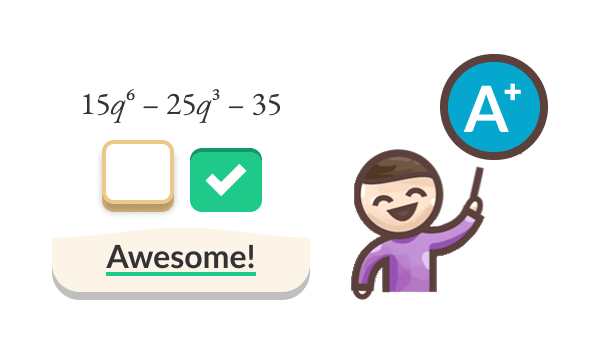
Expert Video Solutions
Watch it solved then solve the next one.
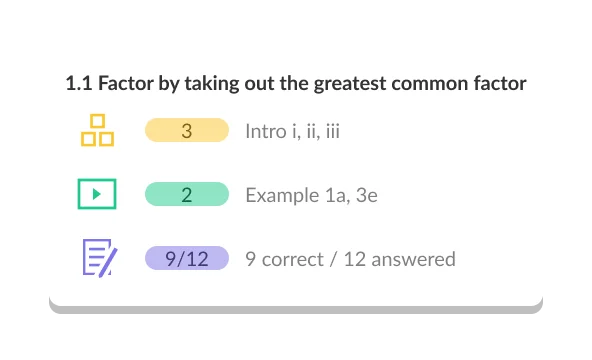
Unlimited Practice
Practice until it truly clicks not just time.
Real Exam Practice
Practice real exam questions and walk in ready.
Try It Now
Test your knowledge
Our approach aligns with the evidence
Exam Scores
Better Recall
Less Anxiety
Year 8 Maths Topics
1. Numbers and Relations
2. Number Theory
3. Adding and Subtracting Integers
4. Multiplying and Dividing Integers
5. Operations with Decimals
6. Adding and Subtracting Fractions
7. Multiplying and Dividing Fractions
8. Rational Numbers
9. Powers, Exponents and Square Roots
10. Ratios, Rates, and Proportions
11. Proportional Relationships
12. Percents
13. Measuring Systems
14. Coordinates, Quadrants, and Transformations
15. Patterns and Solving Equations
16. Linear Equations (Basic)
17. Solving Linear Equations
18. Angles, Lines, and Transversals
19. Symmetry and Surface Area
20. Properties of Triangles
21. Scale Factors and Similarity
22. Introduction to 3-Dimensional Figures
23. Data and Graphs
25 Chapters · 108 Topics · 1030 Videos

Ready to practice Year 8 Maths?
Try practice questions on every Year 8 Maths topic — with instant feedback and step-by-step video solutions when you get stuck.
Discover Our Learning Areas
Explore key subjects and start learning with interactive content.

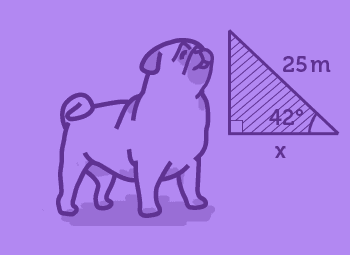




What Is Year 8 Maths?
Year 8 maths is the final year of intermediate school mathematics in New Zealand, and it's one of the most important. It's where students make the transition from concrete arithmetic to more abstract thinking — working with algebraic expressions, applying proportional reasoning, and developing the problem-solving skills they'll need throughout secondary school. Year 8 maths covers the Number, Algebra, Geometry and Measurement, and Statistics strands of the New Zealand curriculum, pulling together everything from primary school while introducing the formal methods that underpin Years 9 and 10.
For many families, Year 8 is the year maths starts to feel harder. Topics like fractions, ratios, and early algebra require a different kind of thinking, and without a solid foundation, gaps can grow quickly. The right support at this stage makes a lasting difference.
What Topics Does Year 8 Maths Cover in New Zealand?
Year 8 maths in New Zealand is broad and builds on every strand introduced in primary school. In Number and Algebra, students work with integers, fractions, decimals, percentages, and ratios — and begin writing and solving simple linear equations. Proportional reasoning runs through much of this strand, asking students to apply rates and relationships in real-world problems.
In Geometry and Measurement, students calculate area and volume for a range of shapes, explore coordinate geometry, and investigate angles and transformations. Statistics and Probability round out the year, with students designing investigations, interpreting data displays, and calculating theoretical and experimental probabilities.
Together, these strands prepare students thoroughly for Year 9 mathematics, where the curriculum introduces Pythagoras' theorem, more complex algebra, and formal statistical analysis.
Is Year 8 Maths Hard? Common Struggles and How to Help
Year 8 is widely recognised as a turning point — and for good reason. Several topics require a conceptual leap that many students find challenging without targeted support.
Algebra is the most common sticking point. Moving from working with numbers to working with letters and unknowns requires a shift in thinking that doesn't come naturally to every student. A child who has always been confident with arithmetic can suddenly feel lost when equations are introduced.
Proportional reasoning — applying ratios, rates, and percentages across different contexts — trips up many Year 8 students. They can often calculate a straightforward percentage but struggle when the same concept appears in a new form, like a discount, a scale drawing, or a speed problem.
Fractions continue to cause difficulty, particularly when students are asked to multiply, divide, or compare fractions with different denominators.
The most effective way to help is to find the exact gap and address it directly rather than revisiting everything. A focused, structured approach — short daily practice sessions, clear explanations, and immediate feedback — builds confidence quickly.
Why StudyPug for Year 8 Maths Help?
StudyPug is designed specifically to help students at this stage — and to give parents the tools to support them. Here's what makes it work for Year 8 maths.
A diagnostic that finds the gap. Instead of working through topics your child already knows, StudyPug's diagnostic assessment identifies precisely where they need to focus. That means every study session is targeted and efficient — no more guessing, no more wasted evenings on revision that isn't needed.
Certified-teacher video lessons that teach the method. Each Year 8 maths concept is explained by a real certified teacher in a clear, step-by-step video. These aren't AI-generated summaries — they're genuine lessons that show your child how to think through a problem, not just what the answer is. When a student understands the method, they can solve similar problems on their own.
Adaptive practice that builds confidence. After watching a lesson, your child practises with questions that adjust to their level automatically. They're always working at the right level of challenge — enough to stretch their thinking without becoming discouraging. Each correct answer builds momentum.
Aligned to the New Zealand curriculum. Every topic on StudyPug's Year 8 maths pathway corresponds to the achievement objectives your child is working towards at school. Lessons aren't generic — they reflect the same language, structure, and expectations as the New Zealand national curriculum.
A Family Plan that covers everyone. If you have more than one child, the StudyPug Family Plan covers up to 5 children under one subscription — all year levels, all subjects. The parent dashboard shows each child's progress separately, so you always know where each one stands.
Free practice content with no risk. Free practice is available from the moment you sign up, so you can try the platform before committing. And if you subscribe and decide it's not right, StudyPug's 30-day money-back guarantee means you can request a full refund — no questions asked.
What Your Child Will Learn: Year 8 Maths Curriculum Coverage
StudyPug's Year 8 maths content covers all the key areas your child will encounter in the New Zealand curriculum:
- Number: Integers and negative numbers, fractions and mixed numbers, decimals and rounding, percentages and percentage change, ratio and proportion.
- Algebra: Writing algebraic expressions, simplifying expressions, solving one-step and two-step linear equations, introducing patterns and relationships.
- Geometry and Measurement: Perimeter, area, and surface area; volume of prisms and cylinders; coordinate geometry; angles, symmetry, and transformations.
- Statistics and Probability: Planning and conducting investigations, interpreting graphs and data displays, mean, median, mode and range, theoretical and experimental probability.
Topics are sequenced so that foundational skills are reinforced before more complex ideas are introduced — meaning students who have gaps from Year 7 can fill them within the same platform, without switching to a different resource.
Because no validated topic-level URLs are available in the current sitemap for this page, the curriculum topic list above is provided as descriptive coverage rather than hyperlinked topic pages. Your child can browse all available Year 8 maths topics directly within StudyPug after signing up.
How to Use StudyPug for Year 8 Maths
Getting started takes less than five minutes. Here's a practical approach for Year 8 families:
Step 1 — Run the diagnostic. When your child first logs in, the diagnostic assessment identifies their strongest areas and their gaps. Use these results to decide where to start — it's far more efficient than working through topics from the beginning.
Step 2 — Watch the lesson video. For each topic that needs work, your child watches a certified-teacher video that explains the concept clearly. Encourage them to pause, rewind, and re-watch as needed — unlike a classroom lesson, the video is always there.
Step 3 — Practise with adaptive questions. After the video, your child completes practice questions. These adjust to their level, so the difficulty is always appropriate. Instant feedback shows where they went wrong and why.
Step 4 — Track progress on the parent dashboard. Log into your parent view to see which topics your child has covered, how their scores are improving, and where they might benefit from more practice. Progress is shown per child, so the Family Plan works cleanly for multiple students.
Step 5 — Use Photo Search if they're stuck on a specific problem. If your child encounters a maths problem they can't start — from homework or a practice worksheet — Photo Search lets them find the matching lesson by photographing the problem. It finds the relevant lesson instantly, so they can get unstuck without waiting for help.
Short, consistent sessions work best at Year 8 — 20 to 30 minutes on most school nights is enough to build real momentum. StudyPug is available on any device, including phone and tablet, so your child can practise wherever works for them.
Year 8 Maths FAQ
Unsure how StudyPug works? Need help with setting up? Check our frequently asked questions or contact us for help.
What does my child learn in Year 8 maths, and what topics does it cover?
Year 8 maths in New Zealand builds on the Number and Algebra, Geometry and Measurement, and Statistics strands of the NZ curriculum. Your child will work with fractions, decimals, percentages, ratios, integers, and early algebraic thinking — including writing and solving simple equations. They'll also study area and volume, coordinate geometry, and interpreting data and probability. It's a pivotal year that bridges primary numeracy to the more formal reasoning expected in secondary school.
Is Year 8 maths hard, and where do children commonly struggle?
Year 8 maths is a significant step up for many students. The most common sticking points are algebra — particularly moving from arithmetic thinking to using letters to represent unknowns — fractions and ratio, and applying proportional reasoning in real-world contexts. Geometry also trips up students who haven't consolidated measurement concepts. The good news is that these are all teachable with the right step-by-step approach, and identifying the specific gap early makes a huge difference to how quickly confidence returns.
What should my child know before Year 8 maths, and what comes after?
A solid Year 7 foundation helps enormously — particularly confident work with fractions, times tables, place value, and basic geometry. Coming into Year 8, students who understand how to work with negative numbers and simple ratios will find the transition smoother. After Year 8, students move into Year 9, where algebra becomes more formal, Pythagoras' theorem is introduced, and statistics grows more analytical. StudyPug covers both Year 7 and Year 9 maths, so you can review backwards or preview forwards at any time.
How does StudyPug maths map to what my child learns at school in New Zealand?
StudyPug's Year 8 maths content is aligned to the New Zealand national curriculum, covering the achievement objectives across Number, Algebra, Geometry, Measurement, and Statistics. Lessons are structured to match what intermediate students cover term by term. Whether your child's school follows a more traditional or integrated approach, the topics on StudyPug reflect the same core skills — so every practice session directly supports what they're learning in the classroom rather than teaching something unfamiliar.
What is one of the trickiest Year 8 maths concepts, and how is it taught on StudyPug?
Proportional reasoning — applying ratios, rates, and percentages to real-life problems — is one of the most challenging concepts at Year 8 and underpins a great deal of secondary maths. Many students can calculate a simple percentage but struggle when the same idea appears in a different context, like scaling a recipe or working out a discount. On StudyPug, a certified teacher walks through the underlying concept first, shows why it works, and then models multiple problem types so your child can recognise and solve them independently.
How much maths practice should my child do at Year 8?
Most intermediate school maths specialists suggest 20–30 minutes of focused practice on most weeknights — enough to consolidate classroom learning without causing burnout. Quality matters more than duration: short sessions where your child actively works through problems and corrects mistakes beat long passive review sessions. StudyPug's adaptive practice adjusts to your child's level automatically, so every session is appropriately challenging. On busy nights, even 10 minutes reviewing a video lesson or completing a few practice questions keeps the skills fresh.





Written by the StudyPug Team
Last updated June 5, 2026
3 M+
students
★★★★★
4.8 average
K–12
all grades