Learn Grade 1 English Language Arts Online
Build phonics, reading, and grammar confidence with certified teacher videos and practice aligned to provincial curriculum.
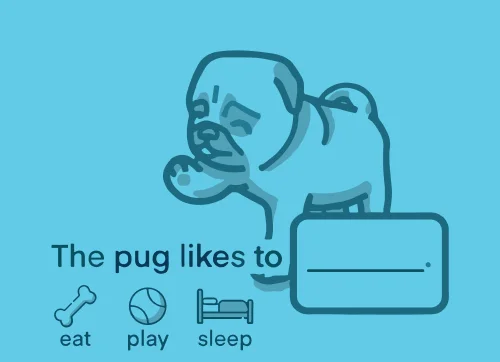
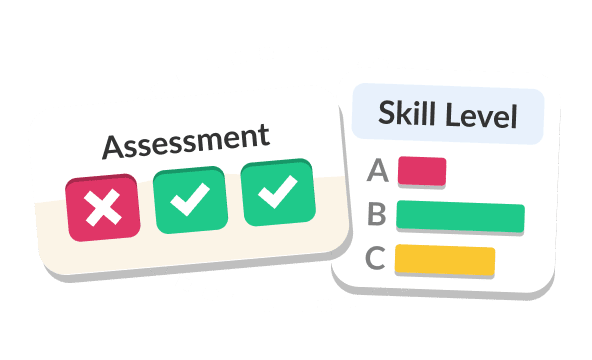
Find Your Weak Spots
See exactly where your child needs help.
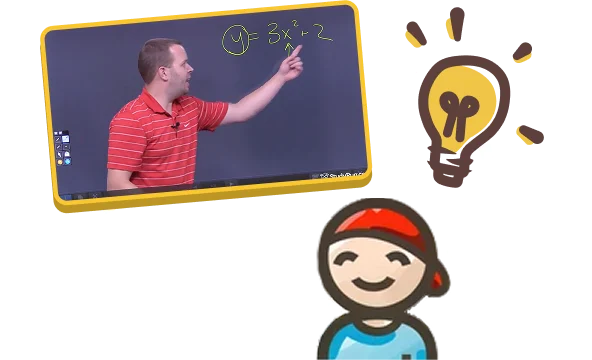
Step-by-Step Videos
Child follows and repeats real lessons alone.
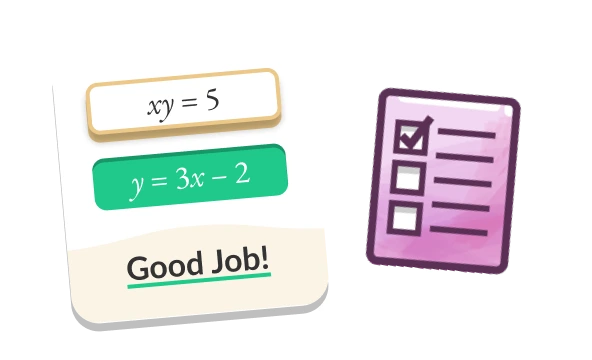
Practice That Adapts
Questions adapt to build child's confidence.
Try It Now
Test your knowledge
Our approach aligns with the evidence
Exam Scores
Better Recall
Less Anxiety
Grade 1 English Topics
1. Key Ideas
2. Story Elements
3. Craft and Structure
4. Integration
5. Main Ideas
8. Print Awareness
9. Phonological Awareness
10. Phonics
12. Opinion
13. Informative
14. Narrative
15. Development
16. Technology
17. Gathering Information
18. Collaboration
19. Understanding
20. Clear Expression
21. Grammar
22. Mechanics
23. Word Relationships
24. Academic Language
25. Safety/Etiquette
26. Digital Literacy
26 Chapters · 34 Topics · 42 Videos
Discover Our Learning Areas
Explore key subjects and start learning with interactive content.



What is Grade 1 English Language Arts?
Grade 1 English Language Arts is the foundational year of formal literacy education in Canada. It is the year children transition from recognizing individual letters to reading connected words, sentences, and short books. The provincial curriculum covers four interconnected strands: reading, writing, oral communication, and media literacy — all introduced at an age-appropriate level. By the end of Grade 1, students are expected to read simple texts independently, write basic sentences, and communicate ideas clearly in spoken language.
StudyPug's Grade 1 English Language Arts course covers every strand of the provincial curriculum, delivering certified-teacher video lessons and adaptive practice so children build these skills step by step — at home, at their own pace, aligned to what their teacher covers in class.
What phonics skills does Grade 1 ELA cover?
Phonics is the backbone of Grade 1 reading instruction. Children learn to connect individual letters and letter combinations — called blends and digraphs — with the sounds they represent. Common targets include short vowel sounds (cat, bed, sit), consonant blends (bl, cr, st), and digraphs (ch, sh, th). Mastering these patterns allows children to decode unfamiliar words rather than guessing.
Many Grade 1 children find phonics blends challenging, especially when multiple consonants appear together. StudyPug's step-by-step video lessons break every blend into its component sounds with clear, visual demonstrations by real certified teachers. Adaptive practice then reinforces each pattern with questions that adjust to your child's level — moving faster when they have it, slowing down when they need more repetition. You can explore the full scope of what is taught by reviewing the english syllabus for class 1 aligned to BC's provincial curriculum.
How is reading comprehension taught in Grade 1?
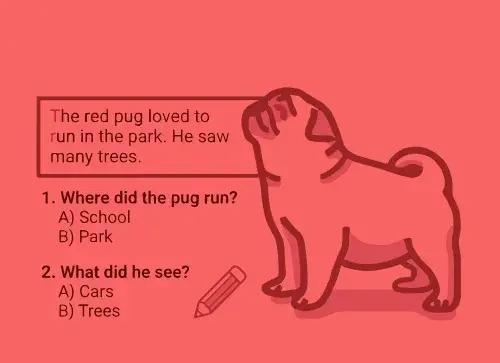
Reading comprehension in Grade 1 moves beyond decoding words to understanding meaning. Students learn to identify the main idea of a short passage, answer who/what/where/when questions, make simple predictions, and connect what they read to their own experience. These strategies build the habits of mind that support reading success through all of elementary school and beyond.
Comprehension is often harder to practise at home than phonics because parents may not know which specific strategies their child's teacher is targeting. StudyPug's diagnostic assessment identifies exactly which comprehension skills need attention — whether that is main-idea identification, sequencing, or making inferences — and creates a focused practice path so your child works on the right thing, not everything at once.
What grammar skills are introduced in Grade 1?
Grade 1 grammar lays the groundwork for clear written communication. The curriculum introduces nouns (naming words), verbs (action words), and basic sentence structure — the idea that a sentence must have a subject doing something. Children learn to write sentences that begin with a capital letter and end with a period, question mark, or exclamation mark. They also begin to distinguish between singular and plural nouns and use simple adjectives to describe things.
Grammar errors are easy to overlook at this age because children are focused on the physical act of writing. StudyPug's practice questions target each grammar rule in isolation so children build accuracy one skill at a time. If your child is in Ontario, the ontario grade 1 ela curriculum page details exactly which grammar outcomes are expected by the end of the year.
How important are sight words in Grade 1?
Sight words — also called high-frequency words — are words that appear so often in text that children should recognize them instantly without sounding them out. Grade 1 lists typically include 50 to 100 words such as the, and, was, said, they, where, and because. Automating these words frees up mental effort for harder decoding tasks and dramatically increases reading fluency.
Sight-word memorization requires repeated exposure in varied contexts. StudyPug practises sight words within sentences and short passages — not just flashcard drills — so children see each word in real reading situations. The adaptive system tracks which words a child has mastered and which still need reinforcement, keeping practice efficient and focused.
What vocabulary skills does Grade 1 ELA build?
Grade 1 vocabulary instruction helps children understand the words they encounter in books and classroom discussions. Students learn to use context clues to figure out unfamiliar words, sort words by category (animals, foods, colours), understand basic synonyms and antonyms, and expand their oral vocabulary through shared reading. A strong vocabulary in Grade 1 directly predicts reading comprehension through Grade 4 and beyond.
StudyPug's Grade 1 vocabulary practice is embedded within comprehension and phonics activities so children encounter new words in context rather than as isolated lists. This mirrors how provincial curricula recommend vocabulary be taught — through rich reading experience, not memorization alone.
Why StudyPug for Grade 1 English Language Arts?
StudyPug is built for busy Canadian families who want to support their child's literacy development without recreating the classroom at home. Here is what makes it different for Grade 1 ELA:
Certified-teacher video lessons that actually teach the method. Every lesson is delivered by a real certified teacher — not a computer-generated voice. Teachers model phonics blending, comprehension strategies, and grammar rules the same way a classroom teacher would, so children hear consistent instructional language between school and home practice.
Diagnostic assessment before practice. Rather than starting every child at lesson one, StudyPug's diagnostic assessment identifies the specific phonics patterns, sight words, and comprehension skills that need attention. This means a child who already reads fluently but struggles with grammar rules gets grammar practice — not more phonics drills they have already mastered.
Adaptive practice that adjusts in real time. Questions increase in difficulty as your child improves and ease back when they hit a barrier. This keeps every session in the learning zone — challenging enough to build skill, never so hard it causes frustration or disengagement.
Provincial curriculum alignment. All Grade 1 content is mapped to Canadian provincial curriculum standards, including Ontario, BC, Alberta, and beyond. When the teacher assigns a reading strategy or grammar concept in class, there is a StudyPug lesson that covers it the same way.
Free practice with no-risk entry. Parents can explore sample lessons and practice materials for free before committing to a subscription. When ready, every paid plan is backed by a 30-day money-back guarantee — if it is not the right fit, you get a full refund.
What you learn: Grade 1 ELA topics on StudyPug
The Grade 1 English Language Arts course on StudyPug covers the full provincial curriculum across reading, phonics, grammar, vocabulary, and comprehension. Key topic areas include:
- Phonics foundations — letter-sound relationships, short and long vowels, consonant blends and digraphs, CVC word patterns
- Sight words — high-frequency word recognition and fluency practice across Grade 1 reading lists
- Reading comprehension — main idea, key details, story structure (beginning, middle, end), making predictions
- Vocabulary development — context clues, word categories, synonyms, antonyms, descriptive language
- Basic grammar — nouns, verbs, adjectives, sentence structure, capitalization, end punctuation, singular and plural nouns
Each topic is covered through a certified-teacher video lesson followed by adaptive practice questions. The diagnostic assessment places your child at the right starting point within this topic sequence so they practise what they actually need.
Using StudyPug for Grade 1 English Language Arts at home
Getting started takes less than five minutes. Once you create an account, your child completes a short diagnostic assessment that identifies which Grade 1 ELA skills to prioritize. StudyPug then recommends a practice path — and your child can watch a teacher video lesson before attempting questions on any topic they find difficult.
Sessions work best in short bursts of 15 to 20 minutes, two to three times per week. This matches the spaced-repetition approach that provincial curriculum frameworks recommend for early literacy — frequent, brief exposure produces stronger retention than infrequent long sessions. The parent dashboard shows exactly which skills have been practised, which gaps remain, and how your child's accuracy is trending over time.
Photo Search is also available as a supporting tool: if your child brings home a reading or grammar question they cannot figure out, you can snap a photo of it and StudyPug will direct you to the relevant lesson. It is a helpful homework bridge — not a replacement for structured practice.
One subscription covers all grades and all subjects, so if you have more than one child — or if your Grade 1 reader is ready to look ahead to Grade 2 — the same plan gives access to every course on StudyPug. Build the reading and language foundation your child needs for the years ahead. Get started today.
Grade 1 English FAQ
Unsure how StudyPug works? Need help with setting up? Check our frequently asked questions or contact us for help.
What's included in the subscription?
Full access to all Grade 1 English Language Arts video lessons, practice problems, assessments, and progress tracking. One subscription covers up to 5 children and all grades, subjects, and courses on StudyPug.
Can I sign up free to try it?
Yes! You can sign up free to explore sample lessons and practice materials. When you're ready to subscribe, we offer a 30-day money-back guarantee — if it's not right for your child, we'll refund you.
How much does it cost?
Plans start with one low monthly payment, with annual options for the best value. One plan covers up to 5 children and all subjects. 30-day money-back guarantee. [See all plans →]
What does Grade 1 English Language Arts cover?
Grade 1 ELA builds foundational literacy: phonics and letter-sound relationships, sight words, early reading comprehension, basic sentence grammar, and vocabulary. These skills form the base for all reading and writing through elementary school.
How does Grade 1 ELA practice work on StudyPug?
Questions start at your child's current level and adjust as they improve. A short diagnostic identifies gaps first, then practice targets exactly what needs work — phonics, comprehension, or grammar — so no time is wasted on skills already mastered.
Is Grade 1 ELA hard for most kids?
It's a big transition year — children move from learning letters to reading words and sentences. Many kids need extra support with phonics blends or sight words. StudyPug's step-by-step video lessons break each skill into manageable steps so the pace feels achievable.




Written by the StudyPug Team
Last updated June 5, 2026
3 M+
students
★★★★★
4.8 average
K–12
all grades