Year 12 Trigonometry Help — Video Lessons & Practice
Get clear explanations for any trigonometry problem and build exam-ready confidence for your ATAR.
Value vs. Private Tutor
Get expert trig help without the price tag.

Multi-Subject
Stuck on trig? Switch subjects anytime.
Practice Until Perfect
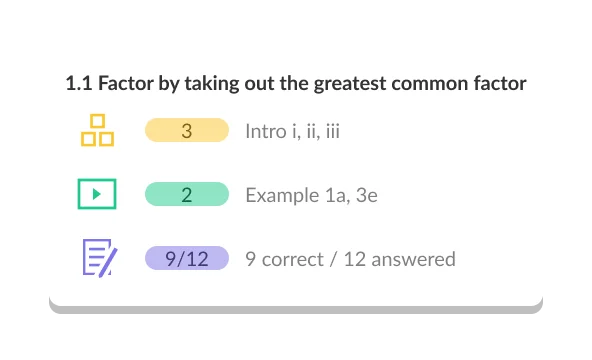
Practice until you truly get it.
Try It Now
Test your knowledge
Our approach aligns with the evidence
Exam Scores
Better Recall
Less Anxiety
Trigonometry Topics
1. Right Triangle Trigonometry
2. Trigonometric Ratios and Angle Measure
3. Bearings
4. Graphing Trigonometric Functions
5. Applications of Trigonometric Functions
6. Trigonometric Identities
7. Solving Trigonometric Equations
8. Inverse Trigonometric Functions
9. Imaginary and Complex Numbers
9 Chapters · 60 Topics · 284 Videos
Discover Our Learning Areas
Explore key subjects and start learning with interactive content.



What Is Year 12 Trigonometry?
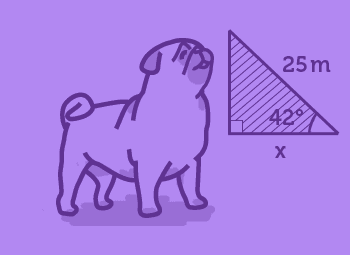
Year 12 Trigonometry is the study of the relationships between angles and the sides of triangles, extended into a broader framework of periodic functions, the unit circle, and mathematical proof. At senior level in Australia, trigonometry moves well beyond the right-angle basics of earlier years into radian measure, the full set of trigonometric functions and their graphs, identities, and multi-step equation solving — all of which are assessed in the ATAR across VCE, HSC, QCE, WACE, and SACE.
It is one of the most cross-cutting topics in senior maths: trig functions are differentiated and integrated in Maths Methods, applied to wave mechanics in physics, and used in vector analysis in Specialist Maths. Getting Year 12 trig right is not just about passing one topic — it underpins a significant portion of your entire senior maths experience.
What topics are covered in Year 12 Trigonometry?
Senior trig in Australia covers a well-defined set of concepts that build on each other progressively.
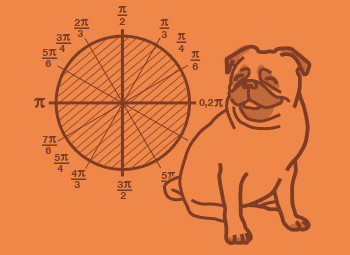
The unit circle is the foundation — understanding how angles map to coordinates on a circle of radius one, and why that gives sine and cosine their values for any angle, not just those in a right triangle. From there, students work with radian measure, converting between degrees and radians and understanding why radians are the natural unit for calculus applications.
Trigonometric graphs — amplitude, period, phase shift, and vertical shift for sine, cosine, and tangent — are a major component, requiring both sketching skills and the ability to read equations from a given graph. Trigonometric identities (Pythagorean, reciprocal, double angle, and compound angle) are used both to simplify expressions and to construct formal proofs.
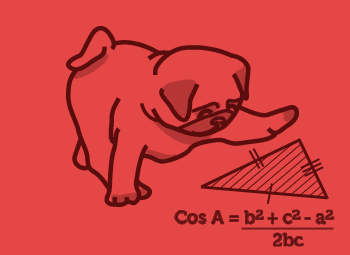
The sine rule and cosine rule extend trig into non-right triangles, with applications in geometry, navigation, and real-world problem solving. Finally, solving trig equations over a specified domain — finding all solutions, not just the principal value — is a skill tested heavily in ATAR written exams.
Is Year 12 Trigonometry harder than Year 11?
Yes — Year 12 trig is substantially more demanding. Year 11 typically focuses on consolidating right-angle trig, introducing the unit circle, and building fluency with trig ratios for standard angles. Year 12 extends this into proof-based work (trig identities), more complex equation solving, function transformations, and integration with calculus.
The key shift is that Year 12 trig rewards understanding over memorisation. Students who have memorised formulas without understanding where they come from often hit a wall when they are asked to prove an identity or solve a non-standard equation. The solution is to understand the method behind every formula — which is exactly what step-by-step video lessons are designed to build.
What are the most common mistakes students make in Year 12 Trigonometry?
Several mistakes appear repeatedly in ATAR assessments. First, mixing up radians and degrees — especially when calculators switch modes — leads to completely wrong answers that are hard to catch unless you estimate. Always check your calculator mode before starting a trig problem.
Second, when solving trig equations, students frequently find only the principal value and forget to identify all solutions in the specified domain. Using the ASTC (All Stations To Central) rule and a clear unit circle sketch prevents this.
Third, trig identity proofs trip students up because they try to work on both sides simultaneously or move terms across the equals sign — neither of which is valid in a formal proof. Work one side only, convert to sine and cosine early, and look for Pythagorean substitutions.
Finally, students often misidentify which rule to apply (sine rule vs cosine rule) in triangle problems. A quick decision tree: if you have two sides and the included angle, use the cosine rule; if you have two angles and a side (or two sides and a non-included angle), use the sine rule.
Why use StudyPug for Year 12 Trigonometry?
StudyPug is built specifically for students who need to understand the method, not just get an answer. Every trigonometry lesson is taught by a certified teacher — not generated by AI — who walks through each problem type step by step and explains the reasoning behind every move. That means when a similar question appears on your ATAR exam, you know how to approach it rather than hoping you memorised the right formula.
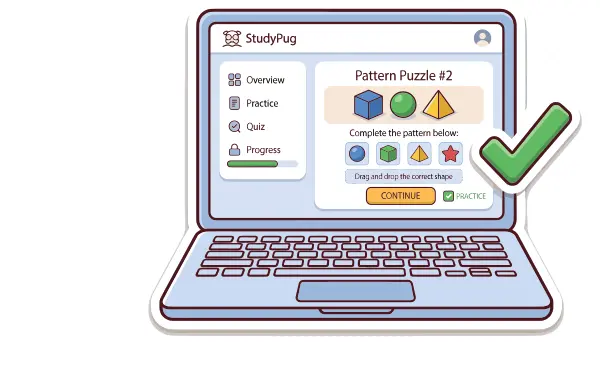
The platform begins with a diagnostic assessment that quickly identifies which trig topics are gaps and which are already solid — so you spend your limited study time where it will move your mark the most. As you work through practice problems, the adaptive practice system adjusts difficulty based on your performance, giving you harder problems when you are ready and reinforcing weaker areas without overwhelming you.
For Year 12 students in Australia, StudyPug lessons are aligned to the Australian curriculum and cover the specific content and question styles that appear in ATAR assessments across all states. Practice questions are based on real exam styles so the format never surprises you on the day.
You can start with free daily practice content right now — no subscription required — to test whether the approach works for you. A full subscription unlocks every video lesson, the diagnostic, adaptive practice, and complete ATAR-style practice tests, all backed by a 30-day money-back guarantee.
What you learn in Year 12 Trigonometry with StudyPug
StudyPug's Year 12 Trigonometry coverage includes every topic assessed in ATAR senior maths across Australian states:
- The unit circle — exact values, quadrant signs, and angle relationships
- Radian measure — conversion, arc length, and sector area
- Trigonometric functions — sine, cosine, tangent and their reciprocals
- Graphing trig functions — amplitude, period, phase shift, and transformations
- Pythagorean, reciprocal, and compound angle identities
- Double angle formulas and their applications
- Proving trigonometric identities — step-by-step strategy
- Solving trig equations over a domain — all solutions, not just principal values
- The sine rule — including the ambiguous case
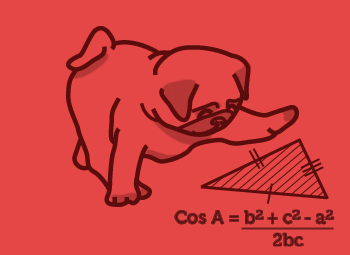
- The cosine rule — for sides and angles in non-right triangles
- Area of a triangle using the trig formula
- Applications: bearings, wave motion, and real-world geometry problems
Each topic has dedicated video lessons, worked examples, and practice problem sets that progress from foundational to exam-level difficulty.
Note: No validated internal topic-page links are available for this course at this time. You can browse all Trigonometry topics directly from the StudyPug Year 12 Trigonometry course page.
How to use StudyPug to improve your Year 12 Trigonometry results
The most effective approach is to start with the diagnostic. It takes only a few minutes and gives you a personalised map of which trig topics to tackle first — starting with your biggest gaps ensures every study session moves your grade rather than covering ground you already know.
From there, watch the video lesson for your target topic. Pause when the teacher sets up a worked example and try it yourself before watching the solution. This active approach — attempting the problem, then watching the method — is far more effective than passive viewing and directly mirrors what happens in a written exam.
After the video, complete the practice problem set for that topic. The adaptive system will adjust the difficulty as you work. Once you are scoring consistently well on individual topics, move to the ATAR-style practice tests that mix topics together — exactly as the real exam does.
For students with limited time before their ATAR exam, focus on: trig equation solving (high exam frequency), identity proofs (a consistent multi-mark question), and graph transformations (often tested in both short and extended response formats). Use Photo Search to snap a photo of any problem you are stuck on and find the matching lesson instantly — available for all grades and subjects on StudyPug.
Trigonometry FAQ
Unsure how StudyPug works? Need help with setting up? Check our frequently asked questions or contact us for help.
What do you learn in Year 12 Trigonometry, and what topics does it cover?
Year 12 Trigonometry builds on earlier maths to cover the unit circle, radian measure, trigonometric functions and their graphs, trigonometric identities, the sine rule, the cosine rule, and solving trigonometric equations. You also explore inverse trig functions and applications in real-world contexts such as bearings and wave motion. These topics form a core part of senior maths in Australia and appear across Maths Methods and Specialist Maths curricula, preparing you for both schoolwork and your ATAR assessments.
What is the difference between Trigonometry and Calculus in Year 12 maths?
Trigonometry is the study of relationships between angles and side lengths, using functions like sine, cosine, and tangent. Calculus, by contrast, deals with rates of change and areas under curves through differentiation and integration. In Year 12, the two subjects intersect — you will differentiate and integrate trigonometric functions in Maths Methods. Trigonometry provides the foundational functions that calculus then analyses. Students often find trig conceptually distinct but must be confident in it before tackling the calculus components of their senior maths course.
Is Year 12 Trigonometry hard, and where do students struggle most?
Year 12 Trigonometry is considered one of the more challenging senior maths topics because it requires solid algebraic fluency alongside a new visual and conceptual framework. Students most commonly struggle with the unit circle and understanding how angles relate to coordinates, proving trig identities (where the manipulation can feel open-ended), and solving trig equations over a specified domain. Confusion between radian and degree measure is also a frequent issue. Breaking each concept into method-by-method steps — rather than trying to memorise outcomes — is the most reliable way to build genuine understanding.
What should I know before Year 12 Trigonometry, and what comes after it?
Before Year 12 Trigonometry you should be comfortable with right-angle trigonometry (SOH CAH TOA), the Pythagorean theorem, basic angle geometry, and algebraic manipulation including factoring and fractions. Year 10 and 11 maths typically cover these prerequisites. After completing Year 12 trig, the natural progression is into differential calculus with trig functions, Fourier analysis, and university-level pure or applied mathematics. A strong trig foundation also supports physics, engineering, and economics at tertiary level.
Is Trigonometry tested in the ATAR, and how does it appear?
Yes — Trigonometry is a core component of the ATAR in all Australian states. In New South Wales (HSC), Victoria (VCE Maths Methods and Specialist), Queensland (QCE), Western Australia, and South Australia, trig questions appear in both the short-answer and multi-step sections of the written exam. Expect to prove identities, solve equations over a domain, sketch trig graphs, and apply the sine and cosine rules in context problems. ATAR exam questions frequently combine trig with calculus, so understanding the underlying method — not just the formula — is essential for full marks.
What is one of the hardest concepts in Trigonometry, and how do you approach it?
Proving trigonometric identities is consistently one of the hardest skills in Year 12 trig. Unlike solving an equation, a proof has no single algorithmic path — you must manipulate one side of the equation until it matches the other using known identities. The key approach is to start with the more complicated side, convert everything to sine and cosine where possible, look for Pythagorean identity substitutions, and avoid moving terms across the equals sign. Seeing multiple worked examples step by step — especially where the solver explains why each move is chosen — is the fastest way to develop this skill.




Written by the StudyPug Team
Last updated June 5, 2026
3 M+
students
★★★★★
4.8 average
K–12
all grades