GED Math Prep: Practice Tests & Video Solutions
Pinpoint your weak areas fast and get step-by-step solutions from certified teachers — built around how the GED Mathematical Reasoning test actually works.

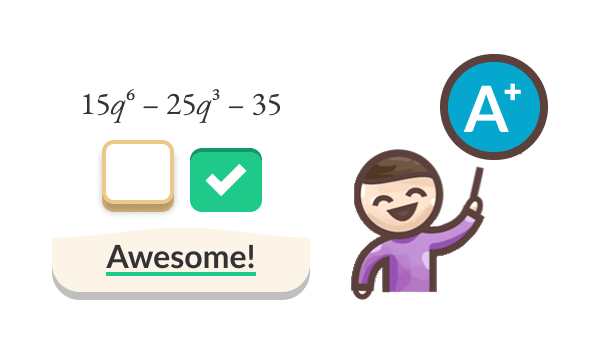
Step-by-Step Videos
Real teaching so you solve it yourself.
Unlimited Practice
Practice until it clicks, not quits.

Real Exam Practice
Practice real GED questions with no surprises.
Try It Now
Test your knowledge
Our approach aligns with the evidence
Exam Scores
Better Recall
Less Anxiety
GED Math Test Prep Topics
1. Understanding Integers
2. Adding and Subtracting Integers
3. Multiplying and Dividing Integers
4. Introduction to Variables and Expressions
5. Number Theory
6. Adding and Subtracting Fractions
7. Multiplying and Dividing Fractions
8. Operation with Decimals
9. Number System and Pattern
10. Ratios, Rates, and Proportions
11. Percents
12. Solving One- and Two- Step Equations
13. Solving Multi-Step Equations
14. Linear Inequalities
15. Pythagorean Theorem
16. Radicals
17. Exponents
18. Introduction to Relations and Functions
19. Linear Functions
20. Solving Linear Systems
21. Operations of Polynomials
22. Factoring Polynomials
23. Rational Expressions
24. Reciprocal Functions
25. Quadratic Functions
26. Solving Quadratic Equations
27. Symmetry and Surface Area
28. Scale Factors and Similarity
29. Angles, Lines, and Transversals
30. Properties of Triangles
31. Circles
32. Measuring Systems
33. Surface Area and Volume
34. Introduction to Probability
36 Chapters · 188 Topics · 1508 Videos
Discover Our Learning Areas
Explore key subjects and start learning with interactive content.








What Is the GED Math Test?
The GED Mathematical Reasoning test is the mathematics component of the General Educational Development (GED) qualification — a credential widely recognised in Australia as an equivalent to a high school certificate for employment, further education, and vocational training purposes. It is a single 115-minute computer-based test containing approximately 45 questions across two parts: a short no-calculator section (Part 1, 5 questions) and a longer calculator-permitted section (Part 2). Questions appear in multiple formats — multiple choice, fill-in-the-blank, drag-and-drop, and hot spot — designed to assess genuine mathematical reasoning rather than rote recall.
The test measures two broad capability areas: Quantitative Reasoning (number sense, geometry, data analysis, and statistics) and Algebraic Thinking (expressions, equations, inequalities, and functions). Because algebraic thinking carries the heaviest question weight, it is the single most important domain to strengthen during your GED Math preparation.
GED Math Format and Sections: Key Facts
Understanding the test structure before you start practising is one of the highest-leverage things you can do for your GED Math prep. Here is what you need to know:
Part 1 — No Calculator (5 questions): Tests mental arithmetic, estimation, and fluency with basic operations. Many students lose points here simply because they have not practised without a calculator recently. Fractions, percentages, and order of operations are the most common item types in this part.
Part 2 — Calculator Permitted (approximately 40 questions): Covers the full range of content domains. The TI-30XS Multiview calculator is built into the testing software; you do not need to bring your own. Knowing how to use this specific calculator efficiently can save you several minutes on test day.
Total time: 115 minutes. There is no scheduled break, but you can request one from the testing centre. Plan your pacing: roughly 2.5 minutes per question on average, though some items are faster.
How Is the GED Math Test Scored?
The GED Mathematical Reasoning test is scored on a scale of 100 to 200 points. There are three performance levels that matter:
- GED Passing Score (145+): The minimum to receive your GED credential. Demonstrates high-school-equivalent mathematical ability.
- GED College Ready (165–174): Signals to colleges and employers that you are ready for entry-level tertiary study without needing remedial coursework.
- GED College Ready + Credit (175+): May qualify you for college credit at participating institutions, effectively rewarding strong preparation with a head start on further education.
Scores are typically available in your MyGED account within 24 hours of completing the test. If you do not pass, you can retake the Mathematical Reasoning section independently — you do not need to resit all four GED subject tests. After two failed attempts, a 60-day waiting period applies before a third attempt.
What Content Areas Does the GED Math Test Cover?
The GED Mathematical Reasoning test draws from four content domains. Your prep should allocate time according to each domain's relative weight:
- Algebraic Thinking and Expressions (~45% of questions): Solving one- and two-variable equations and inequalities; linear and quadratic expressions; functions and their representations; word problems requiring algebraic translation.
- Number Sense and Operations (~25%): Whole numbers, integers, fractions, decimals, percentages, ratios, proportions, and scientific notation.
- Geometry (~20%): Area, perimeter, circumference, volume, surface area, coordinate geometry, and the Pythagorean theorem.
- Data Analysis, Statistics, and Probability (~10%): Interpreting graphs, tables, and charts; mean, median, mode; basic probability.
Given that algebraic thinking represents nearly half the test, candidates who can confidently solve multi-step equations and translate word problems into algebraic expressions have a significant advantage. That is where your GED Math study plan should begin.
What Is the Hardest Part of the GED Math Test?
Algebraic Thinking is consistently the section most candidates find hardest — particularly multi-step word problems that require setting up an equation from scratch, working with functions, and problems that blend algebra with geometry (such as finding the area of a shape using an algebraic expression). The no-calculator Part 1 is a secondary challenge because many adult learners have not practised mental arithmetic in years.
The most effective way to tackle these: do not just practise the steps — practise the reasoning. After every incorrect practice question, use a video solution to understand why the method works, not just what the answer is. This approach means you can handle similar questions presented differently on the real test.
Why StudyPug for GED Math Preparation?
StudyPug is built around one idea: most students do not need more content — they need to find their specific gaps and close them efficiently. For GED Math prep, that means three things working together.
A diagnostic that finds your weak spots first. Rather than starting at page one of a textbook, StudyPug's diagnostic assessment identifies exactly which GED Math topics are holding your score back. You then follow a targeted study path — spending your prep time on the areas that will move your score the most, not the ones you already know.
Certified-teacher video solutions that teach the method. Every GED Math topic on StudyPug has step-by-step video lessons delivered by certified teachers — not AI-generated content. These videos teach you how to approach a problem so that you can handle similar questions on test day, not just memorise a single worked example. That distinction matters on a test like the GED, where question formats vary considerably.
Unlimited practice tests with adaptive difficulty. Full-length GED Math practice tests based on real exam formats let you build test-day stamina and familiarity with question types. Retake topic quizzes as many times as you need — adaptive practice adjusts difficulty to your current level, keeping you challenged without overwhelming you. Progress tracking shows you exactly how far you have come and where to focus next.
StudyPug works on all devices — desktop, tablet, and mobile — so your GED Math prep fits around work, family, and life. Every subscription comes with a 30-day money-back guarantee, so there is no risk in starting today.
What You Will Learn: GED Math Topics Covered
StudyPug's GED Math preparation covers the full range of content domains tested on the Mathematical Reasoning section:
- Number Sense and Operations: Whole number arithmetic, integer operations, fractions and mixed numbers, decimals, percentages, ratios and proportions, scientific notation, and absolute value.
- Algebraic Thinking: Writing and simplifying algebraic expressions; solving one-step and multi-step equations; solving and graphing inequalities; systems of equations; linear and quadratic functions; factoring polynomials; function notation and interpretation.
- Geometry: Perimeter, area, and circumference of 2D shapes; surface area and volume of 3D solids; properties of triangles and quadrilaterals; the Pythagorean theorem; coordinate geometry including slope, distance, and midpoint.
- Data, Statistics, and Probability: Reading and interpreting bar graphs, line graphs, circle graphs, and scatterplots; calculating mean, median, mode, and range; basic probability concepts.
If you are also preparing for other standardised tests, StudyPug offers SAT prep for students pursuing US college admissions alongside their GED pathway.
How to Prepare for the GED Math Test: A Study Plan
A structured study plan makes the difference between going into the GED Math test feeling anxious and going in feeling ready. Here is a framework that works for most candidates:
Weeks 1–2: Diagnostic and foundation building. Start with StudyPug's diagnostic to find your weak areas. Use this to prioritise your topic list. Spend these first two weeks closing any Number Sense and Operations gaps — these are foundational for every other content domain and appear in Part 1 where you cannot use a calculator.
Weeks 3–6: Algebraic Thinking deep-dive. Since algebra carries the heaviest question weight, this is where the most study time pays off. Work through linear equations, inequalities, and functions using video lessons. After each topic, do the adaptive practice quizzes until you can answer similar questions consistently. Focus especially on translating word problems into algebraic expressions — this is the highest-frequency item type in the section.
Weeks 7–8: Geometry and Data Analysis. Cover area, volume, coordinate geometry, and data interpretation. These topics are more rule-based, which means targeted practice pays off quickly.
Weeks 9–10: Full-length practice tests and review. Take at least two full-length timed practice tests under exam conditions. Review every incorrect answer using the corresponding video solution — not to memorise the answer but to understand the reasoning. This is the phase where your score improvement tends to accelerate.
Week 11–12 (if time allows): Targeted re-practice. Use your practice-test results to identify any remaining weak areas and drill them with adaptive practice and quizzes. Then take one final timed practice test to confirm you are ready.
Consistency matters more than volume. Three focused 45-minute sessions per week will outperform an occasional four-hour cramming marathon. StudyPug's progress tracking keeps you accountable and lets you see your improvement week by week — which matters on a longer prep journey like the GED.
GED Math Test Prep FAQ
Unsure how StudyPug works? Need help with setting up? Check our frequently asked questions or contact us for help.
What does the GED Math test cover, and how is it structured?
The GED Mathematical Reasoning test is a single section lasting 115 minutes and contains approximately 45 questions. It covers two main content areas: Mathematical Reasoning (roughly 45% algebraic thinking) and Quantitative Reasoning (roughly 55% number sense, geometry, data, and statistics). The test is split into two parts — Part 1 (5 questions, no calculator) and Part 2 (the remainder, calculator permitted). Questions use multiple formats including multiple choice, fill-in-the-blank, drag-and-drop, and hot spot items.
How is the GED Math test scored, and what counts as a good score?
The GED Mathematical Reasoning test is scored on a scale of 100–200. A score of 145 or above is the passing mark (GED Passing Score). A score of 165–174 is considered GED College Ready, signalling you have the skills for college-level work without remediation. A score of 175 or above earns GED College Ready + Credit, potentially granting college credit. Aiming for 165+ gives you the strongest post-GED options. Scores are available online through your MyGED account within 24 hours of sitting the test.
What subjects and content areas are tested on the GED Math test?
GED Mathematical Reasoning tests across four main content domains: Number Sense and Operations (whole numbers, fractions, decimals, percentages, ratios); Algebraic Thinking and Expressions (equations, inequalities, functions, linear and quadratic expressions); Geometry (area, perimeter, volume, surface area, coordinate geometry, Pythagorean theorem); and Data, Statistics, and Probability (reading graphs and tables, mean, median, measures of central tendency). Algebraic thinking is the largest domain by question weight, making it the highest-priority area for your GED Math prep.
How should I prepare for the GED Math test, and how long does it take?
Most candidates need between 8 and 16 weeks of focused preparation, depending on their current maths level. A strong study plan starts with a diagnostic to identify weak areas, then works through targeted topic lessons before moving on to timed, full-length practice tests. Aim for at least three to four full practice sessions per week. In the final two weeks, shift to timed test simulation and review incorrect answers using video solutions to understand where your reasoning broke down. Consistent short daily sessions outperform infrequent long ones.
When should I take the GED Math test, and how do I register in Australia?
In Australia, the GED is administered by Pearson VUE at authorised testing centres. You can register at ged.com or through the MyGED portal. Tests are available year-round at most centres, subject to seat availability, so early booking is recommended — popular centres in Sydney, Melbourne, and Brisbane can fill up weeks in advance. There is no minimum age requirement in most states, but candidates must not be enrolled in a secondary school. Check ged.com for the latest Australian testing-centre list and current registration fees before booking.
What is the hardest part of the GED Math test, and how do I tackle it?
Most candidates find the Algebraic Thinking questions the most challenging, particularly solving multi-step equations, working with functions, and interpreting algebraic expressions in word-problem contexts. The no-calculator Part 1 also catches many students off guard. To tackle these: first, make sure you are solid on order of operations and linear equations before moving to quadratics. Practice translating word problems into algebraic expressions regularly — this is a high-frequency item type. Using video solutions to walk through each wrong answer (not just marking it incorrect) is the most effective way to close the gap.





Written by the StudyPug Team
Last updated June 5, 2026
3 M+
students
★★★★★
4.8 average
K–12
all grades