Year 8 Pre-Algebra Help — Step-by-Step Video Lessons & Practice
Help your child understand every pre-algebra topic and build confidence, one lesson at a time.

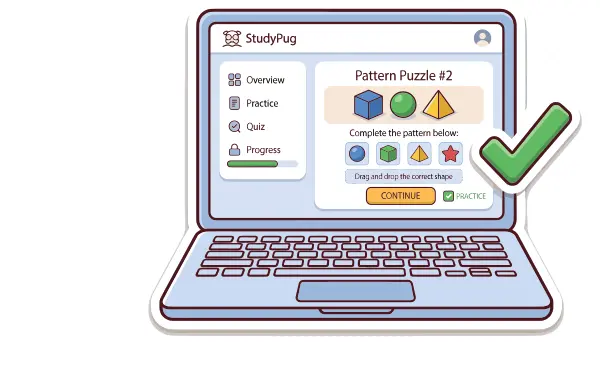
Value vs. Private Tutor
Expert lessons without the tutor price.
Multi-Subject
Switch plans anytime and master any subject.
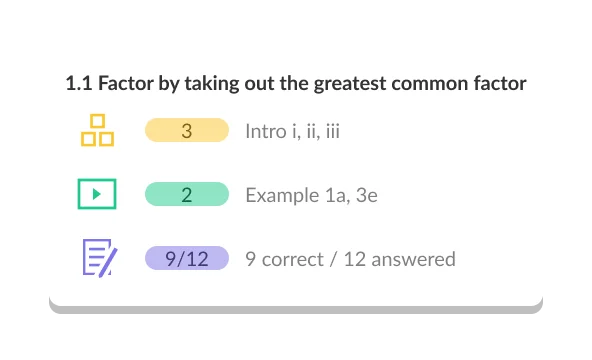
Unlimited Practice
Practice until it clicks not till class ends.
Try It Now
Test your knowledge
Our approach aligns with the evidence
Exam Scores
Better Recall
Less Anxiety
Pre-Algebra Topics
1. Integers
2. Factors and multiples
3. Decimals
4. Fractions
5. Ratios, rates, and proportions
6. Measuring Systems
7. Applying mathematical reasoning
8. Radicals
9. Exponents and Scientific Notation
10. Pythagorean Theorem
11. Surface Area of 3-Dimensional Shapes
12. Volume of 3-Dimensional Shapes
13. Function and Linear Relationships
14. Linear Equations
15. Linear Functions
16. Probability
17. Symmetry and Tessellations
18 Chapters · 77 Topics · 661 Videos
Discover Our Learning Areas
Explore key subjects and start learning with interactive content.












What Is Year 8 Pre-Algebra?
Year 8 pre-algebra is the bridge between the arithmetic your child learned in primary school and the formal algebra they will encounter in Years 9 and 10. It covers the core number and algebra strands of the Australian National Curriculum: working with integers and rational numbers, writing and solving equations, understanding ratios and proportions, and introducing linear relationships. These are not just abstract concepts — they underpin everyday problem-solving and lay the groundwork for every maths course your child will take through secondary school and beyond.
What Topics Does Year 8 Pre-Algebra Cover?
The Australian National Curriculum organises Year 8 maths into strands that form the backbone of pre-algebra. Your child will work through operations with positive and negative integers, fractions, and decimals; simplifying and evaluating algebraic expressions; solving one-step and two-step equations and inequalities; ratio, rate, and proportion; percentage calculations including discounts and increases; and an introduction to graphing linear relationships on the coordinate plane. Each of these topics builds directly on Year 7 content and feeds directly into the Year 9 algebra strand — so a strong Year 8 foundation genuinely matters.
Is Year 8 Pre-Algebra Hard? Common Struggle Points
For many students, Year 8 pre-algebra is the first time maths feels genuinely abstract. Instead of calculating a definite answer, they are suddenly asked to work with unknowns, balance both sides of an equation, and think logically about relationships between quantities. The most common struggle points are:
- Negative integers — especially subtracting a negative number or multiplying two negatives.
- Two-step equations — students often apply inverse operations in the wrong order.
- Setting up equations from word problems — translating a sentence into an algebraic expression is a skill that needs deliberate practice.
- Ratio and proportion — particularly identifying when two quantities are proportional and cross-multiplying correctly.
None of these struggles are permanent. With clear teaching of the method — not just the procedure — most students make strong progress within a few weeks of consistent, focused practice.
Why StudyPug for Year 8 Pre-Algebra?
StudyPug is built around what actually helps students improve: knowing where to start, understanding the method, and practising at the right level.
The diagnostic assessment takes just a few minutes and identifies exactly which pre-algebra topics your child has mastered and where the gaps are. This means no wasted time reviewing things they already know — and no skipping past the concepts causing the most trouble.
Every lesson is delivered by a certified teacher in a step-by-step video. These are not AI-generated explanations — they are real teachers who show the working, explain the reasoning, and anticipate the mistakes students commonly make. The goal is always that your child can watch a lesson and then solve a similar problem independently, not just copy the steps.
After each lesson, adaptive practice adjusts question difficulty to your child's current level — building genuine confidence rather than moving too fast or repeating easy problems that offer no challenge. Over time, the system tracks progress across every topic so you can see clearly where your child is improving.
For families with more than one child at school, the Family Plan covers up to 5 children at one price across all year levels and all subjects — genuine value compared to a private tutor for even one child.
What Your Child Will Learn in Year 8 Pre-Algebra
StudyPug's Year 8 pre-algebra course covers every major topic in the Australian National Curriculum's Number and Algebra strands for Year 8. Core areas include:
- Integer and rational number operations
- Algebraic expressions — simplifying, expanding, and evaluating
- Solving one-step and two-step equations and inequalities
- Ratio, rate, and proportion
- Percentages, including applications such as discounts, mark-ups, and interest
- Introduction to linear relationships and graphing
Because this page's topic URLs are not yet in the validated sitemap index, we have not linked to individual topic pages here — but all of the above topics are available in full inside the course. Use the Browse Topics button above to see the complete list.
Using StudyPug for Year 8 Pre-Algebra: A Practical Guide
Getting started is straightforward. After signing up, your child takes the diagnostic assessment — a short, adaptive quiz that maps their current understanding across the Year 8 pre-algebra syllabus. The results tell you immediately which topics to prioritise.
From there, a typical StudyPug session looks like this: watch the certified-teacher video for the topic (usually 5–15 minutes), then move into the adaptive practice questions. If your child gets stuck on a question, they can access the worked solution and rewatch the relevant part of the video. Sessions of 20–30 minutes most days are more effective than longer, infrequent study blocks.
As a parent, you can check the parent dashboard at any time to see which topics have been covered, how your child is performing in practice, and where they may need encouragement or a different approach.
Free daily practice content is available without a subscription, so you can try StudyPug's practice questions before committing. If you subscribe and are not satisfied within the first 30 days, StudyPug's money-back guarantee means you receive a full refund — no questions asked. There is no lock-in contract, and you can cancel anytime.
For Year 8 students preparing for school assessments, StudyPug's practice questions are based on real exam-style problems, giving your child the best chance of feeling confident and well-prepared when it matters most.
Pre-Algebra FAQ
Unsure how StudyPug works? Need help with setting up? Check our frequently asked questions or contact us for help.
What does my child learn in Year 8 pre-algebra, and what topics does it cover?
Year 8 pre-algebra builds the maths foundations your child will need for algebra and beyond. Key topics include operations with integers and rational numbers, solving one- and two-step equations and inequalities, ratio, rate and proportion, percentages, introduction to linear relationships, and basic graphing on the coordinate plane. The Australian National Curriculum frames these as essential number and algebra strands, preparing students for the more abstract algebra work in Years 9 and 10.
Is Year 8 pre-algebra hard, and where do students commonly struggle?
Year 8 pre-algebra is a significant step up from primary maths because students move from concrete arithmetic to abstract thinking. The most common struggle points are working with negative integers, understanding how variables work in equations, and setting up ratio and proportion problems from word problems. Students who haven't fully consolidated their fraction skills in Year 7 often find pre-algebra more difficult. The good news is that these gaps are highly fixable with targeted practice and clear explanation of the underlying method.
What should my child know before Year 8 pre-algebra, and what comes next?
Before starting Year 8 pre-algebra, your child should be comfortable with fractions, decimals, percentages, and basic order of operations from Year 7. A solid understanding of number facts and basic equation balancing also helps. After pre-algebra, students move into formal algebra in Year 9 — covering linear equations, simultaneous equations, and quadratic expressions — and then into more advanced functions and trigonometry in Year 10 and beyond.
How does StudyPug pre-algebra map to what my child learns at school?
StudyPug's pre-algebra course is aligned to the Australian National Curriculum for Year 8 maths, covering the Number and Algebra strands that Australian schools follow. Lessons are sequenced to match the way topics are typically taught in Australian classrooms, so your child can use StudyPug alongside their school work and textbooks. Whether their school uses a state-based scope and sequence or a commercial curriculum, the core content coverage is consistent with what Year 8 students are assessed on.
What is one of the trickiest pre-algebra concepts at Year 8, and how is it taught?
One of the trickiest concepts is solving two-step equations — for example, solving 3x + 7 = 22. Many students make errors because they don't apply inverse operations in the correct order. StudyPug's certified-teacher video lessons break the process into clear steps: identify what is being done to the variable, apply the inverse operation to both sides, and check the answer by substituting back. The lesson then moves straight into adaptive practice so your child can immediately try similar problems with instant feedback.
How much maths practice should my child do at Year 8?
For Year 8 students, a consistent routine of 20 to 30 minutes of focused maths practice most days is more effective than long, infrequent sessions. StudyPug's adaptive practice adjusts the difficulty to your child's current level, so each session is productive rather than repetitive. Free daily practice content is available without a subscription, making it easy to build a steady habit. StudyPug's diagnostic assessment can also help identify which topics deserve the most attention so practice time is used efficiently.





Written by the StudyPug Team
Last updated June 5, 2026
3 M+
students
★★★★★
4.8 average
K–12
all grades