A-Level Trigonometry Help — Video Lessons & Practice
Get clear, step-by-step explanations for every trig topic and build exam-ready confidence for your A-Level.
Value vs. Private Tutor
Get expert help without the price tag.

Multi-Subject
One subscription covers all math help.
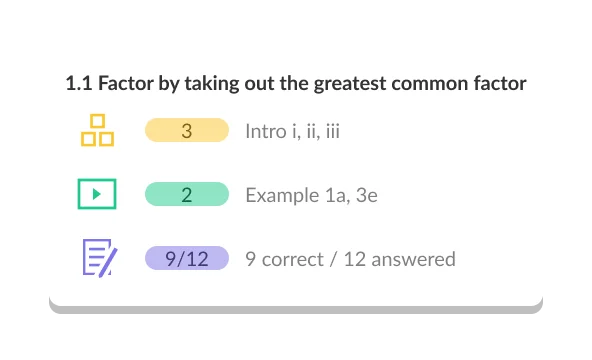
Practice Until Perfect
Keep practicing until it truly clicks.
Try It Now
Test your knowledge
Our approach aligns with the evidence
Exam Scores
Better Recall
Less Anxiety
Trigonometry Topics
1. Right Triangle Trigonometry
2. Trigonometric Ratios and Angle Measure
3. Bearings
4. Graphing Trigonometric Functions
5. Applications of Trigonometric Functions
6. Trigonometric Identities
7. Solving Trigonometric Equations
8. Inverse Trigonometric Functions
9. Imaginary and Complex Numbers
9 Chapters · 60 Topics · 284 Videos
Discover Our Learning Areas
Explore key subjects and start learning with interactive content.





What is A-Level Trigonometry?
A-Level Trigonometry is the study of the relationships between angles and lengths in triangles and, at this level, the behaviour of trigonometric functions across the full number line. It is a core unit in A-Level Maths, taught in Year 12 and extended in Year 13, and it underpins a significant portion of the Pure Mathematics papers. In practical terms, trigonometry answers questions like: given an angle, what are the coordinates of a point on a circle? How do periodic patterns in nature — from sound waves to seasonal cycles — get described mathematically? Understanding trig is not just about passing your exams; it is foundational for anyone going on to study physics, engineering, computer science or any mathematics-heavy degree.
What topics are covered in A-Level Trigonometry?
The A-Level Maths trig syllabus — across AQA, Edexcel and OCR — covers the following core areas:
Radian measure. Moving from degrees to radians is the first major shift from GCSE. You will learn to convert between the two, calculate arc length and sector area using radians, and work fluently in radians throughout the rest of the trig unit.
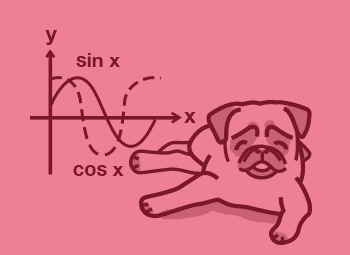
Trig functions and their graphs. You will study the graphs of sin, cos and tan — including their periodicity, amplitude and transformations (shifts, stretches, reflections). Recognising how a graph changes when you write y = 2sin(3x + π/4) is a testable skill.
Exact trig values. You need to recall and use the exact values for sin, cos and tan at 0°, 30°, 45°, 60° and 90° (or their radian equivalents) without a calculator.
Trig identities. The Pythagorean identity (sin²x + cos²x = 1) and its rearrangements, plus tanx = sinx/cosx, form the toolkit you use to simplify and prove expressions.
Addition and double-angle formulae. These extend the identity toolkit to expressions like sin(A + B) and cos(2A), which appear in both proof questions and integration problems.
Reciprocal trig functions. Cosecant (csc), secant (sec) and cotangent (cot) are introduced at A-Level, along with their graphs, identities and use in solving equations.
Solving trig equations. You will solve equations such as 2sin(2x) = √3 for x in a specified interval, requiring you to find all valid solutions using the unit circle or CAST diagram.
Is A-Level Trigonometry hard — and where do students struggle most?
Most students find A-Level trig notably harder than anything they encountered at GCSE, and that reaction is entirely normal. The difficulty is not random — it clusters around a few specific skills.
Working in radians. After years of thinking in degrees, switching to radians feels unnatural. Students frequently mix up the two in multi-step problems, which cascades into wrong answers even when the method is correct.
Proving trig identities. Identity proofs are unlike most maths questions because you are not solving for a number — you are showing that two expressions are equivalent. There is no single algorithm; it requires pattern recognition and comfort with algebraic manipulation. Students who have not practised this extensively find it very difficult under exam conditions.
Finding all solutions in a given interval. When solving a trig equation, it is common to find one solution and miss the others. A-Level mark schemes require all valid solutions, and a systematic approach — using the CAST diagram or the unit circle — is essential.
Connecting trig to calculus. In Year 13, trig and calculus overlap heavily. Differentiating sin(3x + 2) or integrating cos²x using a double-angle formula trips up students who have not fully internalised the trig identities.
The consistent pattern among students who improve their trig grades is that they do not just read worked examples — they watch the method being applied to a fresh problem, then immediately attempt a similar one themselves. That cycle of observe → attempt → check is what StudyPug's lesson structure is built around.
Why StudyPug for A-Level Trigonometry?
There is no shortage of A-Level Maths resources, so it is worth being clear about what makes StudyPug different for trig specifically.
The diagnostic assessment takes the guesswork out of revision. Rather than working through every trig topic from the beginning, StudyPug's diagnostic identifies exactly which areas are causing you to drop marks. For a subject as broad as A-Level trig — where you might be solid on radian measure but weak on double-angle formulae — this is genuinely useful. You stop wasting revision time and start working on what will actually move your grade.
Certified-teacher videos teach the method, not just the answer. Every video on StudyPug is made by a certified teacher, not generated by AI. The lessons are built around exam technique: you see a teacher think through a problem from scratch, verbalise the decision points, and arrive at a solution using a method you can replicate. For trig identity proofs in particular — where the path is not obvious — watching an expert reason through the problem is far more valuable than reading a completed proof.
Adaptive practice adjusts as you improve. Once you have watched a lesson, the practice questions adapt to your performance. If you are consistently getting radian-conversion questions right, the system moves you on to harder material. If you are dropping marks on double-angle problems, it gives you more exposure there. This keeps your practice time efficient.
Content is aligned to the UK A-Level Maths specification. StudyPug's trig lessons are mapped to AQA, Edexcel and OCR. You are not working through generic maths content — you are covering the exact topics and techniques your exam board tests.
The free practice content is a genuine entry point. You can access free trig practice problems without a subscription. There is no pressure and no commitment required to get started. If you choose to subscribe, every plan comes with a 30-day money-back guarantee — so there is no financial risk.
What you learn — A-Level Trigonometry curriculum coverage
StudyPug's A-Level Trigonometry content covers the full UK specification, organised into clear topic areas so you can navigate directly to what you need:
- Radian measure: converting between degrees and radians, arc length, sector area
- Graphs of trig functions: sin, cos, tan — periodicity, amplitude, transformations
- Exact trig values and the unit circle
- Trig identities: Pythagorean identity, tanx = sinx/cosx and their applications
- Addition formulae: sin(A ± B), cos(A ± B), tan(A ± B)
- Double-angle formulae and their use in simplification and integration
- Reciprocal trig functions: cosecant, secant, cotangent — graphs, identities, equations
- Solving trig equations over specified intervals
- Trig in calculus: differentiating and integrating trig functions (Year 13)
Every topic has at least one video lesson, a set of practice problems and worked solutions. The curriculum map is updated to reflect the current A-Level Maths specifications.
Note: no validated internal topic-page links are available for this course in the current sitemap — links will be added once the topic pages are confirmed live.
How to use StudyPug for A-Level Trigonometry
Step 1 — Run the diagnostic. Start with the A-Level Maths diagnostic assessment. It takes around 15 minutes and gives you a clear picture of which trig topics you have solid foundations in and which need work. Use those results to build your revision plan rather than starting from the beginning of every topic.
Step 2 — Watch the lesson video for your target topic. Go to the topic you need — for example, double-angle formulae or solving trig equations — and watch the certified-teacher lesson. Pay attention to the method and the decision points, not just the final answer. Pause and rewind freely; that is one of the main advantages over a classroom setting.
Step 3 — Attempt the practice problems immediately. Do not wait until the night before your exam. The retention benefit of practising immediately after watching a lesson is significant. The adaptive practice system will give you problems at the right level and adjust as your accuracy improves.
Step 4 — Use exam-style questions to consolidate. Once you feel confident on a topic, work through the exam-style practice questions. These are based on real A-Level exam formats and will help you build the speed and accuracy the mark scheme rewards. Pay particular attention to showing your working clearly — A-Level trig questions award method marks, so a structured response is always worth more than a rushed one.
Step 5 — Return to weak areas using Photo Search. If you get a trig problem wrong in a mock exam or past paper, you can use StudyPug's Photo Search feature — available across all subjects and grades — to find the matching lesson. Take a photo of the problem type and it will locate the relevant lesson so you can address that specific gap immediately.
Consistent, targeted practice over several weeks is far more effective than a cramming session the week before your papers. StudyPug is designed to support that sustained approach — with the diagnostic, the adaptive practice, and the complete topic library available whenever you need them.
Trigonometry FAQ
Unsure how StudyPug works? Need help with setting up? Check our frequently asked questions or contact us for help.
What do you learn in A-Level Trigonometry, and what topics does it cover?
A-Level Trigonometry covers a broad range of topics built on GCSE foundations. You will study radian measure, arc length and sector area, the graphs and transformations of sine, cosine and tangent functions, exact trig values, trig identities including the Pythagorean identities, double-angle and addition formulae, and solving trig equations within given intervals. At A-Level you also encounter the reciprocal trig functions — cosecant, secant and cotangent — and their graphs. These topics appear throughout both Year 12 and Year 13 content and are tested in multiple papers.
What is the difference between A-Level Trigonometry and GCSE Trigonometry?
GCSE Trigonometry focuses on right-angled triangles using SOHCAHTOA and basic applications of the sine and cosine rules. A-Level Trigonometry goes significantly further. You move from degree measure into radians, study the full graphs of trig functions and their transformations, learn to prove and apply a range of identities, and solve more complex equations. The algebra involved is more demanding, and you are expected to work with abstract functions rather than just concrete triangles. If GCSE trig felt manageable, the A-Level step up is notable but very achievable with the right support.
Is A-Level Trigonometry hard, and where do students struggle most?
Trigonometry is widely regarded as one of the more challenging units in A-Level Maths. Students most commonly struggle with switching fluently between degrees and radians, applying double-angle and addition formulae correctly under exam pressure, and proving trig identities — which requires working backwards from an unfamiliar expression without a clear path. Another common difficulty is solving equations over a specified interval and finding all valid solutions without missing any. The good news is that these are all learnable skills — they respond well to seeing the method worked out clearly, step by step, before practising independently.
What should I know before A-Level Trigonometry, and what comes after it?
You should be confident with GCSE trigonometry — SOHCAHTOA, the sine and cosine rules, and basic graphs — before starting A-Level trig content. A solid foundation in algebra, including rearranging equations and working with fractions, is also essential. Within A-Level Maths, trigonometry feeds directly into calculus: you will integrate and differentiate trig functions in Year 12 and Year 13, and trig identities appear frequently in further integration. If you progress to Further Maths, trigonometry is foundational for complex numbers, hyperbolic functions and further calculus topics.
Is Trigonometry tested on the A-Level Maths exam, and how does it appear?
Yes — trigonometry is a core component of the A-Level Maths specification across all major UK awarding bodies including AQA, Edexcel and OCR. It appears in both the Pure Mathematics papers taken in Year 13. Questions can require you to prove identities, solve trig equations over a given domain, work with radian measure, or apply trig within calculus problems. A-Level trig questions are often multi-step and require showing clear working. Practising with exam-style questions throughout your course — not just before the exam — is one of the best ways to build the speed and accuracy the mark scheme rewards.
What is one of the hardest concepts in A-Level Trigonometry, and how do you tackle it?
Proving trigonometric identities is consistently one of the hardest skills for A-Level students. Unlike equations, you are not solving for a value — you must manipulate one side of an expression until it matches the other, with no guarantee that the path is obvious. The key strategies are: start from the more complex side, convert everything to sine and cosine where possible, look for opportunities to use the Pythagorean identity sin²x + cos²x = 1, and never move terms across the equals sign. Seeing a teacher work through several proofs from scratch — rather than just reading a finished version — is the fastest way to internalise the approach.





Written by the StudyPug Team
Last updated June 5, 2026
3 M+
students
★★★★★
4.8 average
K–12
all grades