AP Calculus AB Help — Video Lessons & Practice
Get clear, step-by-step explanations for every AP Calculus AB topic and build exam-ready confidence.
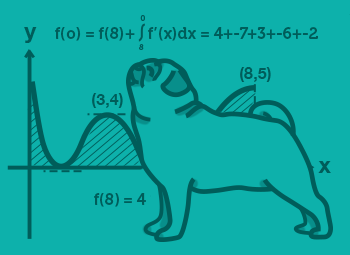
Step-by-Step Video Lessons
Real teaching helps you solve problems alone.
Unlimited Practice
Practice until it truly sticks.
Real Exam Practice
Practice real AP exam questions in your plan.
Try It Now
Test your knowledge
Our approach aligns with the evidence
Exam Scores
Better Recall
Less Anxiety
AP Calculus AB Topics
1. Limits & Continuity
2. Derivatives
3. Derivative Applications
4. Integrals
5. Integration techniques
6. Integral Applications
7 Chapters · 44 Topics · 313 Videos
Discover Our Learning Areas
Explore key subjects and start learning with interactive content.






What is AP Calculus AB?
AP Calculus AB is a College Board Advanced Placement course and exam that introduces students to the fundamental ideas of single-variable calculus. It is designed to be equivalent to a first-semester university calculus course and covers three major pillars: limits and continuity, differential calculus (derivatives), and integral calculus. Students who score well on the AP Calculus AB exam — typically a 3 or higher — can earn university credit at institutions in the UK, the US, and internationally, allowing them to skip introductory maths modules at degree level.
What topics are covered in AP Calculus AB?
The AP Calculus AB curriculum is organised into eight units by the College Board. You begin with limits and continuity — understanding how functions behave as inputs approach a value and identifying where functions are continuous. From there you move into differentiation, covering the power rule, product rule, quotient rule, chain rule, and implicit differentiation. Applications of derivatives follow: related rates, curve sketching using the first and second derivative tests, and optimisation problems. The second half of the course focuses on integration: Riemann sums, definite and indefinite integrals, the Fundamental Theorem of Calculus, and integration techniques including substitution. The course closes with differential equations (slope fields and basic separable equations) and applications of integration such as area between curves and accumulation problems. Every unit appears in both the multiple-choice and free-response sections of the AP exam.
Is AP Calculus AB difficult, and how do students typically find it?
AP Calculus AB has a reputation as one of the most challenging AP courses, but difficulty is closely tied to preparation. Students who arrive with strong Pre-Calculus skills — solid function notation, trigonometric identities, and algebraic fluency — find the transition manageable. Those who struggle most usually have gaps in prerequisite algebra rather than a fundamental problem with calculus concepts.
The topics students report finding hardest are related rates, implicit differentiation, and applying the Fundamental Theorem of Calculus in both its forms. Related rates problems require building a dynamic equation from a word problem and then differentiating with respect to time — a two-step process that trips up many students who try to shortcut the set-up. The free-response section of the AP exam is also where many otherwise well-prepared students drop marks, because it rewards complete, clearly written working rather than just a final answer.
The good news is that calculus rewards consistent, incremental practice more than natural talent. Working through problems daily — even for 20 to 30 minutes — builds the pattern recognition that makes AP-level questions feel routine.
What comes before and after AP Calculus AB?
Before starting AP Calculus AB you should be confident with Pre-Calculus content: functions and their graphs, polynomial and rational expressions, exponential and logarithmic functions, and trigonometry (unit circle, identities, inverse trig). Many schools require or recommend Pre-Calculus as a formal prerequisite. If your algebra skills are weak, spending time strengthening them before the course begins pays dividends throughout the year.
After AP Calculus AB, the natural next step is AP Calculus BC, which extends the AB syllabus to include parametric and polar functions, sequences and series (including Taylor series), and additional integration techniques. At university, students who have completed AB-level content typically continue into multivariable calculus, differential equations, and linear algebra. A strong AP score can also allow direct entry into more advanced degree-level modules, saving time and tuition fees.
Why StudyPug for AP Calculus AB help?
StudyPug is built around one idea: understanding the method, not memorising the answer. Every AP Calculus AB lesson is taught by a certified teacher who walks through the reasoning step by step — showing you not just what to write but why each step follows from the last. This matters in AP Calculus because the exam's free-response section allocates partial credit based on method, so a student who understands the process recovers marks even when arithmetic slips.
The diagnostic assessment identifies your weakest topics before you spend time on material you already know. Rather than working through every unit from the start, you get a prioritised study plan that targets your actual gaps — whether that is the chain rule, related rates, or definite integrals. This is studying smarter, not harder.
Adaptive practice adjusts problem difficulty in real time based on your performance. If you are getting integration-by-substitution questions right, the system moves you to harder composite functions. If you are struggling with curve-sketching, it keeps you there until the concept is solid. Progress is visible and measurable at every session.
AP exam preparation is built into the subscription — no extra fee. You practise with exam-style questions modelled on the AP Calculus AB format, including both multiple-choice and free-response question types, so nothing on exam day feels unfamiliar. And because every lesson is available on demand, you can rewatch the chain rule explanation at midnight before a mock exam as many times as you need.
What you learn — AP Calculus AB curriculum coverage
StudyPug's AP Calculus AB content is aligned to the College Board curriculum framework. The video lesson library covers all eight AP units, including every major differentiation and integration technique, application topics, and differential equations. Key areas include:
- Limits and continuity — one-sided limits, infinite limits, squeeze theorem, continuity at a point, and the Intermediate Value Theorem.
- Differentiation — all core rules (power, product, quotient, chain), implicit differentiation, derivatives of trigonometric, exponential, and logarithmic functions, and higher-order derivatives.
- Applications of derivatives — related rates, linear approximation, mean value theorem, critical points, first and second derivative tests, curve sketching, and optimisation.
- Integration — Riemann sums, definite and indefinite integrals, Fundamental Theorem of Calculus (both parts), and integration by substitution.
- Differential equations — slope fields, Euler's method, and separable differential equations.
- Applications of integration — area between curves, average value of a function, accumulation functions, and particle motion problems.
Because this page's internal link map does not currently list validated topic URLs for this course, no topic-level links are placed here. Your topic list is accessible directly from the AP Calculus AB course page on StudyPug.
How to use StudyPug for AP Calculus AB
The most effective way to use StudyPug for AP Calculus AB is to let the diagnostic lead. Take the short assessment at the start — it takes around ten minutes and produces a clear picture of where to begin. From there, follow the recommended lesson sequence rather than jumping around: calculus is cumulative, and gaps in differentiation will follow you into integration if left unaddressed.
For each topic, watch the certified-teacher video first with the goal of understanding the method. Then move to the practice problems and attempt them before looking at the worked solution — this active retrieval step is what makes the concept stick. If you get a problem wrong, rewatch the relevant video section rather than simply reading the solution; hearing the reasoning explained again in context builds deeper understanding than scanning text.
In the weeks before your AP Calculus AB exam, use StudyPug's AP-style practice questions to simulate exam conditions. Time yourself on free-response sets, write your working clearly, and then compare your method to the model answer step by step. This habit of reviewing the method — not just the final answer — is what separates students who score 4s and 5s from those who stall at 3.
StudyPug is available on any device, so you can keep a lesson open on your phone during a study period or load a practice set on a tablet during a commute. There is no fixed schedule — your revision fits around school, not the other way around. And with the 30-day money-back guarantee, there is no risk in getting started today.
AP Calculus AB FAQ
Unsure how StudyPug works? Need help with setting up? Check our frequently asked questions or contact us for help.
What do you learn in AP Calculus AB, and what topics does it cover?
AP Calculus AB covers the foundational concepts of single-variable calculus. You study limits and continuity, differentiation (including the chain rule, product rule, and implicit differentiation), applications of derivatives such as curve sketching and optimisation, integration using the Fundamental Theorem of Calculus, and basic differential equations. The course is equivalent to a first-semester university calculus course and is assessed through both a multiple-choice and a free-response section on the AP exam.
What is the difference between AP Calculus AB and AP Calculus BC?
AP Calculus AB covers roughly one semester of university calculus, focusing on limits, derivatives, and integrals. AP Calculus BC covers all the AB content plus additional topics such as parametric equations, polar coordinates, sequences and series, and more advanced integration techniques — equivalent to two semesters of university maths. Most students take AB first. If you are strong in AB material and want to go deeper, BC is the natural progression. Both exams award university credit upon a qualifying score.
Is AP Calculus AB hard, and where do students struggle most?
AP Calculus AB is considered one of the more demanding AP courses. Students most commonly struggle with related rates problems, implicit differentiation, and applying the Fundamental Theorem of Calculus correctly in both directions. Many students also find interpreting free-response questions difficult under exam conditions. The key is understanding the underlying concepts, not just memorising formulas — so building fluency with limits and derivatives early makes later topics far more manageable.
What should I study before AP Calculus AB, and what comes after it?
You should be comfortable with Pre-Calculus before starting AP Calculus AB — particularly functions, trigonometry, exponential and logarithmic expressions, and algebraic manipulation. A solid foundation in algebra is essential. After AP Calculus AB, students typically progress to AP Calculus BC or, at university level, multivariable calculus and linear algebra. A strong AB result can also earn university credit, letting you skip straight to higher-level maths courses.
Is AP Calculus AB on the AP exam, and how is it tested?
Yes. The AP Calculus AB exam is a three-hour, 15-minute exam set by the College Board. Section 1 is multiple choice (45 questions, 105 minutes — split into a no-calculator and a calculator-permitted part). Section 2 is free response (6 questions, 90 minutes — again split by calculator use). The exam is scored 1–5; a score of 3 or above is generally accepted for university credit in the UK and internationally. The free-response section rewards clear, step-by-step working.
What is one of the hardest concepts in AP Calculus AB, and how do you tackle it?
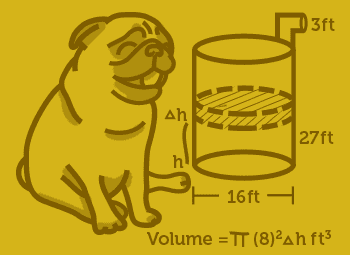
Related rates is consistently one of the toughest topics. The challenge is translating a word problem into a differentiable equation that connects two changing quantities, then applying implicit differentiation with respect to time. The best approach is a four-step method: draw and label the situation, write the relationship equation, differentiate implicitly with respect to time, and substitute known values last. Practising a variety of related-rates scenarios — cones, ladders, shadows — builds the pattern recognition you need under exam pressure.





Written by the StudyPug Team
Last updated June 5, 2026
3 M+
students
★★★★★
4.8 average
K–12
all grades