Year 4 Maths Help — Step-by-Step Video Lessons & Practice
Help your child understand every topic and build confidence, one lesson at a time.
Step-by-Step Video Lessons
Watch a real lesson then solve the next one.
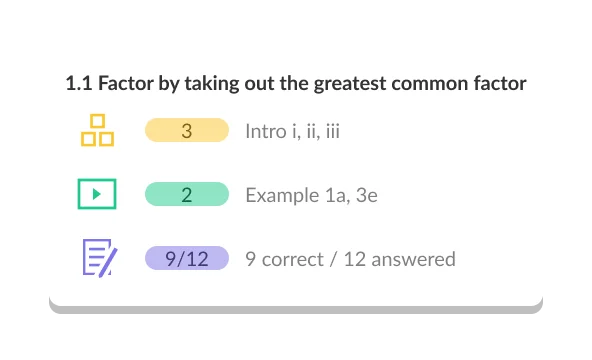
Practice Until Perfect
Practice until it clicks not until time ends.
Real Exam Practice
Practice real exam questions to walk in ready.
Try It Now
Test your knowledge
Our approach aligns with the evidence
Exam Scores
Better Recall
Less Anxiety
Year 4 Maths Topics
1. Fractions
2. Introduction to Decimals
3. Adding and Subtracting Numbers
4. Multiplying and Dividing Numbers
5. Place Value
6. Patterns
7. Angles and Lines
8. 2D Shapes and Planes
9. 3D Shapes
10. Perimeter and Area
12. Time
13. Organizing Data
14 Chapters · 76 Topics · 1224 Videos

Ready to practice Year 4 Maths?
Try practice questions on every Year 4 Maths topic — with instant feedback and step-by-step video solutions when you get stuck.
Discover Our Learning Areas
Explore key subjects and start learning with interactive content.








What is Year 4 Maths?
Year 4 Maths is the fourth year of primary school mathematics in New Zealand, typically for children aged eight to nine. At this stage, children extend their number skills significantly — moving from basic addition and subtraction into confident multiplication and division, a deeper understanding of fractions, and working with numbers up to 10,000 and beyond. The New Zealand National Curriculum organises Year 4 Maths across five strands: Number and Algebra, Geometry and Spatial Sense, Measurement, and Statistics. Together these build the quantitative reasoning and problem-solving skills children will use throughout secondary school and daily life.
What topics are covered in Year 4 Maths in New Zealand?
Year 4 Maths in New Zealand is rich and varied. Here is what your child is working on across the school year:
Number and Algebra: Multiplication and division facts to 10×10 (times tables), place value to at least 10,000, addition and subtraction with larger numbers, introduction to unit fractions and simple decimals, and basic number patterns.
Geometry: Properties of 2D and 3D shapes, lines of symmetry, half and quarter turns, and simple coordinate grids.
Measurement: Length, perimeter, area, volume, mass, and time — including conversions between common units and reading analogue and digital clocks.
Statistics: Collecting, organising, and interpreting data using tally charts, bar graphs, and pictographs; describing likelihood using everyday language.
Each of these strands builds directly on Year 3 learning and feeds into the more formal mathematical reasoning expected in Year 5 and Year 6.
Why do children find Year 4 Maths challenging?
Year 4 is often described by New Zealand teachers as a pivotal year in maths. Several factors combine to make it harder than earlier years:
Times tables pressure: By Year 4, children are expected to know all multiplication facts to 10×10 with fluency. This is a significant memorisation load, and gaps here slow down almost every other area of maths.
Fractions: Moving from halves and quarters to unit fractions like one-fifth or one-eighth requires a conceptual shift. Many children mistakenly assume a larger denominator means a larger fraction.
Place value with large numbers: Reading, writing, and comparing numbers in the thousands and ten-thousands is abstract for many eight- and nine-year-olds.
Word problems: Year 4 word problems require children to decode text, identify the correct operation, and carry out the calculation — combining literacy and numeracy in ways that can overwhelm children who are strong in one but not the other.
The good news is that these challenges are very well understood, and targeted practice with clear explanations resolves them quickly. If your child is hitting a wall in one of these areas, a short diagnostic and some focused work usually produces visible improvement within a few weeks.
Why StudyPug for Year 4 Maths?
StudyPug is built around the way children actually learn maths — through clear teaching, repeated practice at the right level, and immediate feedback. Here is what makes it particularly effective for Year 4:
Diagnostic assessment from day one: When your child starts, a quick diagnostic identifies exactly where the gaps are in their Year 4 Maths knowledge. You do not have to guess whether the problem is fractions or times tables — StudyPug shows you, so every practice minute counts.
Certified-teacher video lessons: Every concept is taught by a real, qualified teacher in a short video lesson. These are not AI-generated explanations — they are the same kind of step-by-step, method-focused teaching your child gets in a good classroom. The goal is always understanding, not just getting an answer.
Adaptive practice: After a lesson, your child practises with questions that adjust to their current level. If they are finding multiplication straightforward, the questions get a little harder. If fractions need more work, they get more targeted practice there. This keeps every session productive and builds confidence gradually.
Printable worksheets with answer keys: For Year 4 Maths, StudyPug includes printable worksheets your child can use away from the screen — great for a Saturday morning at the kitchen table or for reinforcing a concept the teacher has just introduced. Answer keys are included so you can check work together.
Parent Dashboard: You can see your child's progress lesson by lesson, track which Year 4 topics have been covered, and spot where they might need an extra session. If you have more than one child, the Family Plan gives each child their own profile — up to five children on one subscription.
New Zealand curriculum alignment: StudyPug lessons for Year 4 Maths align to the New Zealand National Curriculum, so what your child practises directly supports what their teacher is covering in class. There is no mismatch between school and home learning.
What your child will learn: Year 4 Maths curriculum coverage
StudyPug covers the full scope of Year 4 Maths as set out in the New Zealand National Curriculum. Key areas include:
- Multiplication and division — all facts to 10×10, strategies for larger multiplications, and understanding the relationship between the two operations
- Place value — reading, writing, ordering, and rounding numbers to at least 10,000
- Fractions — unit fractions, equivalent fractions at an introductory level, and simple decimal fractions (tenths)
- Addition and subtraction — mental and written strategies for numbers to 10,000
- Geometry — properties of shapes, symmetry, angles as turns, and simple coordinate positions
- Measurement — length in centimetres and metres, area, volume, mass, and time including 24-hour time
- Statistics — constructing and reading bar graphs and pictographs, basic probability language
Because no validated topic-level URLs are currently available in the internal link map for this page, we recommend browsing the full topic list directly on StudyPug's Year 4 Maths course page, where every topic above is covered with lessons and practice.
Using StudyPug for Year 4 Maths: a practical guide for parents
Getting the most from StudyPug does not require a structured timetable or maths expertise on your part. Here is a simple approach that works well for most families:
Start with the diagnostic. Before your child watches a single lesson, let the diagnostic run. It takes around ten minutes and produces a clear picture of where your child is in Year 4 Maths. Use those results to decide where to begin.
Keep sessions short and regular. Fifteen to twenty minutes of focused practice five days a week outperforms an hour-long session on the weekend. Short sessions keep concentration high and build the daily habit that consolidates number facts into long-term memory.
Watch the video first, then practise. For each new topic, have your child watch the certified-teacher lesson before attempting the practice questions. The video teaches the method; the practice builds fluency. Skipping straight to practice without the teaching often leads to frustration.
Use worksheets for variety. Mixing screen-based practice with printable worksheets keeps things fresh. The maths worksheets (with answer keys) are especially useful for times tables practice — a five-minute paper drill at breakfast can make a real difference over a term.
Check the Parent Dashboard weekly. A quick five-minute review of your child's progress each week lets you celebrate wins and spot topics that need another pass. You do not need to understand the maths yourself — the dashboard tells you which topics are green and which need attention.
Use the 30-day money-back guarantee. StudyPug's only guarantee is a full refund within 30 days if you are not satisfied. There is no free trial, but free practice content is available so you can explore the platform before subscribing. If the full plan is not right for your family, you can request a refund with no hassle.
Year 4 is the year many children either build a solid maths foundation or begin to fall behind — and the gap widens quickly in Year 5 and Year 6. Starting now, with a clear picture of where your child is and a structured path forward, gives them the best chance of heading into the later primary years with confidence.
Year 4 Maths FAQ
Unsure how StudyPug works? Need help with setting up? Check our frequently asked questions or contact us for help.
What does my child learn in Year 4 Maths, and what topics does it cover?
Year 4 Maths in New Zealand covers a broad range of number and algebra skills, including multiplication and division up to 10×10, place value to at least 10,000, fractions and simple decimals, basic geometry (shapes and symmetry), measurement (length, area, volume, time), and data handling through graphs and statistics. Children also begin exploring patterns and relationships. These topics follow the New Zealand National Curriculum strand structure across Number, Geometry, Measurement, and Statistics, building the foundations for Year 5 and beyond.
Is Year 4 Maths hard, and where do children commonly struggle?
Year 4 is a significant step up for many children. The most common struggle points are multiplication and division facts (times tables), understanding fractions as parts of a whole, and working with place value across larger numbers. Many children also find word problems challenging because they require reading comprehension alongside maths skills. Measurement conversions and telling time to the minute can also trip children up. If your child is finding one of these areas hard, targeted practice with clear explanations — rather than just drilling — tends to make the biggest difference.
What should my child know before Year 4 Maths, and what comes next?
Before Year 4, children should be confident with addition and subtraction within 1,000, basic multiplication concepts, simple fractions like halves and quarters, and telling time to the half hour. Coming out of Year 4, children move into Year 5 Maths where they extend multiplication to larger numbers, work with decimals more formally, and begin proportional reasoning. Gaps in times tables or place value at Year 4 often cause difficulty in Year 5, so it is worth identifying and closing those early.
How does StudyPug Year 4 Maths map to what they learn at school?
StudyPug's Year 4 Maths content is aligned to the New Zealand National Curriculum, covering the same Number, Algebra, Geometry, Measurement, and Statistics strands that New Zealand primary teachers follow. Every topic your child studies in class — from multiplication strategies to fractions and data graphs — has a corresponding lesson on StudyPug. This means practice on StudyPug directly reinforces what your child is working on at school, rather than covering unrelated material.
What is one of the trickiest Year 4 Maths concepts, and how is it taught?
Fractions are consistently one of the trickiest concepts in Year 4. Children move from simple halves and quarters to understanding unit fractions (like one-third or one-fifth) and comparing fractions with the same denominator. The key difficulty is that children often think a larger denominator means a larger fraction. StudyPug addresses this with certified-teacher video lessons that use visual models — like fraction bars and number lines — to build genuine understanding of what fractions represent before moving to written symbols and calculations.
How much Maths practice should my child do in Year 4?
Most education guidance suggests 15–20 minutes of focused maths practice daily at Year 4 is more effective than longer, infrequent sessions. Short, regular practice helps consolidate times tables and number facts into long-term memory. On StudyPug, the adaptive practice system adjusts question difficulty to your child's level, so each session is productive without being overwhelming. A good routine is a short video lesson on a new topic, followed by a practice set — five days a week keeps skills sharp without causing burnout.





Written by the StudyPug Team
Last updated June 5, 2026
3 M+
students
★★★★★
4.8 average
K–12
all grades