Sixth Class Maths Help — Step-by-Step Video Lessons & Practice
Help your child understand every Sixth Class maths topic and build confidence, one lesson at a time.
Step-by-Step Video Lessons
Learn once and solve the rest yourself.
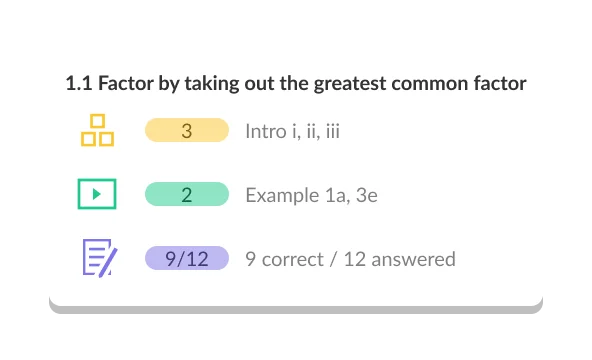
Unlimited Practice
Practice each topic until it clicks.
Test Prep Included
Practice real exam questions in your plan.
Try It Now
Test your knowledge
Our approach aligns with the evidence
Exam Scores
Better Recall
Less Anxiety
Sixth Class Maths Topics
1. Number Theory
2. Adding and Subtracting Integers
3. Multiplying and Dividing Integers
4. Operations with Decimals
5. Adding and Subtracting Fractions
6. Multiplying and Dividing Fractions
7. Number System and Radicals
8. Powers, Exponents and Square Roots
9. Introduction to Ratios, Rates and Percentages
10. Measuring Systems
11. Coordinates, Quadrants, and Transformations
12. Introduction to Variables and Expressions
13. Introduction to Equations
14. Properties of Triangles
15. Symmetry and Surface Area
16. Introduction to 3-Dimensional Figures
17. Circles
18. Data and Graphs
20 Chapters · 88 Topics · 788 Videos

Ready to practice Sixth Class Maths?
Try practice questions on every Sixth Class Maths topic — with instant feedback and step-by-step video solutions when you get stuck.
Discover Our Learning Areas
Explore key subjects and start learning with interactive content.

What is Sixth Class Maths?
Sixth Class maths is the final year of primary school mathematics in Ireland. It follows the Irish Primary Curriculum and covers five core strands: Number, Algebra, Shape and Space, Measures, and Data. By the end of Sixth Class, children should be able to work fluently with fractions, decimals, and percentages, solve simple algebraic problems, interpret a range of data displays, and apply maths reasoning to multi-step word problems. It is a pivotal year — a strong Sixth Class foundation sets children up confidently for the step up to Junior Cycle maths in secondary school.
What topics does Sixth Class maths cover in Ireland?
The Irish Primary Curriculum organises Sixth Class maths into five strands, each with several strand units:
Number — place value to millions, operations with large numbers, fractions (equivalent fractions, adding, subtracting, multiplying, and dividing), decimals and percentages, ratio and proportion, and mental maths strategies.
Algebra — number patterns and sequences, variables, and solving simple equations with an unknown. This is the earliest formal introduction to algebraic thinking in Irish primary education.
Shape and Space — properties of 2D and 3D shapes, angles (measuring, constructing, and classifying), symmetry, tessellation, and co-ordinates.
Measures — length, area, volume, capacity, weight, time, and money — all involving more complex calculations than earlier classes, including work with compound units.
Data — collecting and recording data, drawing and interpreting bar charts, line graphs, and pie charts, calculating averages (mean, mode, and median), and understanding chance and probability.
StudyPug's Sixth Class maths course covers all five strands, with individual lessons for each strand unit so your child can work on exactly the topic they need help with tonight.
Is Sixth Class maths difficult — and what are the most common struggles?
Many children find Sixth Class maths noticeably harder than Fifth Class. The step up is real: the number work becomes more abstract, algebra introduces letters and unknowns for the first time, and children are expected to apply multiple skills to solve longer word problems. Here are the areas where children most often need extra support:
Fractions, decimals, and percentages together. Children can often calculate each in isolation but struggle to convert between them fluently or compare them on the same number line. This is the single most common difficulty reported by Sixth Class teachers across Ireland.
Algebra. Even simple equations like "find n if 3n + 5 = 20" can feel unfamiliar. Children need time to understand what a variable means before they can work confidently with it.
Multi-step word problems. These require children to read carefully, choose the right operation, carry it out accurately, and then interpret the answer — a chain of steps where each one needs to be secure.
Area and volume. Moving from perimeter to area, and from area to volume, involves a conceptual leap that trips up many children who are otherwise strong at maths.
If your child is finding any of these areas tough, it does not mean they are behind — it means they need a clearer explanation of the method. That is exactly what StudyPug's certified-teacher videos are designed to provide.
Why StudyPug for Sixth Class maths?
StudyPug is designed to give children the kind of clear, methodical teaching that makes difficult maths topics stick — and to give parents real visibility into how their child is progressing.
Certified-teacher video lessons. Every Sixth Class maths lesson on StudyPug is taught by a qualified, experienced teacher — not an AI tool. The videos focus on the method: why the steps work, not just what the steps are. That means your child learns to solve similar problems independently, rather than just copying a procedure.
Diagnostic assessment from day one. Rather than working through every topic from the beginning, StudyPug's diagnostic identifies exactly where your child's gaps are in Sixth Class maths. Your child focuses their time where it matters most, and you can see the results quickly.
Adaptive practice that builds confidence. Once a topic is introduced through video, your child practises with questions that adjust to their current level. If they find something easy, the questions challenge them more. If they find something hard, the practice slows down and scaffolds them back to understanding. Progress feels achievable rather than overwhelming.
Aligned to the Irish Primary Curriculum. StudyPug's Sixth Class maths content is built around the same five strands your child's teacher is covering this year. There is no mismatch between what they learn at school and what they practise at home.
Family Plan — one subscription, up to five children. If you have more than one child, the Family Plan covers all of them — different grades, different subjects — for a single flat price. The parent dashboard gives you a separate progress view for each child.
What your child will learn in Sixth Class maths with StudyPug
StudyPug's Sixth Class maths course covers the full Irish Primary Curriculum across all five strands. Key topics your child will practise include:
- Fractions: equivalent fractions, simplifying, adding and subtracting fractions with different denominators, multiplying and dividing fractions
- Decimals and percentages: converting between fractions, decimals, and percentages; percentage of a quantity; percentage increase and decrease
- Algebra: number patterns, finding unknowns, solving simple equations
- Measures: area of rectangles, triangles, and circles; volume of cuboids; reading and calculating with compound measures
- Shape and Space: angles (acute, obtuse, reflex), constructing triangles and quadrilaterals, co-ordinates in all four quadrants
- Data: drawing and interpreting pie charts and line graphs, mean, mode, median, and range, probability language and simple experiments
- Number: long multiplication and division, order of operations, ratio and proportion, mental maths strategies
Each topic has its own focused lesson and accompanying practice set, so your child can work on the exact area their teacher assigned this week — or revisit something from earlier in the year before an assessment.
How to use StudyPug for Sixth Class maths
Getting started with StudyPug takes only a few minutes. Here is how most families use it effectively:
Step 1 — Run the diagnostic. The short diagnostic assessment identifies where your child needs to focus in Sixth Class maths right now. It removes the guesswork and gives you and your child a clear starting point.
Step 2 — Watch the lesson video. For each topic, your child watches the certified-teacher video, which explains the concept and walks through worked examples step by step. They can pause and rewatch any section — there is no pressure to keep up.
Step 3 — Practise with adaptive questions. After the video, your child completes practice questions that adjust to their level. Instant feedback shows them whether they are right, and if they are wrong, a worked solution explains exactly where to correct their thinking.
Step 4 — Check progress on the parent dashboard. Log in to the parent dashboard to see which topics your child has covered, where they are improving, and where they might need more time. You get a clear picture without having to sit beside them for every session.
Step 5 — Use Photo Search to find any topic fast. If your child comes home with a specific maths problem they are stuck on, Photo Search lets them photograph it and find the matching lesson immediately — across all subjects and all year groups.
Short, regular sessions of 15–20 minutes work best for Sixth Class. StudyPug is available on any device, so your child can practise at the kitchen table, on a tablet, or on a phone — wherever works for your family. The 30-day money-back guarantee means you can try the full plan without any risk.
Sixth Class Maths FAQ
Unsure how StudyPug works? Need help with setting up? Check our frequently asked questions or contact us for help.
What does my child learn in Sixth Class maths, and what topics does it cover?
Sixth Class maths in Ireland covers number (whole numbers, fractions, decimals, and percentages), algebra (finding unknowns and simple equations), measures (length, area, volume, weight, and time), shape and space (2D and 3D shapes, angles, and symmetry), data (collecting, representing, and interpreting data), and money and problem solving. The curriculum is set by the Irish Primary Curriculum and aims to prepare children for the move to secondary school. StudyPug covers all of these strands with short video lessons and adaptive practice matched to what your child is doing in Sixth Class.
Is Sixth Class maths hard, and where do children commonly struggle?
Sixth Class maths introduces more abstract thinking than earlier years, which many children find challenging. The most common sticking points are working with fractions, decimals, and percentages together (especially converting between them), long division with larger numbers, introducing simple algebraic thinking, reading and interpreting data charts, and applying maths to multi-step word problems. Children who find these topics tricky are not behind — they often just need a different explanation. StudyPug's certified-teacher videos break each topic down step by step so your child can pause, rewatch, and truly understand before moving on.
What should my child know before Sixth Class maths, and what comes next?
Before Sixth Class, children should be confident with the four operations (addition, subtraction, multiplication, and division), basic fractions and decimals, and reading simple graphs from Fifth Class. Sixth Class builds directly on all of these. After Sixth Class, children move to First Year of secondary school, where they begin the Junior Cycle maths course, covering number, algebra, geometry, statistics, and functions in greater depth. A solid Sixth Class foundation — especially in fractions, algebra, and measures — makes that transition significantly easier.
How does StudyPug maths map to what my child learns in school?
StudyPug's Sixth Class maths content is aligned to the Irish Primary Curriculum strands: Number, Algebra, Shape and Space, Measures, and Data. Every lesson is built around the methods and language your child's teacher uses in class, so there is no confusion between school and home learning. The parent dashboard lets you see which curriculum topics your child has practised and where progress is being made — giving you clear visibility without having to sit beside them.
What is one of the trickiest maths concepts in Sixth Class, and how is it taught?
Fractions, decimals, and percentages — and moving fluently between all three — is consistently the concept Sixth Class children find most difficult. Many pupils can calculate a fraction in isolation but lose confidence when asked to compare 0.75, ¾, and 75%. StudyPug's certified teachers tackle this by first securing each representation separately, then showing exactly how to convert between them using clear, repeatable methods. Practice questions then increase gradually in difficulty, reinforcing the method until it becomes automatic. This approach builds the kind of deep understanding that carries through to Junior Cycle.
How much maths practice should my child do in Sixth Class?
For Sixth Class, 15–20 minutes of focused maths practice four to five times a week is generally more effective than longer, infrequent sessions. Short, regular practice helps children retain methods and build fluency. StudyPug's adaptive practice adjusts to your child's current level, so each session is productive rather than frustrating. Starting with a short diagnostic lets your child (and you) see quickly which topics need the most attention, making every practice session count.





Written by the StudyPug Team
Last updated June 5, 2026
3 M+
students
★★★★★
4.8 average
K–12
all grades