Grade 11 Chemistry Help — Video Lessons & Practice
Get clear explanations for any chemistry problem and build exam-ready confidence for the Leaving Cert.
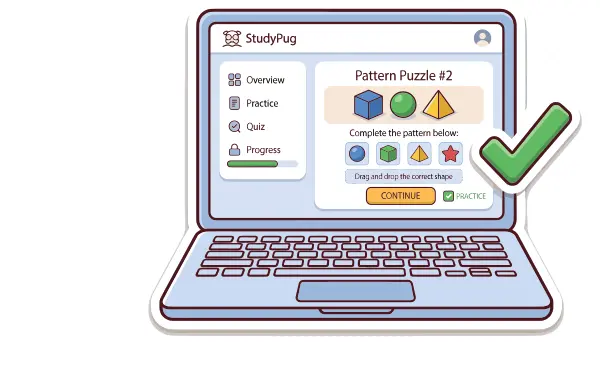
Value vs. Private Tutor
Get expert Chemistry help without high fees.
Multi-Subject
Stuck on Chemistry? Switch subjects anytime.
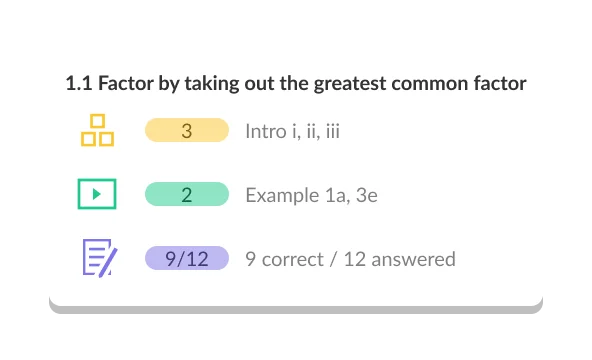
Build Mastery
Master a topic before moving on.
Chemistry Topics
1. Introduction to Chemistry
2. The Atom
3. The Periodic Table and Elements
4. Compounds and Bonding
5. Chemical Reactions and Groups
6. Stoichiometry
7. Basic Organic Chemistry
8. Solution Chemistry
9. Energetics, Kinetics and Reaction Rate
10. Equilibrium
11. Acid-Base Theory
12. Solubility Equilibria
13 Chapters · 84 Topics · 695 Videos
Discover Our Learning Areas
Explore key subjects and start learning with interactive content.
What Is Grade 11 Chemistry?
Grade 11 Chemistry in Ireland is a Senior Cycle subject that forms part of the Leaving Certificate programme. It gives students a rigorous, structured introduction to the principles that govern matter and chemical change — from the behaviour of atoms and electrons to large-scale industrial processes. Chemistry at this level is both conceptual and mathematical, demanding that students understand the why behind each reaction, not just the steps to get an answer.
The course is available at Higher Level and Ordinary Level. Higher Level covers greater depth across every topic and is the standard route for students aiming for points-intensive programmes such as medicine, pharmacy, or chemical engineering at Irish universities.
What Topics Are Covered in Leaving Cert Chemistry?
The Irish Leaving Cert Chemistry curriculum is broad and builds systematically from foundational ideas to complex applications. Core areas include:
- Atomic structure and the periodic table — electron configuration, periodic trends, and periodicity.
- Chemical bonding — ionic, covalent, and metallic bonding; VSEPR theory; intermolecular forces.
- Stoichiometry and the mole — mole calculations, limiting reagents, percentage yield, and empirical formulas.
- Thermochemistry — enthalpy changes, Hess's Law, bond enthalpies.
- Reaction kinetics — collision theory, factors affecting reaction rate, activation energy.
- Chemical equilibrium — Le Chatelier's principle, the equilibrium constant Kc.
- Acids and bases — pH, strong and weak acids, buffers.
- Electrochemistry — electrolysis, galvanic cells, electrode reactions.
- Organic chemistry — hydrocarbons, functional groups, reaction mechanisms, polymers.
- Industrial chemistry — the Haber process, the Contact process, water treatment.
Students also carry out Prescribed Practical Activities (PPAs) throughout the year, which form 15% of the final mark — making hands-on lab work a graded component of the course, not just a classroom exercise.
Is Leaving Cert Chemistry Hard?
Chemistry is widely regarded as one of the more demanding Leaving Cert subjects, and for good reason. The subject requires students to switch constantly between qualitative reasoning — understanding why a reaction happens — and quantitative problem-solving, such as mole calculations or pH computations. Neither skill alone is sufficient; you need both working together.
The most common sticking points are the mole concept (an abstract idea that underpins most of the course), electron configuration and bonding models, and balancing complex redox equations. The organic chemistry section also trips up many students who try to memorise reactions without understanding the underlying patterns.
The good news is that chemistry rewards students who invest time in understanding the method. Once the logic behind a calculation or reaction type is clear, applying it to unseen exam questions becomes far more manageable. That is where step-by-step video lessons — ones that teach the method, not just the answer — make a genuine difference.
What Comes Before and After Grade 11 Chemistry?
Students entering Senior Cycle Chemistry are expected to have completed Junior Cycle Science. A sound understanding of atoms, elements, compounds, mixtures, basic reactions, and the periodic table from Junior Cycle is the foundation the Leaving Cert course builds on. Students who struggled with Junior Cycle Science — particularly the chemistry strands — often find it worth revisiting those basics before September of fifth year.
After the Leaving Cert, a strong Chemistry result opens doors to a wide range of third-level programmes. Medicine, pharmacy, veterinary science, dentistry, biochemistry, chemical engineering, and environmental science all either require or strongly favour Chemistry at Higher Level. Many CAO points tables reflect this — Higher Level Chemistry is often one of the most useful subject choices for science-oriented applicants.
Why StudyPug for Grade 11 Chemistry?
StudyPug is built specifically for students who need more than a textbook explanation. Here is what makes it different for Leaving Cert Chemistry:
Diagnostic assessment that finds your gaps. Rather than working through every topic from the beginning, StudyPug's diagnostic assessment identifies exactly which areas need attention. You get a clear picture of where to focus — and where you are already strong — from day one. No wasted sessions, no guessing.
Certified-teacher video lessons that teach the method. Every chemistry lesson on StudyPug is made by a certified teacher — not generated by AI. The videos are designed to show you how to think through a problem, step by step, so that you can apply the same reasoning to the next question you encounter. This is particularly valuable for topics like stoichiometry and equilibrium, where the exam can present familiar concepts in unfamiliar formats.
Adaptive practice that keeps you challenged. Once you have watched a lesson, you need to practise. StudyPug's adaptive practice adjusts difficulty based on your actual performance — so you are always working at the right level. You will not waste time on problems that are too easy, and you will not be thrown into questions you are not ready for.
Leaving Cert exam alignment. All StudyPug chemistry content is aligned to the Irish Leaving Certificate curriculum. Lessons cover both Higher Level and Ordinary Level material, and practice questions are based on real exam-style formats — so what you practise reflects what you will face on the day.
Free practice to start. You can access free chemistry practice content on StudyPug without a subscription. It is a genuine, no-commitment way to work through problems and see whether the platform suits your study style before subscribing.
30-day money-back guarantee. Every new subscription comes with a 30-day money-back guarantee. If StudyPug is not the right fit, you get a full refund — no questions asked.
What You Will Learn — Leaving Cert Chemistry Curriculum Coverage
StudyPug covers the full Senior Cycle Chemistry curriculum as taught in Irish schools. Whether you are working through atomic structure for the first time or revisiting electrochemistry before your Leaving Cert, the platform has lessons for every topic on the course.
Key areas covered in detail include stoichiometry and mole calculations, chemical bonding and molecular geometry, thermochemistry and Hess's Law, reaction kinetics and equilibrium, organic chemistry reaction mechanisms, acids and bases including pH and buffer calculations, and electrochemistry. Industrial chemistry applications — including the Haber and Contact processes — are also covered in line with the curriculum.
Because the validated topic URLs for this page are not yet available in the internal link map, specific topic links will be added once the sitemap is confirmed. In the meantime, use the Browse Topics button above to explore all available chemistry lessons on StudyPug.
How to Use StudyPug for Grade 11 Chemistry
Step 1 — Take the diagnostic. Start with the chemistry diagnostic assessment. It takes a short time to complete and gives you a personalised picture of which topics to prioritise. Students who skip this step often spend time on material they already know, which slows progress.
Step 2 — Watch the concept video. For each topic you need to work on, watch the certified-teacher video lesson. Pause, rewind, and re-watch sections as needed — unlike a classroom or grind, the video is always available and never moves on without you. Focus on understanding the method, not just the final answer.
Step 3 — Practise with adaptive questions. After each lesson, move into practice. The adaptive system adjusts the difficulty based on your responses, so you build confidence on easier questions before tackling harder ones. This mirrors the way Leaving Cert exam papers are structured — straightforward application first, then more complex problem-solving.
Step 4 — Use Photo Search if you get stuck. If you encounter a chemistry problem in your textbook or on a past paper that you cannot place, you can use StudyPug's Photo Search feature to find the matching lesson. It works across all grades and subjects — just photograph the problem and the tool finds the relevant video for you.
Step 5 — Build your exam preparation routine. In the weeks before your Leaving Cert, use StudyPug's practice tests to work under exam-style conditions. Review any topics where you lose marks, revisit the relevant video, and practise again. Consistent, targeted revision — guided by your diagnostic results — is the most effective way to improve your chemistry grade before the exam.
Chemistry FAQ
Unsure how StudyPug works? Need help with setting up? Check our frequently asked questions or contact us for help.
What do you learn in Grade 11 Chemistry, and what topics does it cover?
Grade 11 Chemistry in Ireland (Senior Cycle) covers atomic structure, chemical bonding, stoichiometry and the mole concept, thermochemistry, reaction kinetics, chemical equilibrium, electrochemistry, and organic chemistry. Students also study acids and bases, oxidation-reduction reactions, and industrial chemistry. The course builds mathematical problem-solving skills alongside conceptual understanding, preparing students for the Leaving Certificate examination in both Higher and Ordinary Level papers.
What is the difference between Chemistry and Physics for the Leaving Cert?
Chemistry focuses on the composition, structure, and reactions of matter — covering topics like bonding, organic molecules, and stoichiometry. Physics deals with energy, forces, waves, and the physical laws governing the universe. Chemistry tends to involve more qualitative reasoning about molecular behaviour alongside quantitative calculation, while Physics is more heavily mathematical. Both are respected science subjects for Leaving Cert points, and many students studying medicine or engineering take both.
Is Grade 11 Chemistry hard, and where do students struggle most?
Chemistry is considered one of the more challenging Leaving Cert subjects. Students most commonly struggle with the mole concept and stoichiometric calculations, understanding electron configuration and bonding models, balancing redox equations, and applying reaction kinetics to unfamiliar problems. The jump from Junior Cycle science to Senior Cycle chemistry is significant. Building a strong grasp of the underlying method — not just memorising formulas — is the key to performing well on exam questions.
What should I study before Grade 11 Chemistry, and what comes after it?
A solid foundation in Junior Cycle science — particularly atoms, elements, compounds, and basic reactions — is essential before starting Senior Cycle Chemistry. Good numeracy skills also help significantly with stoichiometry. After the Leaving Cert, Chemistry is a prerequisite or strong advantage for third-level courses in medicine, pharmacy, biochemistry, chemical engineering, environmental science, and dentistry. Higher Level Chemistry with a strong grade is particularly valued by Irish universities for science-based programmes.
Is Chemistry on the Leaving Certificate, and how is it tested?
Yes. Chemistry is a full Leaving Certificate subject available at Higher and Ordinary Level. The written exam accounts for 85% of the mark and includes short questions, extended questions, and mandatory experiment questions. The remaining 15% comes from a laboratory coursework assessment (the Prescribed Practical Activities). Higher Level covers additional depth across all topics. StudyPug lessons are aligned to the Irish chemistry curriculum and include practice based on real exam-style questions at both levels.
What is one of the hardest concepts in Leaving Cert Chemistry, and how do you tackle it?
The mole concept is consistently rated as the hardest topic in Leaving Cert Chemistry. Students find it hard because it bridges the invisible world of atoms with measurable quantities. The key is building the concept in stages: understand Avogadro's number, then molar mass, then mole ratios in balanced equations. Practice converting between grams, moles, and particles until the steps feel automatic. StudyPug's certified-teacher videos walk through each stage with worked examples so you can learn the method, not just memorise a formula.




Written by the StudyPug Team
Last updated June 5, 2026
3 M+
students
★★★★★
4.8 average
K–12
all grades