Grade 12 Trigonometry Help — Video Lessons & Practice
Get clear explanations for any trigonometry problem and build Leaving Cert–ready confidence.
Value vs. Private Tutor
Expert Trigonometry help for less than a tutor.

Multi-Subject
Master the Irish curriculum with one plan.
Practice Until Perfect
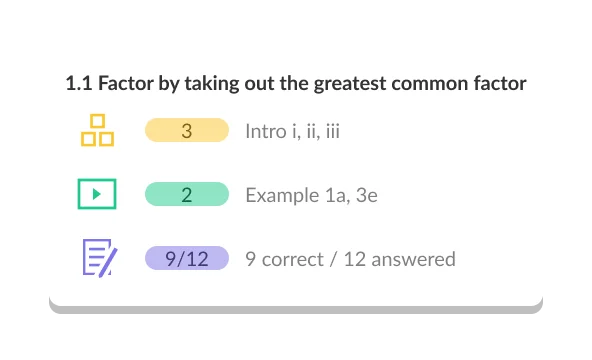
Practice sin cos and tan until it sticks.
Try It Now
Test your knowledge
Our approach aligns with the evidence
Exam Scores
Better Recall
Less Anxiety
Trigonometry Topics
1. Right Triangle Trigonometry
2. Trigonometric Ratios and Angle Measure
3. Bearings
4. Graphing Trigonometric Functions
5. Applications of Trigonometric Functions
6. Trigonometric Identities
7. Solving Trigonometric Equations
8. Inverse Trigonometric Functions
9. Imaginary and Complex Numbers
9 Chapters · 60 Topics · 284 Videos
Discover Our Learning Areas
Explore key subjects and start learning with interactive content.




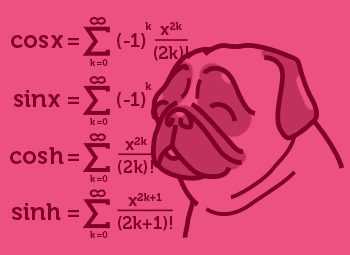
What is Trigonometry?
Trigonometry is the branch of mathematics that studies the relationships between the angles and sides of triangles, and extends those relationships into functions that describe periodic behaviour. At its core, trigonometry answers questions like: given two sides of a triangle, what are the angles? Given an angle on a unit circle, what are the coordinates of the point on the circle's edge? These questions turn out to be fundamental in physics, engineering, music, computer graphics, and almost every quantitative discipline.
For Leaving Cert students in Ireland, trigonometry sits within the Strand 3 (Trigonometry) and Strand 4 (Algebra and Functions) content of the Project Maths syllabus. It appears on both Higher Level and Ordinary Level Paper 2, and it rewards students who understand the underlying structure rather than those who simply memorise formulas.
What Topics Are Covered in Leaving Cert Trigonometry?
The Leaving Cert trigonometry course covers the following key areas:
- Right-angle trigonometry and SOH-CAH-TOA — reviewed and extended from Junior Cycle.
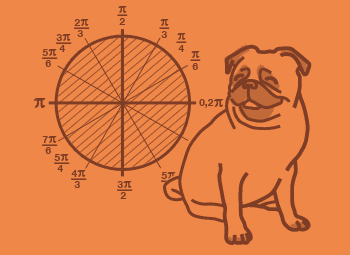
- The unit circle and radian measure — understanding how angles beyond 90° are defined and how radians relate to degrees.
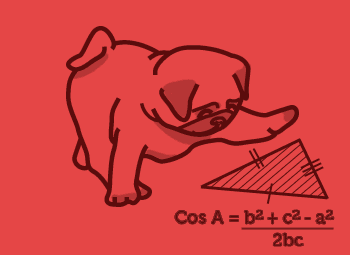
- The sine and cosine rules — solving non-right-angle triangles, a staple of Paper 2 applied problems.
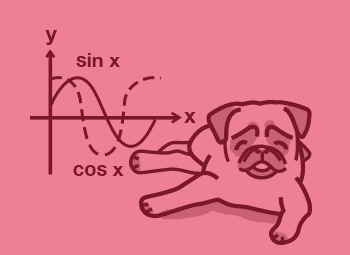
- Trigonometric functions and their graphs — sketching and interpreting y = sin x, y = cos x, y = tan x, and their transformations.
- Trigonometric identities — the Pythagorean identity and quotient identity, used heavily in proofs and simplification questions.
- Compound and double angle formulae — sin(A ± B), cos(A ± B), sin 2A, cos 2A, applied in both proof and problem-solving contexts.
- Solving trigonometric equations — finding all solutions in a given domain, requiring careful use of the unit circle and CAST diagram.
Higher Level questions typically combine several of these areas in a single multi-part question, so fluency with each topic individually is essential before you can perform well under exam conditions.
Is Trigonometry Hard at Leaving Cert Level?
Trigonometry is consistently rated one of the more challenging Leaving Cert Maths topics, particularly at Higher Level. The difficulty comes from several directions at once: the notation is unfamiliar (radians, arc length, sector area), the identities require algebraic confidence, and the exam questions often involve applying a chain of ideas rather than a single formula.
The most common trouble areas are:
- Radian measure — students who learned only degrees in Junior Cycle find it counterintuitive at first. The fix is to practise converting and to get comfortable with exact values like π/6, π/4, π/3.
- Trigonometric identities — proofs require a plan of attack, not just symbol-shuffling. Learning which identity to substitute first comes from pattern recognition built through practice.
- Compound angle formulae under pressure — students know the formulas but freeze in the exam. The answer is repeated timed practice on worked examples, so the structure becomes automatic.
The good news is that trig is one of those topics where targeted practice pays off quickly. Students who commit a few focused sessions to understanding the unit circle and the identity framework typically see a marked improvement in their practice paper scores within weeks.
What Comes Before and After Trigonometry?
Before senior-cycle trigonometry you need a solid grounding in Junior Cycle right-angle trigonometry, basic algebra (particularly factorising and rearranging), and the coordinate plane. If any of those feel shaky, addressing them first will make the Leaving Cert content much more accessible.
Trigonometry connects directly to several other Leaving Cert topics. Differentiation (calculus) requires you to find derivatives of sin x and cos x — impossible if you're not comfortable with what those functions mean. Complex numbers in polar form use the same angle-based notation. Coordinate geometry occasionally requires trigonometric reasoning. Practising trigonometry also sharpens your overall algebraic manipulation skills, which benefits every other Maths topic.
After school, trigonometry feeds into first-year calculus (integrals of trig functions), Fourier analysis, mechanics, electrical engineering, and signal processing. It's one of the most transferable strands of senior-cycle Maths.
How is Trigonometry Examined on the Leaving Cert?
Trigonometry is tested on Leaving Cert Mathematics Paper 2, which also covers coordinate geometry, statistics, and probability. At Higher Level, there is typically a substantial trigonometry question in Section B (long questions worth up to 25 marks each). At Ordinary Level, shorter applied questions appear in Section A.
Exam questions are based on real exam-style problems drawn from the Project Maths framework. Common question types include: solving a triangle with the sine or cosine rule and finding its area; proving a trigonometric identity; sketching a function and reading off properties; and solving a trigonometric equation for all values in a given range. Multi-part questions frequently combine diagram reading, identity application, and equation solving — so the ability to move fluidly between sub-skills is what separates higher-grade answers from mid-grade ones.
Why StudyPug for Leaving Cert Trigonometry?
StudyPug is built around a simple idea: students improve faster when they study smarter, not just longer. For trigonometry, that means starting with a diagnostic assessment that quickly identifies which topics are secure and which have gaps — so you're not spending 40 minutes on the unit circle if your real weakness is compound angle formulae.
From there, certified-teacher concept videos walk through every Leaving Cert trigonometry topic step-by-step. These lessons are taught by real qualified teachers, not generated by AI. The focus is always on the method — why you choose a particular identity, how you read the domain of a trig equation, what the graph of a transformed sine function tells you — because understanding the method is what lets you handle the unfamiliar variations the Leaving Cert loves to include.
Adaptive practice builds on each video. Questions adjust in difficulty based on how you're performing, which means you're always working at a level that challenges you without overwhelming you. You can also access free daily practice content to keep your skills sharp between study sessions — no subscription required for that entry point.
Every lesson and every practice set is aligned to the Irish Leaving Cert syllabus and the Project Maths framework. The curriculum coverage is specific: not generic trigonometry, but the exact topics, notation, and question styles that appear on the Irish exam. And if you subscribe and decide StudyPug isn't the right fit, a 30-day money-back guarantee means there's no financial risk in trying.
What You Learn: Trigonometry Curriculum Coverage
StudyPug's Leaving Cert Trigonometry course covers the full Project Maths syllabus content for senior cycle, including both Higher Level and Ordinary Level material. Here is what you can expect to find:
- Right-angle triangles and exact trigonometric values (30°, 45°, 60°)
- The unit circle: definition, radian measure, arc length, sector area
- Trigonometric functions: sine, cosine, tangent — graphs, transformations, period, amplitude
- The sine rule and cosine rule: proofs and applied triangle problems
- Area of a triangle using ½ab sin C
- Fundamental trigonometric identities: Pythagorean, quotient, and reciprocal identities
- Compound angle formulae for sin and cos; double angle formulae
- Solving trigonometric equations on specified domains
- Inverse trigonometric functions and their graphs
Each topic has multiple video lessons — covering the core concept, worked examples at increasing difficulty, and common exam traps to avoid. The practice library for each topic mirrors the question types and mark-scheme structures used in the Leaving Cert, so you're always practising in a way that transfers directly to the exam hall.
Using StudyPug: How to Get Started with Trigonometry
Getting started is straightforward. When you create your account, select your grade (Leaving Cert / Grade 12) and the Irish curriculum. StudyPug's diagnostic assessment will then run through a set of trigonometry questions to map out your starting point — identifying which topics are already solid and which need focused attention. This takes around 10–15 minutes and saves you hours of unfocused revision.
From your personalised dashboard, you'll see a recommended study path through the trigonometry content. Watch the concept video for a topic, then move straight into the adaptive practice. If you get a question wrong, a step-by-step solution is available immediately — not just the final answer, but the full reasoning so you understand where your approach diverged.
You can also use StudyPug's Photo Search feature to take a photo of a trigonometry problem — from your textbook, a past Leaving Cert paper, or a teacher's worksheet — and find the matching lesson on StudyPug instantly. This is useful when you hit a specific problem type you haven't seen before and want to find the relevant video without searching manually.
Study sessions work equally well on desktop and mobile, so you can keep practising on the bus, during a free class, or late at night before an exam. The platform syncs across devices, so your progress and adaptive difficulty level carry over wherever you log in.
The most effective study pattern for Leaving Cert trigonometry is short, regular sessions focused on one topic at a time — watch the video, attempt 10–15 adaptive questions, review any mistakes with the step-by-step solutions, and then move on. That rhythm, repeated consistently in the weeks before your Leaving Cert, is how students go from struggling with trig to handling it confidently on the day.
Trigonometry FAQ
Unsure how StudyPug works? Need help with setting up? Check our frequently asked questions or contact us for help.
What do you learn in Trigonometry, and what topics does it cover?
Trigonometry focuses on the relationships between angles and sides in triangles, and extends into circular and wave functions. In a Leaving Cert course you'll cover the unit circle, sine and cosine rules, trigonometric functions and their graphs, trigonometric identities, compound and double angle formulae, and solving trigonometric equations. These topics build the foundation for further work in calculus, physics, and engineering at third level.
What is the difference between Trigonometry and Coordinate Geometry?
Trigonometry deals with angle and side relationships — in triangles and on the unit circle — and extends to periodic functions and identities. Coordinate Geometry deals with shapes and lines plotted on the x-y plane, using equations to find distances, midpoints, and intersections. At Leaving Cert level both strands appear on the same Higher Level Maths paper, and they sometimes overlap — for example, finding the angle a line makes with an axis uses both skills together.
Is Trigonometry hard, and where do students struggle most?
Trigonometry is one of the topics Leaving Cert students find most challenging. The biggest stumbling blocks are the unit circle and radian measure (students often mix up degrees and radians), manipulating trigonometric identities without a clear method, and applying compound angle formulae under exam pressure. The key is learning the method step-by-step rather than memorising results — once you understand why a formula works, applying it in unfamiliar questions becomes much more manageable.
What should I take before Trigonometry, and what comes after it?
Before tackling senior-cycle trigonometry you should be comfortable with Junior Cycle right-angle trig (SOH-CAH-TOA), basic algebra, and the coordinate plane. At Leaving Cert Higher Level, trigonometry links closely with functions, calculus (derivatives of sin and cos), and complex numbers. After school, strong trig skills feed directly into college-level calculus, physics, engineering, and computer science — so the investment at sixth year pays off well beyond the Leaving Cert.
Is Trigonometry on the Leaving Cert, and how is it tested?
Yes — trigonometry is examined on the Leaving Cert Higher Level and Ordinary Level Mathematics papers, typically in Paper 2. Questions test the sine and cosine rules (often in applied contexts), the unit circle, trig identities, and solving equations. Higher Level questions frequently require multi-step reasoning and proof. Based on real exam-style questions, StudyPug's practice materials help you build the fluency and problem-solving approach the Leaving Cert rewards.
What is one of the hardest concepts in Trigonometry, and how do you tackle it?
Compound and double angle formulae are among the trickiest topics for Leaving Cert students. Questions ask you to prove identities or simplify expressions using sin(A ± B), cos(A ± B), and their double-angle versions — often in ways that aren't immediately obvious. The best approach is to practise deriving each formula from scratch, recognise the common patterns, and work through plenty of varied examples until you can spot which identity to apply quickly. Breaking each proof into small algebraic steps makes the process much clearer.




Written by the StudyPug Team
Last updated June 5, 2026
3 M+
students
★★★★★
4.8 average
K–12
all grades