SAT Prep: Practice Tests & Video Solutions
Pinpoint your weak areas with a quick diagnostic, then build skills with certified-teacher video lessons and unlimited practice tests.

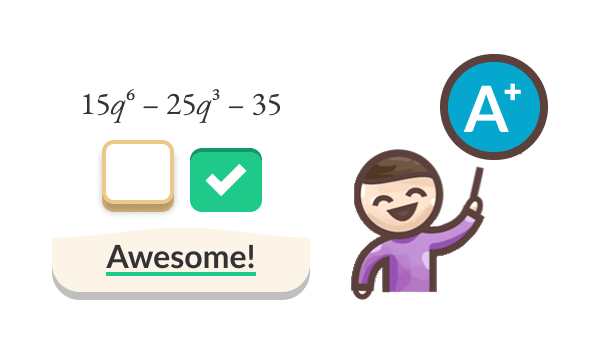
Step-by-Step Videos
Watch it solved then try it yourself.
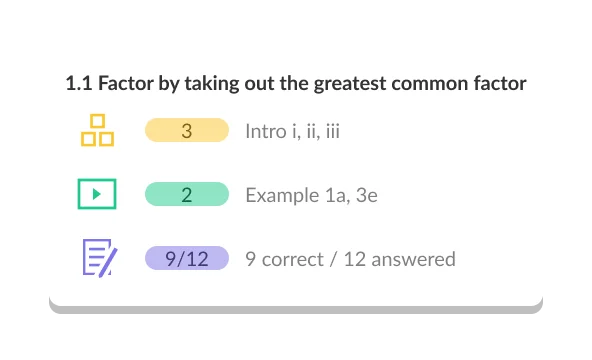
Unlimited Practice
Practice each question until it clicks.

Test Prep Included
Practice free real SAT exams today.
Try It Now
Test your knowledge
Our approach aligns with the evidence
Exam Scores
Better Recall
Less Anxiety
SAT Test Prep Topics
1. Understanding Integers
2. Adding and Subtracting Integers
3. Multiplying and Dividing Integers
4. Number Theory
5. Adding and Subtracting Fractions
6. Multiplying and Dividing Fractions
7. Operation with Decimals
8. Fractions, Decimals, and Percents
9. Ratios, Rates, and Proportions
10. Introduction to Variables and Expressions
11. Solving Linear Equations
12. Linear Inequalities
13. Measuring Systems
14. Number System
15. Radicals
16. Exponents
17. Operations of Polynomials
18. Introduction to Relations and Functions
19. Linear Functions
20. Systems of Equations
21. Factoring Polynomials
22. Quadratic Functions
23. Solving Quadratic Equations
24. Rational Expressions
25. Function Notation
26. Transformations of Functions
27. Polynomial Functions
28. Direct and Inverse Variation
29. Trigonometry with Right Triangles
30. Trigonometric Ratios and Angle Measure
31. Law of Sines and Cosines
32. Imaginary and Complex Numbers
33. Angles, Lines, and Transversals
34. Circles
35. Surface Area and Volume
37. Data and Graphs
38 Chapters · 219 Topics · 1657 Videos
Discover Our Learning Areas
Explore key subjects and start learning with interactive content.














What Is the SAT? Overview for Irish Students
The SAT (Scholastic Assessment Test) is a standardised college admissions test administered by the College Board and widely accepted by universities across the United States. For Irish students targeting US universities — or international programmes that recognise SAT scores — it is one of the most important exams to prepare for thoroughly. The SAT assesses skills in Evidence-Based Reading and Writing (EBRW) and Mathematics, evaluating your ability to reason clearly and solve problems rather than simply recall information.
The test is taken in a single sitting of approximately three hours. Because the content spans specific, well-defined topic areas, a structured SAT preparation plan built around your individual weak spots is far more effective than general study.
SAT Format and Sections
The SAT is divided into two main sections. The Evidence-Based Reading and Writing section includes a Reading Test and a Writing and Language Test. The Mathematics section is split into a no-calculator portion (20 questions, 25 minutes) and a calculator-allowed portion (38 questions, 55 minutes). An optional Essay section, where offered, adds approximately 50 minutes. Total testing time without the Essay is around 3 hours. Questions are a mix of multiple-choice and student-produced response (grid-in) formats in the Maths section.
Understanding the exact structure before you sit a practice test helps you allocate time wisely and reduce surprises on the day of the real exam.
SAT Scoring: What You Need to Know
The SAT is scored on a total scale of 400 to 1600. The Evidence-Based Reading and Writing section and the Maths section are each scored between 200 and 800, and the two scores are combined for your composite total. There is no penalty for wrong answers, so it always pays to attempt every question. The national average composite score is approximately 1060. A score of 1200 or above is generally competitive for many US universities, while scores of 1400 and above are considered strong at selective institutions. Setting a target score based on the middle 50% ranges published by your shortlisted universities is a practical first step in your preparation plan.
What Content Areas Does the SAT Maths Section Test?
The SAT Maths section covers four core content areas:
- Heart of Algebra — linear equations and inequalities, systems of equations, and interpreting linear expressions. This is the single largest content area and worth prioritising early.
- Problem Solving and Data Analysis — ratios, rates, percentages, unit conversion, statistics, probability, and reading graphs or tables. Together with Heart of Algebra, these two areas make up the bulk of the Maths score.
- Passport to Advanced Math — quadratic equations and expressions, exponential functions, polynomial operations, and function notation. This area is where many students lose the most marks.
- Additional Topics in Math — geometry (area, volume, coordinate geometry), trigonometry, and complex numbers. This area typically accounts for a smaller proportion of questions but can still affect your final score meaningfully.
For Irish students who have completed the Leaving Certificate Ordinary Level or Higher Level Maths curriculum, many of these topics will be familiar — but the SAT question style, with its emphasis on multi-step reasoning and data interpretation, requires dedicated practice with exam-style problems.
What Is the Hardest Part of the SAT, and How Should You Approach It?
Most students find the no-calculator Maths section and the Passport to Advanced Math questions the most demanding. These questions require clean algebraic manipulation, comfort with function notation, and the ability to work efficiently without a calculator as a safety net. Problem Solving and Data Analysis questions can also catch students off guard because they test statistical reasoning rather than pure calculation.
The most effective approach is to practise these specific question types repeatedly using exam-style problems, review the reasoning in step-by-step video solutions (not just whether the final answer was correct), and retake quizzes in those content areas until your accuracy is consistent across multiple attempts.
Why StudyPug for SAT Preparation?
StudyPug is built around the way students actually learn: by identifying what they do not know, working through the concept with expert guidance, and then practising until the method feels automatic. For SAT preparation specifically, three features make the biggest difference.
First, the diagnostic assessment starts by pinpointing your weakest SAT content areas. Rather than working through every topic from the beginning, you focus your study time on the sections that will move your score the most. Second, certified-teacher video lessons walk through every concept and question type step by step. These are not AI-generated explanations — they are taught by qualified teachers who show you the method behind each solution, so when you encounter a similar problem on test day you know exactly how to approach it. Third, adaptive practice adjusts the difficulty of questions as you improve, making sure each session challenges you at the right level rather than repeating content you have already mastered.
All of this is available on any device, so you can study whether you are at home or commuting — a real advantage when you are balancing SAT preparation with Leaving Certificate coursework.
What SAT Topics Are Covered on StudyPug?
StudyPug's SAT preparation covers every Maths content area tested on the exam: Heart of Algebra, Problem Solving and Data Analysis, Passport to Advanced Math, and Additional Topics in Math including geometry and trigonometry. Each topic has dedicated video lessons and practice quizzes so you can build understanding before testing yourself.
If you are also considering other standardised tests or want to strengthen your broader maths foundation, you can explore GED math prep as a related resource for foundational maths skills.
The practice content across all topics is built around real exam-style questions, so every session closely reflects the type of reasoning the actual SAT demands.
How to Prepare for the SAT: A Study Plan
A well-structured SAT preparation plan typically runs eight to twelve weeks. Here is a practical framework for Irish students:
Weeks 1–2: Diagnostic and Baseline. Take a full-length SAT practice test under timed conditions. Use the results and StudyPug's diagnostic assessment to identify which content areas need the most attention. Note your baseline score so you can track progress.
Weeks 3–6: Targeted Topic Work. Work through concept video lessons and topic quizzes in your weakest areas first — typically Heart of Algebra, Passport to Advanced Math, or Problem Solving and Data Analysis depending on your diagnostic results. Retake quizzes until accuracy is high before moving on. Use adaptive practice to keep the difficulty appropriate to your current level.
Weeks 7–9: Full-Length Practice Tests. Shift the focus to timed, full-length practice tests. Review every incorrect answer using video solutions, identifying whether the error was a concept gap or a test-taking strategy issue (misreading the question, time pressure, etc.).
Weeks 10–12: Refinement and Confidence. Target any remaining weak spots identified in your practice tests. Take one or two final full-length tests to confirm your score range and reduce test-day anxiety. At this stage you should feel familiar with the format, comfortable with the timing, and confident in your approach to the question types you found hardest at the start.
Registering for your SAT test date before you begin preparation keeps the timeline concrete. Irish and international students register through the College Board at collegeboard.org; aim to register at least four to six weeks before your preferred sitting date to secure a centre place.
Start your SAT preparation today with a free diagnostic practice session on StudyPug and find out exactly where to focus first.
SAT Test Prep FAQ
Unsure how StudyPug works? Need help with setting up? Check our frequently asked questions or contact us for help.
What does the SAT cover, and how is it structured?
The SAT is a standardised college admissions test consisting of two main sections: Evidence-Based Reading and Writing (EBRW) and Mathematics. The Maths section is further split into a no-calculator portion and a calculator-allowed portion. In total the test runs approximately three hours, with an optional Essay section adding roughly fifty minutes. Questions are designed to assess reasoning and problem-solving skills rather than rote memorisation, making structured practice an essential part of preparation.
How is the SAT scored, and what counts as a good score?
The SAT is scored on a scale of 400 to 1600, combining the Evidence-Based Reading and Writing section (200–800) and the Maths section (200–800). The national average score sits around 1060. A score of 1200 or above is generally considered competitive for most universities, while scores above 1400 are strong for selective institutions. Many US universities also publish their middle 50% score ranges for admitted students, which is useful when setting your personal target score.
What subjects and content areas are tested on the SAT Maths section?
The SAT Maths section tests four main content areas: Heart of Algebra (linear equations, systems, and inequalities), Problem Solving and Data Analysis (ratios, percentages, statistics, and interpreting data), Passport to Advanced Math (quadratics, functions, and complex equations), and Additional Topics in Math (geometry, trigonometry, and complex numbers). Heart of Algebra and Problem Solving together account for the majority of questions, so building strong skills in those areas is particularly valuable for improving your overall maths score.
How should I prepare for the SAT, and how long does preparation take?
Most students benefit from eight to twelve weeks of focused preparation, though six weeks of intensive study is achievable with a clear plan. Start with a diagnostic practice test to identify your weakest content areas, then work through targeted concept lessons and quizzes in those topics. Build up to full-length timed practice tests in the final two to three weeks. StudyPug's diagnostic assessment pinpoints exactly which SAT topics to prioritise, and certified-teacher video lessons teach you the method behind each question type so you can handle similar problems confidently on test day.
When should I take the SAT, and how do I register?
The SAT is offered several times a year, typically in March, May, June, August, October, November, and December. Irish and international students register through the College Board website at collegeboard.org. It is advisable to register at least four to six weeks before your chosen test date to secure a spot at your preferred test centre. Many students sitting the SAT from Ireland target a spring or autumn date to align with US university application deadlines, which typically fall between November and January of senior year.
What is the hardest part of the SAT Maths section, and how do I tackle it?
Most students find the no-calculator Maths portion and the Passport to Advanced Math questions the most challenging, as both demand fluent algebraic manipulation without computational shortcuts. Multi-step problems involving quadratic equations, function notation, and systems with non-linear terms trip up even well-prepared students. The best approach is to practise these question types repeatedly using exam-style problems, review the step-by-step reasoning in video solutions rather than just checking whether an answer is correct, and retake quizzes on those topics until accuracy is consistent across multiple attempts.





Written by the StudyPug Team
Last updated June 5, 2026
3 M+
students
★★★★★
4.8 average
K–12
all grades