8th Grade Pre-Algebra Help — Step-by-Step Video Lessons & Practice
Help your child understand every pre-algebra topic and build real confidence, one lesson at a time.
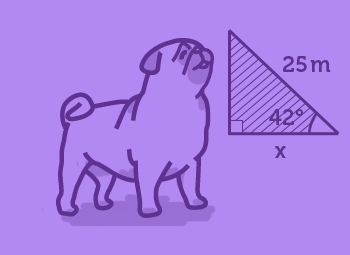
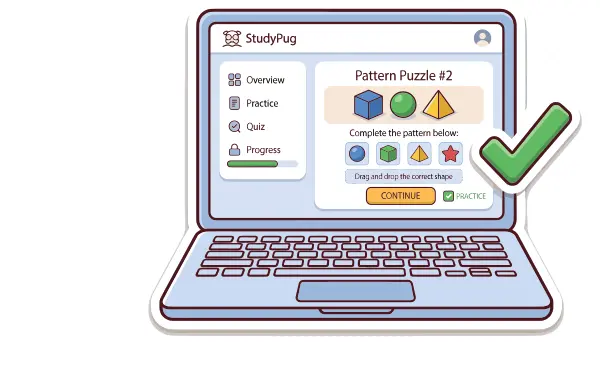
Value vs. Private Tutor
Expert pre-algebra help minus the price tag.
Multi-Subject
One subscription unlocks all subjects.
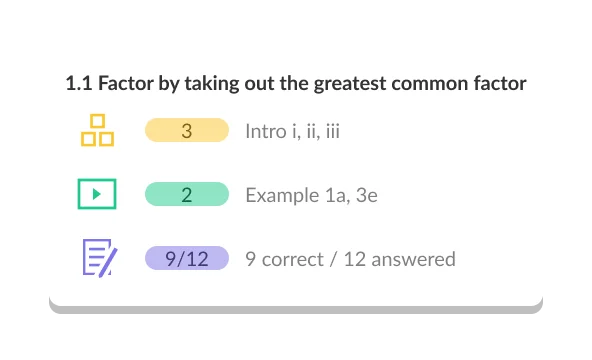
Unlimited Practice
Practice topics until they click.
Try It Now
Test your knowledge
Our approach aligns with the evidence
Exam Scores
Better Recall
Less Anxiety
Pre-Algebra Topics
1. Integers
2. Factors and multiples
3. Decimals
4. Fractions
5. Ratios, rates, and proportions
6. Measuring Systems
7. Applying mathematical reasoning
8. Radicals
9. Exponents and Scientific Notation
10. Pythagorean Theorem
11. Surface Area of 3-Dimensional Shapes
12. Volume of 3-Dimensional Shapes
13. Function and Linear Relationships
14. Linear Equations
15. Linear Functions
16. Probability
17. Symmetry and Tessellations
18 Chapters · 77 Topics · 661 Videos
Discover Our Learning Areas
Explore key subjects and start learning with interactive content.









What Is 8th Grade Pre-Algebra?
8th grade pre-algebra is the course that bridges arithmetic and formal algebra. It is the year your child stops working purely with numbers and starts working with unknowns — learning to write, manipulate, and solve equations that represent real situations. In Ireland, this content sits within the Junior Cycle maths strand and covers the Number, Algebra, and Functions areas of the curriculum. By the end of the year, students should be fluent with rational numbers, proportional reasoning, linear equations, and the basics of coordinate geometry. Pre-algebra is not just preparation for the next maths class; it is the foundation for every quantitative subject your child will study for the rest of their school career.
What Topics Does 8th Grade Pre-Algebra Cover?
The pre-algebra curriculum at 8th grade typically spans six major topic areas. First, integers and rational numbers — working with positive and negative numbers, absolute value, and all four operations on fractions and decimals. Second, order of operations, ensuring your child applies arithmetic rules consistently, especially inside complex expressions. Third, ratios, rates, and proportions — a heavily tested area in the Junior Cycle maths assessment and essential for everyday numeracy. Fourth, linear equations and inequalities, where students learn to solve for an unknown and represent solutions on a number line. Fifth, coordinate geometry — plotting points, identifying quadrants, and beginning to explore gradients and straight-line graphs. Sixth, an introduction to functions, where students see how inputs and outputs relate and graph simple functions for the first time. Together these topics prepare students for Algebra 1 and the higher-level Junior Cycle maths paper.
Is 8th Grade Pre-Algebra Hard? Common Struggle Points to Watch For
Pre-algebra is the first time many students encounter truly abstract mathematical thinking, and that shift is genuinely challenging. The most common struggle points are:
Negative numbers and integer rules. Students who learned arithmetic with only positive numbers often make sign errors that cascade through an entire problem. The rules for multiplying and dividing negatives need deliberate practice before they become automatic.
Setting up equations from word problems. Translating a sentence into an algebraic expression requires reading comprehension and mathematical reasoning working together — a skill that takes time to develop.
Fractions inside equations. When an equation contains fractional coefficients or requires fraction arithmetic mid-solution, error rates rise sharply. Many students who are confident with standalone fractions struggle when fractions appear inside a larger problem.
Proportional reasoning. Cross-multiplication is easy to memorise but hard to apply flexibly. Students often struggle to recognise when a proportion is the right tool for a problem.
The encouraging news is that none of these difficulties are permanent. They are all concept gaps, not ability ceilings, and they respond quickly to clear step-by-step instruction and consistent practice.
What Should My Child Know Before Pre-Algebra — and What Comes Next?
A student ready for 8th grade pre-algebra should be confident with whole-number arithmetic, decimal operations, fraction addition and subtraction, and basic percentages. They should also be familiar with simple number patterns and the concept of a variable from earlier maths classes. If any of these areas feel shaky, spending a short period reinforcing them first will make pre-algebra far less frustrating.
After completing pre-algebra, the natural next step is Algebra 1, which extends equation-solving to quadratic expressions, systems of equations, and exponential functions. Students who build a solid pre-algebra foundation typically find Algebra 1 manageable rather than overwhelming. Beyond that, the trajectory leads through geometry, Algebra 2, and pre-calculus — all of which rely on the algebraic fluency that starts here in 8th grade.
How Does StudyPug's 8th Grade Pre-Algebra Support Align With the Junior Cycle Curriculum?
StudyPug's pre-algebra lessons are mapped to the Irish Junior Cycle maths curriculum. The Number and Algebra strands covered on StudyPug correspond directly to the learning outcomes assessed in Junior Cycle, including the Classroom-Based Assessments and the written examination your child will sit in third year. This means that when your child practises on StudyPug, they are reinforcing the same skills their teacher is developing in class — not working through a generic programme that may not match Ireland's curriculum expectations. Parents in Ireland can be confident that time spent on StudyPug translates directly into stronger performance in school.
Why StudyPug for 8th Grade Pre-Algebra Help?
StudyPug is built around three principles that make a meaningful difference for 8th grade pre-algebra students.
Start where your child actually is. The diagnostic assessment quickly identifies which pre-algebra topics your child has already grasped and which need attention. Instead of starting from the beginning of the course, your child gets a focused study plan from day one.
Learn the method, not just the answer. StudyPug's certified teachers explain the reasoning behind every step in short, clear video lessons. This is different from simply showing a worked solution — your child comes away understanding why the method works, which means they can apply it to new problems independently. This is especially important for 8th grade pre-algebra, where the concepts are new and the methods are non-obvious.
Practice that adjusts to your child's level. Adaptive practice questions respond to your child's performance in real time, presenting problems that are just the right level of challenge. When a concept is shaky, the system provides more support; when it is solid, it introduces the next level of difficulty. This builds genuine competence rather than surface familiarity.
For families in Ireland, StudyPug's Family Plan also means that if you have more than one child at school, all of them — at every year level and across every subject — can access the platform under a single subscription. The parent dashboard lets you see each child's progress separately, so you always know where each child stands without having to quiz them yourself.
What Your Child Will Learn in 8th Grade Pre-Algebra on StudyPug
StudyPug's 8th grade pre-algebra course covers all the major topic areas of the Junior Cycle maths curriculum at this level. Your child will work through integers and operations on rational numbers, master the order of operations in multi-step expressions, develop proportional reasoning through ratios and rates, learn to solve linear equations and inequalities step by step, plot and interpret points and lines on the coordinate plane, and get an introduction to functions and their graphs.
Every topic includes concept videos, worked examples, and adaptive practice problems. For parents who want a screen-free option for younger children in the family, printable worksheets with answer keys are available for Maths at Key Stage 1 and Key Stage 2 (up to and including 3rd grade equivalent), though the 8th grade pre-algebra course is primarily delivered through video and interactive practice.
Free daily practice content is available without a subscription, so your child can get a feel for how the platform works before you commit. When you are ready to subscribe, the 30-day money-back guarantee means the decision carries no financial risk.
How to Use StudyPug for 8th Grade Pre-Algebra
The most effective routine for 8th grade pre-algebra students is straightforward. Begin by completing the diagnostic assessment — it takes around ten minutes and immediately shows which topics need the most attention. Then, before each study session, watch the concept video for the target topic. The certified teacher will walk through the method clearly, usually in under ten minutes. Immediately after watching, attempt the practice problems while the steps are fresh — the adaptive system will calibrate the difficulty to your child's current level and provide instant feedback on each answer.
For test or Junior Cycle preparation, use StudyPug's practice tests, which are structured based on real exam formats, to identify any remaining gaps and build exam confidence. The parent dashboard updates in real time, so you can check in on progress without disrupting your child's study flow.
StudyPug works on any device — desktop, tablet, or phone — so your child can study at home, on the go, or wherever it suits them. Getting started takes less than five minutes. The diagnostic is free to take, and the full course content is available from the moment you subscribe.
Pre-Algebra FAQ
Unsure how StudyPug works? Need help with setting up? Check our frequently asked questions or contact us for help.
What does my child learn in 8th grade pre-algebra, and what topics does it cover?
In 8th grade pre-algebra, your child builds the core skills needed for algebra and beyond. Topics typically include integers and rational numbers, order of operations, proportions and ratios, linear equations and inequalities, coordinate geometry, and an introduction to functions. These concepts form the foundation of the Junior Cycle maths strand, preparing students for more advanced algebraic reasoning in the years ahead. By the end of the year, your child should be comfortable solving one- and two-step equations and interpreting simple graphs and tables.
Is 8th grade pre-algebra hard, and where do children commonly struggle?
Pre-algebra introduces abstract thinking for the first time, which can feel like a big jump. The most common sticking points are understanding negative numbers and integer rules, setting up and solving equations, and working with fractions and percentages together. Many students also find it tricky to translate a word problem into a mathematical expression. The good news is that these skills are highly learnable with clear explanations and consistent practice — most children who struggle early make strong progress once the underlying concepts click.
What should my child know before 8th grade pre-algebra, and what comes next?
Before starting pre-algebra, your child should be comfortable with the four operations on whole numbers, basic fractions and decimals, and simple number patterns. A solid grasp of factors, multiples, and percentages also helps. After 8th grade pre-algebra, students move into Algebra 1, where they extend equation-solving to more complex expressions, systems of equations, and quadratic functions. The pre-algebra year is essentially the bridge between arithmetic and full algebraic reasoning, so a strong foundation here pays dividends for every maths course that follows.
How does StudyPug pre-algebra map to what my child learns at school in Ireland?
StudyPug's pre-algebra content is aligned to the Irish Junior Cycle maths curriculum, covering the Number, Algebra, and Functions strands that 8th grade students encounter in school. Lessons follow the same progression your child's teacher uses, so there is no confusion between what is taught in class and what is practised at home. Whether your child's school follows the common-introductory course or a higher-level track, the curriculum-aligned lessons ensure every practice session reinforces — not contradicts — classroom learning.
What is one of the trickiest pre-algebra concepts at 8th grade, and how is it taught?
Solving linear equations with variables on both sides is consistently one of the hardest topics for 8th graders. Students must keep track of inverse operations while maintaining balance on both sides of the equals sign — a multi-step process where one misstep leads the whole solution astray. On StudyPug, a certified teacher walks through the concept from scratch: why we apply inverse operations, how to move variable terms to one side, and how to check the answer by substituting back. The method is taught step-by-step so your child can replicate it independently in a test.
How much maths practice should my child do at 8th grade pre-algebra level?
For 8th grade pre-algebra, most education guides recommend 20–30 minutes of focused maths practice per school day outside of class. Short, consistent sessions work better than occasional long cramming. Start with watching a concept video, then attempt five to ten practice problems while the method is fresh. Before assessments, mix in a full practice test to spot any remaining gaps. StudyPug's adaptive practice adjusts difficulty automatically, so your child is always working at the right level — challenging enough to grow, not so hard it discourages.





Written by the StudyPug Team
Last updated June 5, 2026
3 M+
students
★★★★★
4.8 average
K–12
all grades