Microeconomics Help: Video Lessons & Practice
Step-by-step video lessons from certified teachers. Practice tests, diagnostics, and adaptive problems — all in one subscription.
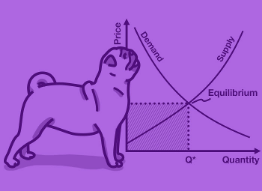
Value vs. Private Tutor
Expert microeconomics help minus the price tag.
Multi-Subject
Study microeconomics today and switch tomorrow.
Build Mastery
You actually get it before moving on.
Microeconomics Topics
1. Introduction to Economics
2. Problems of Economics
3. Demand and Supply
4. Elasticity
5. Welfare Economics
6. Consumer Choice
7. Output and Costs
8. Perfect Competition
9. Monopoly
11. Government & Inequalities
11 Chapters · 42 Topics · 453 Videos
Discover Our Learning Areas
Explore key subjects and start learning with interactive content.







What is Microeconomics?
Microeconomics is the branch of economics that studies how individual decision-makers — consumers, firms, and markets — allocate scarce resources. At its core, the discipline asks: how do prices form, how do people respond to incentives, and what happens when markets fail? Australian university Microeconomics units build from these foundations to cover a wide range of real-world applications, from analysing the petrol market to understanding why tech companies behave like oligopolists. It is typically one of the first units taken in an economics, commerce, or business degree, and it provides the analytical toolkit used in every subsequent economics subject.
What Topics Are Covered in University Microeconomics?
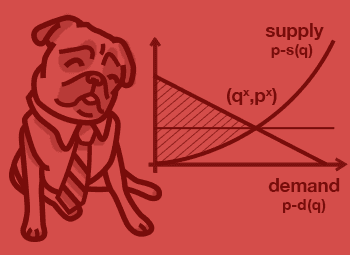
A standard first-year Microeconomics unit at an Australian university works through several interconnected modules. Supply and demand is almost always the starting point — you learn how prices and quantities are determined in competitive markets and how they shift in response to external events. Elasticity follows, measuring how sensitive buyers and sellers are to price changes, which has direct applications in business strategy and policy analysis.
Consumer theory introduces utility maximisation and indifference curve analysis, giving a rigorous account of how households make spending decisions. On the production side, you work through cost functions, short-run versus long-run trade-offs, and profit maximisation. Market structures then take centre stage: perfect competition, monopoly, monopolistic competition, and oligopoly each have distinct implications for pricing, output, and welfare. Game theory — including dominant strategies and Nash equilibria — is introduced to model strategic interaction between firms. Many units finish with welfare economics, externalities, and public goods, bridging the gap between positive and normative economics.
How Is Microeconomics Different from Other Economics Subjects?
Students often wonder how Microeconomics sits alongside Macroeconomics, Econometrics, and intermediate-level offerings. Microeconomics is distinguished by its focus on individual agents and specific markets rather than economy-wide aggregates. It is more algebraic and graphical than introductory Macroeconomics, requiring you to work through optimisation conditions and equilibrium diagrams from first principles.
Compared to Intermediate Microeconomics, which typically introduces calculus-based consumer and producer theory in full, the introductory unit is more intuitive but no less rigorous in its logic. Econometrics, by contrast, is a methods course that teaches you how to test economic hypotheses with data — it builds on the theoretical foundations that Microeconomics provides. Understanding where Microeconomics sits in the sequence helps you study it with the right level of ambition: deep enough to support later units, practical enough to apply immediately.
Is Microeconomics Hard? What Do Students Struggle With?
Microeconomics is widely considered a moderately challenging first-year subject, particularly for students who are new to formal economic reasoning or who have not studied mathematics recently. The subject requires you to move fluidly between verbal explanations, graphical representations, and algebraic expressions — often for the same concept. Students who read the textbook without doing practice problems frequently find that they understand the material in principle but cannot execute it under exam conditions.
The topics that generate the most difficulty are consumer theory (especially indifference curves and the budget constraint), cost-minimisation and production theory, and oligopoly models including game theory. Elasticity calculations cause errors because students confuse percentage changes with absolute changes, and demand-supply diagrams become tricky when multiple shifts happen simultaneously. The most reliable solution is structured practice: work through problems topic by topic, check your reasoning against a full solution, and then redo the problem without looking. StudyPug's adaptive practice system is built exactly for this workflow — it adjusts difficulty as your performance improves and flags the topics where your accuracy is still inconsistent.
Why StudyPug for Microeconomics?
StudyPug is built for exactly the study challenge that university Microeconomics presents: a large syllabus, a tight exam timeline, and a need to genuinely understand concepts rather than memorise them. The platform starts every student with a diagnostic assessment that maps their existing knowledge against the full microeconomics curriculum. Rather than working through every topic from scratch, you immediately know which areas need attention — and you can build a study plan around them.
Every video lesson is recorded by a certified teacher who explains the method, not just the answer. When you watch a lesson on monopoly profit maximisation or consumer surplus, you are learning the reasoning process that lets you handle any exam variant of that question — not just the specific example in the video. Lessons can be paused, rewound, and rewatched as many times as needed. For a subject like Microeconomics, where one unclear diagram can cascade into confusion across multiple topics, this is a significant advantage over a single lecture viewing.
Adaptive practice adjusts to your level as you work. If you answer elasticity questions confidently, the system moves you to harder applications. If you struggle with indifference curve shifts, it keeps you in that topic until your accuracy is solid. Combined with mock mid-semester and final-exam papers, this creates a complete preparation loop: learn the concept, practise at increasing difficulty, then test yourself under exam conditions. One subscription gives you access to every university economics course on StudyPug — Macroeconomics, Intermediate Microeconomics, Econometrics, Calculus, Statistics, and more — so your study tools grow with your degree.
What You Learn: Microeconomics Course Coverage
StudyPug's Microeconomics coverage is structured to follow the arc of a standard Australian university unit. The topic sequence moves from foundational market analysis through to strategic behaviour and market failure:
- Supply and demand — market equilibrium, price floors and ceilings, comparative statics
- Elasticity — price elasticity of demand and supply, income elasticity, cross-price elasticity, applications to revenue and tax incidence
- Consumer theory — utility functions, indifference curves, budget constraints, optimal consumption, income and substitution effects
- Production and costs — production functions, short-run and long-run cost curves, returns to scale, profit maximisation
- Perfect competition — firm and industry equilibrium, short-run and long-run adjustments, efficiency
- Monopoly — profit maximisation, deadweight loss, price discrimination, regulation
- Oligopoly and game theory — Cournot and Bertrand competition, Nash equilibrium, dominant strategies, the prisoner's dilemma
- Welfare economics and market failure — consumer and producer surplus, externalities, public goods, asymmetric information
Because no validated internal topic-page URLs are currently available for this course in the StudyPug sitemap, links to individual topic pages are omitted here. You can explore all available topics from the Microeconomics course page directly.
Using StudyPug for Microeconomics: A Practical Guide
The most effective way to use StudyPug for a university Microeconomics unit is to integrate it with your weekly study schedule rather than leaving it for the week before exams. At the start of semester, run the diagnostic assessment. This takes around fifteen minutes and gives you a clear picture of which topics are already comfortable and which need work — useful even if you have prior economics knowledge from school.
As each new topic is introduced in lectures, use StudyPug's video lessons the same day or the day after. The certified-teacher explanations reinforce what you heard in the lecture but work through the method in more detail, often with a different example that consolidates the concept. After watching, move straight into the adaptive practice set for that topic. Even five to ten problems per week per topic, done consistently, compounds into a significant advantage by mid-semester.
In the lead-up to your mid-semester exam, use StudyPug's mock exam papers to practise under timed conditions. Review every question you answered incorrectly and trace the error back to the concept — then rewatch the relevant video lesson and do a few more practice problems. Repeat this loop for the final exam. The 30-day money-back guarantee means there is no risk in starting your subscription at the beginning of semester and evaluating it after your first assessment. Free practice content is available from day one, so you can begin working on supply and demand problems before you commit to a full plan.
Microeconomics FAQ
Unsure how StudyPug works? Need help with setting up? Check our frequently asked questions or contact us for help.
What do you learn in Microeconomics, and what topics does it cover?
Microeconomics studies how individual households, firms, and markets make decisions about allocating scarce resources. Core topics include supply and demand, price elasticity, consumer theory, production and costs, perfect competition, monopoly, oligopoly, game theory, and factor markets. At Australian universities the course also introduces welfare economics, externalities, and public goods. By the end you understand how prices are set, how firms maximise profit, and how government policy affects market outcomes — skills that carry directly into intermediate economics and finance units.
What is the difference between Microeconomics and Macroeconomics?
Microeconomics examines decisions made by individual agents — consumers, firms, and industries — and how those decisions interact in specific markets. Macroeconomics steps back to study the economy as a whole: GDP, inflation, unemployment, monetary policy, and fiscal policy. Most Australian economics degrees require both in first year. Microeconomics tends to be more mathematical, focusing on optimisation and equilibrium in single markets, while Macroeconomics is more model-driven at the aggregate level. A solid grasp of micro is usually essential before tackling intermediate macro.
What are the prerequisites for Microeconomics, and what course comes after it?
Most Australian university Microeconomics units assume Year 12 Economics or basic calculus, though many introductory offerings are designed for students without a prior economics background. After first-year Microeconomics, students typically progress to Intermediate Microeconomics, which uses more advanced calculus and game theory, and then to electives such as Industrial Organisation, Behavioural Economics, or Public Economics. Students in commerce or business degrees often pair micro with Introductory Macroeconomics in the same semester.
Is Microeconomics hard, and where do students struggle most?
Microeconomics is considered moderately challenging at university level. Students with little maths background often struggle with elasticity calculations, cost-minimisation problems, and interpreting supply-demand diagrams under shifting conditions. Indifference curves and consumer theory trip up many first-years, as does the transition from perfect competition to imperfect competition models. Game theory — particularly Nash equilibria — is another common sticking point. The key is practising problems regularly rather than just reading notes, and making sure you understand the economic intuition behind each model before moving on.
How is Microeconomics assessed — mid-semesters, finals, and assignments?
Australian university Microeconomics units typically combine a mid-semester exam (worth 20–35%), a final exam (40–50%), and one or two assignments or tutorial participation components. Final exams are usually two to three hours and test problem-solving across all major topics. Some units include online quizzes throughout the semester for continuous assessment. Grading follows the standard Australian scale: High Distinction, Distinction, Credit, Pass, and Fail. Knowing the exam format early helps you allocate study time — StudyPug's mock exams are built to mirror the structure of university-level assessments.
What is one of the hardest topics in Microeconomics, and how do you approach it?
Consumer theory — particularly indifference curve analysis and utility maximisation — is consistently rated among the hardest topics in first-year Microeconomics. Students must simultaneously understand budget constraints, marginal rates of substitution, and the conditions for an interior optimum. The best approach is to start with the graphical intuition: draw the budget line and indifference map together, then practise shifting each one in response to price and income changes. Once the geometry is clear, work through the algebraic optimisation using Lagrange conditions. Doing five to ten practice problems from scratch, without looking at solutions, is the fastest path to genuine understanding.





Written by the StudyPug Team
Last updated June 5, 2026
3 M+
students
★★★★★
4.8 average
K–12
all grades