AP Chemistry Help — Video Lessons & Practice
Get clear explanations for any AP Chemistry problem and build exam-ready confidence.

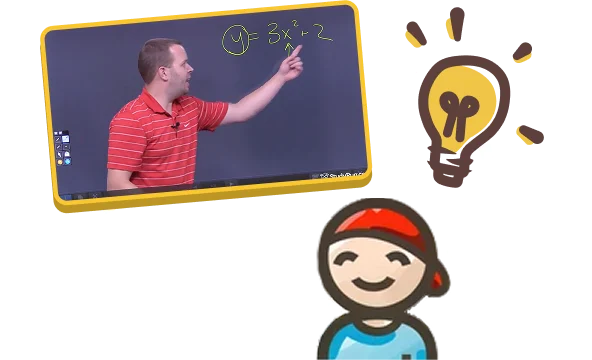
Certified-Teacher Concept Videos
Watch step-by-step AP Chemistry lessons made by certified teachers — not AI — that teach you the method, so you can solve similar problems on your own and feel confident going into the ATAR.
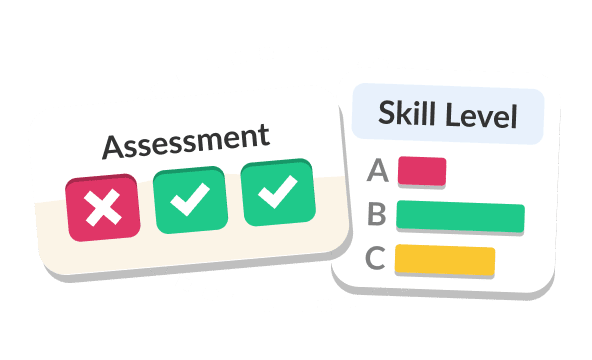
Diagnostic Assessment
A quick diagnostic pinpoints exactly which AP Chemistry topics need your attention, so you study smarter — no wasted time working through concepts you already know.

Adaptive Practice
Practice questions adjust to your performance level, building your AP Chemistry skills efficiently from stoichiometry through thermodynamics and beyond.
AP Chemistry Topics
1. Foundation Chemistry
3. Acid-Base Theory
4. Solubility and Precipitation
5. Enthalpy and Thermodynamics
6. Redox and Electrochemistry
7. Kinetics
8. Atomic Structure and Properties
9. Chemical Bonding
Discover Our Learning Areas
Explore key subjects and start learning with interactive content.








What is AP Chemistry?
AP Chemistry is a college-level chemistry course and exam offered by the College Board, designed to give high school students the equivalent of a first-year university chemistry experience. Students who score well on the AP Chemistry exam can earn university credit at many institutions in Australia, the United States, and internationally, giving them a genuine academic advantage before they even begin their degree.
The course demands a high level of both conceptual understanding and mathematical problem-solving. Rather than memorising facts, students learn to reason about chemical systems, design experiments, interpret data, and construct evidence-based arguments — skills that underpin success in any STEM field.
What Topics Does AP Chemistry Cover?
AP Chemistry is broad and deep. The major topic areas include atomic structure and periodicity, chemical bonding and molecular geometry, stoichiometry and chemical reactions, thermodynamics, chemical kinetics, chemical equilibrium, electrochemistry, and acid-base chemistry. Each unit builds on the last, meaning gaps in foundational understanding compound quickly.
Stoichiometry underpins nearly every calculation in the course. Equilibrium and thermodynamics are the areas students most often flag as difficult, requiring both conceptual clarity and comfort with logarithms and multi-step algebra. Electrochemistry — covering galvanic cells, electrolysis, and standard reduction potentials — is another high-yield area for the AP exam's free-response section.
Is AP Chemistry Hard?
Yes — AP Chemistry is consistently ranked among the most demanding AP courses. The combination of abstract chemical concepts, quantitative problem-solving, and laboratory reasoning makes it genuinely challenging for most Year 12 students. That said, difficulty is not the same as impossibility. Students who approach each topic methodically, learn the underlying method rather than just formula patterns, and practise with exam-style problems regularly can and do achieve scores of 4 or 5.
The students who struggle most are typically those who try to memorise their way through the course. AP Chemistry rewards understanding. If you can explain why a reaction shifts when conditions change, you can answer any equilibrium question — even one you have never seen before. That is what the right kind of study help makes possible.
How Does AP Chemistry Relate to the ATAR?
AP Chemistry is not part of the standard Australian Curriculum or ATAR assessment pathway. It is a College Board qualification taken by Australian students who want to pursue international university options, earn advance credit at US or Canadian institutions, or seek recognition at Australian universities that accept AP credentials. Some Australian universities, particularly those with strong international partnerships, do grant credit for AP scores of 4 or 5.
If you are an Australian student taking AP Chemistry alongside your ATAR subjects, you are carrying a significant workload. Having reliable, on-demand chemistry help is not a luxury — it is a practical necessity when you are managing multiple assessment streams at once.
What Comes Before and After AP Chemistry?
Before starting AP Chemistry, students should be confident in Year 10 or Year 11 Chemistry fundamentals: the periodic table, ionic and covalent bonding, balancing equations, and mole calculations. Mathematical comfort with algebra and basic logarithms is also essential. Students who struggle with these foundations will find the pace of AP Chemistry overwhelming from the first few weeks.
After AP Chemistry, the pathways are wide. Strong performance opens doors to university chemistry, biochemistry, chemical engineering, pharmacy, and medicine. Students who earn university credit effectively skip introductory chemistry at university, allowing them to move directly into more specialised second-year content.
Why StudyPug for AP Chemistry?
StudyPug is built around one core idea: you learn chemistry by understanding how to solve problems, not by watching someone else solve them for you. Every AP Chemistry video lesson on StudyPug is made by a certified teacher who walks you through the method — step by step — so that you can apply the same reasoning to any similar problem on the actual AP exam.
Before you watch a single lesson, a short diagnostic assessment identifies exactly which AP Chemistry topics are your weakest points. That means you are never wasting time on material you already know. You go straight to what matters. As you work through practice problems, adaptive practice technology adjusts the difficulty to match your current level, so you are always being challenged appropriately — not bored by easy questions and not overwhelmed by ones that are too hard.
All of this is available 24 hours a day, seven days a week. Whether you are reviewing stoichiometry at 10pm before a test or working through equilibrium on a Sunday afternoon, StudyPug AP Chemistry help is there. On any device. No appointment needed.
What You Learn — AP Chemistry Curriculum Coverage
StudyPug covers the full AP Chemistry curriculum as specified by the College Board, including all nine units: atomic structure, molecular and ionic compound structure and properties, intermolecular forces and properties, chemical reactions, kinetics, thermodynamics, equilibrium, acids and bases, and electrochemistry. Lessons are aligned to AP exam question types, including both the multiple-choice section and the free-response questions that require written chemical reasoning.
Practice problems on StudyPug are based on real exam-style questions, giving you confidence that what you are practising reflects what you will face on exam day. Photo Search is also available: if you are stuck on a specific problem from your textbook or a past paper, you can use Photo Search to find the matching StudyPug lesson instantly — across all grades and subjects, including AP Chemistry.
Because no validated internal topic links are available in the current link map for this page, we have not linked to specific topic pages here. The full AP Chemistry topic library is accessible directly from the AP Chemistry course page on StudyPug.
Using StudyPug for AP Chemistry
Getting started is straightforward. Sign up, take the short AP Chemistry diagnostic, and StudyPug will show you exactly where to begin. From there, work through the video lessons for your priority topics, then move to practice problems. The adaptive practice engine will track your performance and adjust as you improve.
For exam preparation, work through the practice tests available in your StudyPug subscription. These are built to mirror the structure and difficulty of the actual AP Chemistry exam, so you go in knowing what to expect. Every subscription comes with a 30-day money-back guarantee — the only guarantee StudyPug makes. If it is not working for you in the first 30 days, you get a full refund. There is no lock-in, no cancellation fee, and you can manage everything from your account settings.
AP Chemistry is hard. The right help makes a measurable difference. Start with StudyPug today and find out exactly what you need to work on.
AP Chemistry FAQ
Unsure how StudyPug works? Need help with setting up? Check our frequently asked questions or contact us for help.
What do you learn in AP Chemistry, and what topics does it cover?
AP Chemistry covers atomic structure, chemical bonding, stoichiometry, thermodynamics, kinetics, equilibrium, electrochemistry, and acid-base chemistry. Students learn to apply mathematical reasoning to chemical systems, interpret data from experiments, and construct scientific arguments. The course is designed to be equivalent to a first-year university chemistry course, demanding both conceptual understanding and strong problem-solving skills across a wide range of physical and chemical phenomena.
What is the difference between AP Chemistry and standard Year 12 Chemistry?
AP Chemistry goes significantly deeper than standard Year 12 Chemistry in both breadth and mathematical rigour. Where standard chemistry introduces concepts like equilibrium and thermodynamics at a descriptive level, AP Chemistry requires quantitative analysis, multi-step problem solving, and experimental design. The AP exam also tests free-response writing about chemical reasoning. Students choosing AP Chemistry are typically aiming for university credit or selective STEM degree entry.
Is AP Chemistry hard, and where do students struggle most?
AP Chemistry is widely considered one of the most demanding AP subjects. Students most commonly struggle with chemical equilibrium (especially ICE tables and Le Chatelier's principle), thermodynamics (Gibbs free energy and entropy), electrochemistry (cell potentials), and multi-step stoichiometry. The mathematical load combined with conceptual depth is where most students hit a wall. Breaking each topic into clear, methodical steps — rather than trying to memorise formulas — is the most effective approach.
What should I take before AP Chemistry, and what comes after it?
Students should have a solid foundation in Year 10 or Year 11 Chemistry and be comfortable with algebra and basic logarithms before starting AP Chemistry. Prerequisites also include familiarity with the periodic table, basic bonding, and mole calculations. After AP Chemistry, students are well prepared for university-level courses in chemistry, biochemistry, chemical engineering, medicine, and pharmacy. Many universities grant credit for a score of 4 or 5 on the AP exam.
Is AP Chemistry on the ATAR, and how is it tested?
AP Chemistry is a College Board course and exam, not part of the standard Australian ATAR curriculum. Australian students may take AP Chemistry independently or through schools offering the AP programme. The AP Chemistry exam includes a multiple-choice section and a free-response section requiring written scientific arguments and calculations. A strong AP Chemistry score (4 or 5) can earn university credit at many Australian, US, and international universities, complementing or supplementing ATAR pathways.
What is one of the hardest concepts in AP Chemistry, and how do you tackle it?
Chemical equilibrium is consistently the concept students find hardest. Understanding how to set up an ICE (Initial, Change, Equilibrium) table, apply the equilibrium constant expression, and use Le Chatelier's principle under exam conditions requires both conceptual clarity and methodical practice. The best approach is to watch a lesson that teaches the complete method step by step, then work through multiple practice problems of increasing difficulty until the process becomes automatic — not just memorised.