Topic
My Progress
Pug Score
0%
Best Streak
0 in a row
Study Points
+0
Overview
Practice
Watch
Read
Quiz
Next Steps
Overview
Practice
Watch
Read
Quiz
Next Steps
Read
Explore Living and Non-Living Parts of an Ecosystem
You will learn how ecosystems are made up of both living things (biotic factors) and non-living things (abiotic factors) that work together and depend on each other to survive.
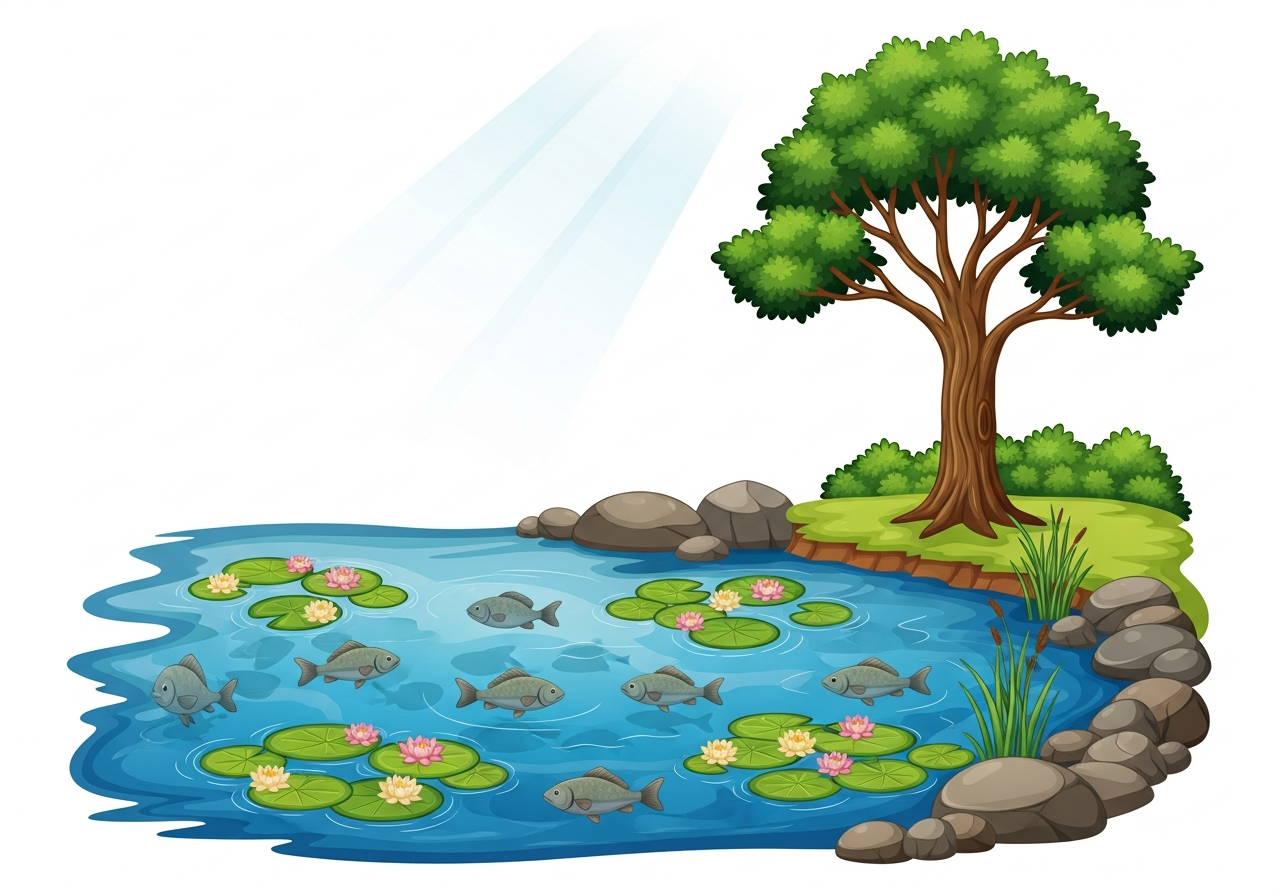
An ecosystem is a community of living things and their non-living surroundings all working together. You can find ecosystems everywhere in a pond, a forest, a desert, or even your backyard. Every ecosystem has two main types of parts: living things and non-living things.
When you study Communities and how populations interact, you will see how all the parts of an ecosystem connect. Understanding ecosystems also prepares you for topics like Terrestrial Biomes and Aquatic Biomes.
Living Parts of an Ecosystem: Biotic Factors
The living parts of an ecosystem are called biotic factors. Something is living if it grows, needs energy, and can reproduce to make more of its own kind. Plants, animals, fungi, and bacteria are all biotic factors.
You can tell if something is living by asking three questions: Does it grow? Does it need food or sunlight? Can it reproduce? If the answer is yes to all three, it is a living thing. A deer, a pine tree, and a mushroom are all living parts of an ecosystem.
Living things in an ecosystem play different roles. Producers (like green plants) make their own food using sunlight and water through a process called photosynthesis. Consumers (like animals) eat other organisms to get energy. Decomposers (like worms and fungi) break down dead organisms and return nutrients to the soil. You will explore these roles more when you study Trophic Levels: Producers, Consumers, and Decomposers and Energy Transfer.
Non-Living Parts of an Ecosystem: Abiotic Factors
The non-living parts of an ecosystem are called abiotic factors. These are things that were never alive and do not grow, breathe, or reproduce. Examples include sunlight, water, air, soil, rocks, and temperature.
Even though abiotic factors are not alive, every living thing depends on them. Plants use sunlight to make food, roots grow in soil to absorb nutrients, and all animals need water and air to survive. Without non-living parts, no living thing could survive in an ecosystem.

How Living and Non-Living Parts Work Together
In every ecosystem, living and non-living parts are deeply connected. A fish (living) needs clean water (non-living) to breathe and swim. A cactus (living) stores water because the desert gets very little rain (non-living factor). A beaver (living) can even change the flow of water (non-living) by building a dam.
Non-living factors like temperature and rainfall also decide which living things can survive in an ecosystem. A cold tundra ecosystem has very low temperatures that freeze the ground, so only specially adapted animals can live there. You will learn more about this when you study Behavioral Adaptations and Structural Adaptations.
Key Terms and Definitions
Ecosystem: An ecosystem is a community of living things and their non-living surroundings that all interact and work together. For example, a pond with fish, frogs, water, and sunlight is a complete ecosystem.
Biotic Factors: Biotic factors are all the living parts of an ecosystem things that grow, need energy, and can reproduce. Plants, animals, fungi, and bacteria are all biotic factors.
Abiotic Factors: Abiotic factors are all the non-living parts of an ecosystem things that were never alive, like water, sunlight, air, soil, rocks, and temperature. They support all the living things around them.
Habitat: A habitat is the specific natural place where a living thing makes its home and finds everything it needs to survive, such as food, water, and shelter. For example, a pond is the habitat of a frog.
Producer: A producer is a living thing usually a green plant that makes its own food using sunlight and water through photosynthesis. Producers create food energy for other organisms in the ecosystem.
Consumer: A consumer is a living thing that gets energy by eating other organisms. Rabbits, deer, and hawks are all consumers.
Decomposer: A decomposer is a living thing like a worm, fungus, or bacteria that breaks down dead organisms and returns nutrients to the soil. Decomposers are an important part of recycling nutrients in an ecosystem.
Photosynthesis: Photosynthesis is the process that plants use to make their own food. Plants use sunlight, water, and carbon dioxide from the air to create food energy. Without sunlight, plants cannot make food, and most animals would eventually lose their food source too.
Organism: An organism is any living thing. Every organism grows, needs energy, and can reproduce. Trees, fish, mushrooms, and bacteria are all organisms.
Practice What You Know
You can practice identifying living and non-living parts by looking at any ecosystem around you. Try listing everything you see and sorting each item into two groups: biotic (living) or abiotic (non-living). Ask yourself: Does it grow? Does it need food or sunlight? Can it reproduce?
You can also practice using a traits table like the one below to classify ecosystem items:
| Ecosystem Item | Grows? | Needs Food or Sunlight? | Can Reproduce? | Living or Non-Living? |
|---|---|---|---|---|
| Oak Tree | Yes | Yes | Yes | Living (Biotic) |
| Deer | Yes | Yes | Yes | Living (Biotic) |
| Rock | No | No | No | Non-Living (Abiotic) |
| Wind | No | No | No | Non-Living (Abiotic) |
| Mushroom | Yes | Yes | Yes | Living (Biotic) |
| Sunlight | No | No | No | Non-Living (Abiotic) |
Remember: a dead tree was once alive, so it is still considered a biotic factor not an abiotic one. This is an important distinction you will use in your practice questions.
What You Already Know That Helps
You have already learned about Animal Groups and major animal classifications and Plant Groups and major plant classifications these are all biotic factors in ecosystems. Your knowledge of Animal Adaptations and Plant Adaptations shows you how living things are shaped by the non-living parts of their ecosystems.
You also know about Water Sources and natural water bodies, which are key abiotic factors. Your understanding of Natural Resources, Conservation, Environmental Changes, and Stewardship all connect to how living and non-living parts of ecosystems must be protected and cared for.
Related Topics and Connections
Understanding ecosystem components opens the door to many exciting science topics. Here is how they all connect to what you are learning now:
You will soon explore Population Dynamics groups of organisms living in the same area and Communities and how populations interact with each other inside ecosystems. These topics build directly on your understanding of biotic factors.
The non-living parts you learn about here connect to Soil Composition and its properties, as well as Matter Cycles like the water, carbon, and nitrogen cycles. You will also study Energy Transfer from producers to consumers, Energy Loss and transfer efficiency, and Food Webs and interconnected food chains all of which depend on both living and non-living ecosystem parts working together.
Your ecosystem knowledge also connects to Resource Use and its effects on the environment, Conservation and protection strategies, and Environmental Knowledge about local ecosystems. You will explore how humans affect ecosystems in Environmental Science and how to protect them through Habitat Protection and Sustainable Practices.
You will also discover how traditional knowledge connects to ecosystems through Indigenous Science and Traditional Ecological Knowledge, Traditional Practices and Resource Management, and Cultural Practices for Sustainable Resource Management. Finally, Energy Flow through food webs and the study of Terrestrial Biomes and Aquatic Biomes will show you how different ecosystems around the world are organized.