TOPIC
Food Webs, Interconnected food chainsMY PROGRESS
Pug Score
0%
Getting Started
"Let's build your foundation!"
Best Streak
0 in a row
Study Points
+0
Overview
Practice
Read
Quiz
Next Steps
Get Started
Get unlimited access to all videos, practice problems, and study tools.
BACK TO MENU
Topic Progress
Pug Score
0%
Getting Started
"Let's build your foundation!"
Best Practice
No score
Read
Not viewed
Best Quiz
No attempts
Best Streak
0 in a row
Study Points
+0
Overview
Practice
Read
Quiz
Next Steps
Read
Food Webs: Discover How Food Chains Connect in Nature
You will learn how food chains connect and overlap to form food webs, and how every living thing plays an important role in keeping an ecosystem healthy and balanced.
What Is a Food Chain?
A food chain shows the path that energy takes as one living thing eats another. It always starts with a producer a green plant that uses sunlight to make its own food. From there, energy moves through consumers in a straight line.
For example: Sun Grass Grasshopper Frog Snake Hawk. Each arrow shows the direction energy flows from the food to the eater. You can think of it as a chain where every link matters.
You will also learn about Energy Transfer: Producer to Consumer Flow, which explains exactly how energy passes from one organism to the next.
What Is a Food Web?
A food web is made up of many food chains that overlap and connect with each other. Most animals eat more than one type of food, so they are part of more than one food chain at the same time.
Imagine two food chains that both include a snake and a hawk. Because those two animals appear in both chains, the chains are linked and together they form a food web. Food webs give you a fuller, more realistic picture of feeding relationships in an ecosystem.
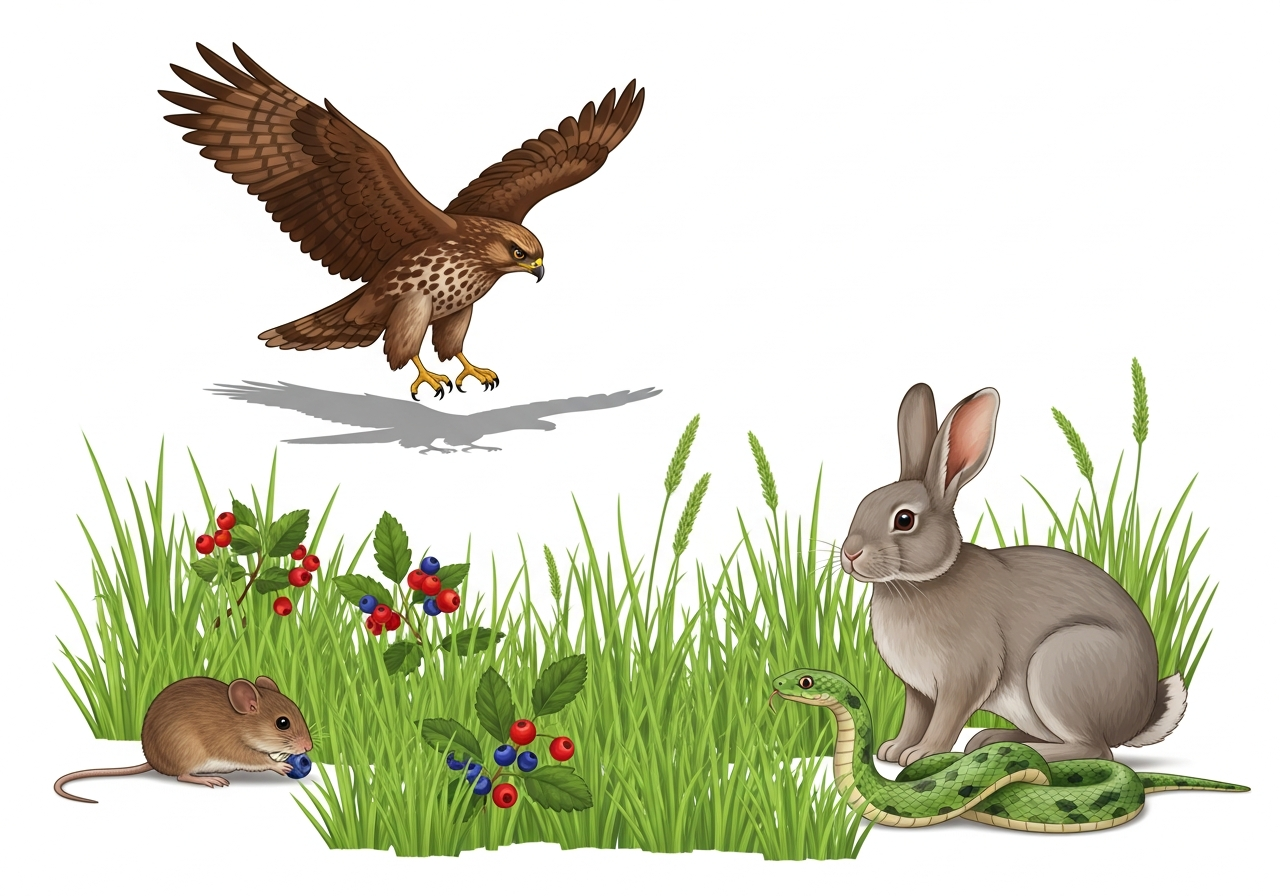
You can explore how these connections work in more detail when you study Energy Flow: Food Webs and Energy Transfer.
Roles in a Food Web
Every organism in a food web has a special role. Here is how each role works:
- Producers Plants like grass and pond weed make their own food using sunlight. They always start a food chain.
- Primary Consumers These are the first animals to eat the producer, such as a rabbit eating grass.
- Secondary Consumers These animals eat the primary consumers, such as a fox eating a rabbit.
- Top Predators These animals are at the very end of the food chain and are not eaten by any other animal, such as a hawk or a lion.
- Decomposers Organisms like worms, fungi, and bacteria break down dead plants and animals and return nutrients to the soil, helping plants grow again.
Understanding these roles connects to what you will learn in Trophic Levels: Producers, Consumers, Decomposers.
Types of Consumers: Herbivores, Carnivores, and Omnivores
Animals in a food web can be grouped by what they eat. A herbivore eats only plants like a caterpillar munching on leaves. A carnivore eats only other animals like a hawk hunting a mouse. An omnivore eats both plants and animals like a bear eating berries and fish.
Knowing what each animal eats helps you understand where it fits in a food web and how many food chains it might be part of.
What Happens When One Organism Is Removed?
Food webs are interconnected, so removing one organism affects the whole web. If all the grass in a meadow disappeared, rabbits and other plant-eaters would lose their food source. Then the foxes and hawks that eat those animals would also struggle to find food.
This ripple effect shows why every organism even a small one is important. You will explore this idea further when you study Energy Loss: Energy Transfer Efficiency and Communities: Interaction Between Populations.
Key Terms and Definitions
Food Chain: A food chain is a path that shows how energy moves from one living thing to another through eating. It always starts with a producer and moves through consumers in order.
Food Web: A food web is made up of many food chains that are linked and connected together. It shows the complex feeding relationships in an ecosystem.
Producer: A producer is a living thing usually a green plant that makes its own food using sunlight, water, and carbon dioxide. Producers always start a food chain.
Consumer: A consumer is a living thing that must eat other organisms to get its energy. Consumers cannot make their own food.
Primary Consumer: A primary consumer is the first animal in a food chain that eats the producer directly, such as a caterpillar eating a leaf.
Secondary Consumer: A secondary consumer eats the primary consumer. For example, a robin that eats a caterpillar is a secondary consumer.
Top Predator: A top predator is an animal at the very end of a food chain that is not hunted or eaten by any other animal, such as a hawk or a shark.
Decomposer: A decomposer is an organism like a worm, mushroom, or bacterium that breaks down dead plants and animals and returns nutrients to the soil.
Herbivore: A herbivore is an animal that eats only plants and plant materials, such as a rabbit or a caterpillar.
Carnivore: A carnivore is an animal that gets its energy by eating only other animals, such as a wolf or a hawk.
Omnivore: An omnivore is an animal that eats both plants and other animals for energy, such as a bear or a raccoon.
Predator: A predator is an animal that hunts and eats other animals. For example, a fox is a predator that hunts rabbits.
Prey: Prey is the animal that gets caught and eaten by a predator. For example, a mouse is prey for an owl.
Energy Flow: Energy flow describes how energy moves through a food chain, starting from the sun, moving to producers, and then to consumers at each level.
Ecosystem: An ecosystem is all the living and non-living things in an area that interact with each other, such as a pond, a meadow, or a forest.
Practice Activities
You can practice drawing your own food web by listing animals from your local environment and drawing arrows to show who eats whom. Try to find animals that appear in more than one food chain those are the links that connect chains into a web.
You can also try removing one organism from your food web and predicting what would happen to the other organisms. This activity connects to what you will explore in Environmental Science: Human Effects on Ecosystems and Habitat Protection: Conservation Methods.
What You Should Know Before This Topic
Before studying food webs, it helps to understand how animals survive in their environments. You should be familiar with Animal Adaptations: Physical and Behavioral Features, which explains how animals are built and behave to help them find food and stay safe.
You should also know about Environmental Changes: Local Ecosystem Effects, which shows how changes in an environment can affect the living things inside it. These ideas will help you understand why food webs are so important for keeping ecosystems healthy.
Related Topics and Connections
Food webs connect to many other science topics that you will explore. Here is how they all fit together:
- Energy Transfer: Producer to Consumer Flow You will learn exactly how energy passes from plants to animals at each step of a food chain.
- Trophic Levels: Producers, Consumers, Decomposers You will explore the different feeding levels that every organism belongs to in a food web.
- Energy Loss: Energy Transfer Efficiency You will discover why the amount of energy gets smaller at each step up a food chain.
- Communities: Interaction Between Populations You will see how different groups of organisms interact with each other in the same area.
- Ecosystem Components: Living and Non-Living Elements You will learn about all the parts living and non-living that make up an ecosystem.
- Population Dynamics: Groups of Organisms in an Area You will understand how the size of animal populations changes and affects food webs.
- Behavioral Adaptations: Actions That Aid Survival You will explore how animal behaviors help them find food and avoid being eaten.
- Structural Adaptations: Physical Features for Survival You will see how an animal's body parts help it succeed in its role in a food web.
- Conservation: Protection Strategies You will learn how protecting food webs helps keep entire ecosystems healthy.
- Resource Use: Effects on Environment You will discover how the way humans use resources can affect food webs.
- Environmental Knowledge: Local Ecosystem Understanding You will build knowledge about the ecosystems right around you.
- Traditional Practices: Resource Management and Sustainable Practices You will explore how traditional ways of living can help protect food webs.
- Energy Flow: Food Webs and Energy Transfer This is a topic you will study next, going deeper into how energy moves through food webs.
- Matter Cycles: Water, Carbon, and Nitrogen Cycles You will learn how matter moves through ecosystems alongside energy.
- Aquatic Biomes: Water-Based Ecosystem Types You will explore food webs that exist in oceans, rivers, and ponds.
- Terrestrial Biomes: Land-Based Ecosystem Types You will discover food webs found in forests, grasslands, and deserts.
- Environmental Science: Human Effects on Ecosystems You will examine how human actions can disrupt food webs.
- Habitat Protection: Conservation Methods You will learn ways to protect the habitats that food webs depend on.