Topic
Terrestrial Biomes, Land-based ecosystem typesMy Progress
Pug Score
0%
Getting Started
Let's build your foundation!
Best Streak
0 in a row
Study Points
+0
Overview
Practice
Read
Quiz
Next Steps
Back to Menu
Topic Progress
Pug Score
0%
Getting Started
"Let's build your foundation!"
Best Practice
No score
Read
Not viewed
Best Quiz
No attempts
Best Streak
0 in a row
Study Points
+0
Overview
Practice
Read
Quiz
Next Steps
Read
Discover Earth's Terrestrial Biomes: Land-Based Ecosystems Explained
You will explore Earth's major terrestrial biomes, learning how climate shapes each land-based ecosystem and the unique plants and animals that live there.
What Is a Terrestrial Biome?
A biome is a large region on Earth that has a similar climate, similar types of plants, and similar animals. You can think of a biome as a giant neighborhood where living things share the same weather conditions. Climate especially temperature and how much rain falls is the main factor that determines which biome exists in a place.
You already know about Climate Zones and Regional Variations, which is the foundation for understanding why different biomes exist in different parts of the world. You also know about Ecosystem Components Living and Non-Living Elements, which helps you understand what makes up each biome.
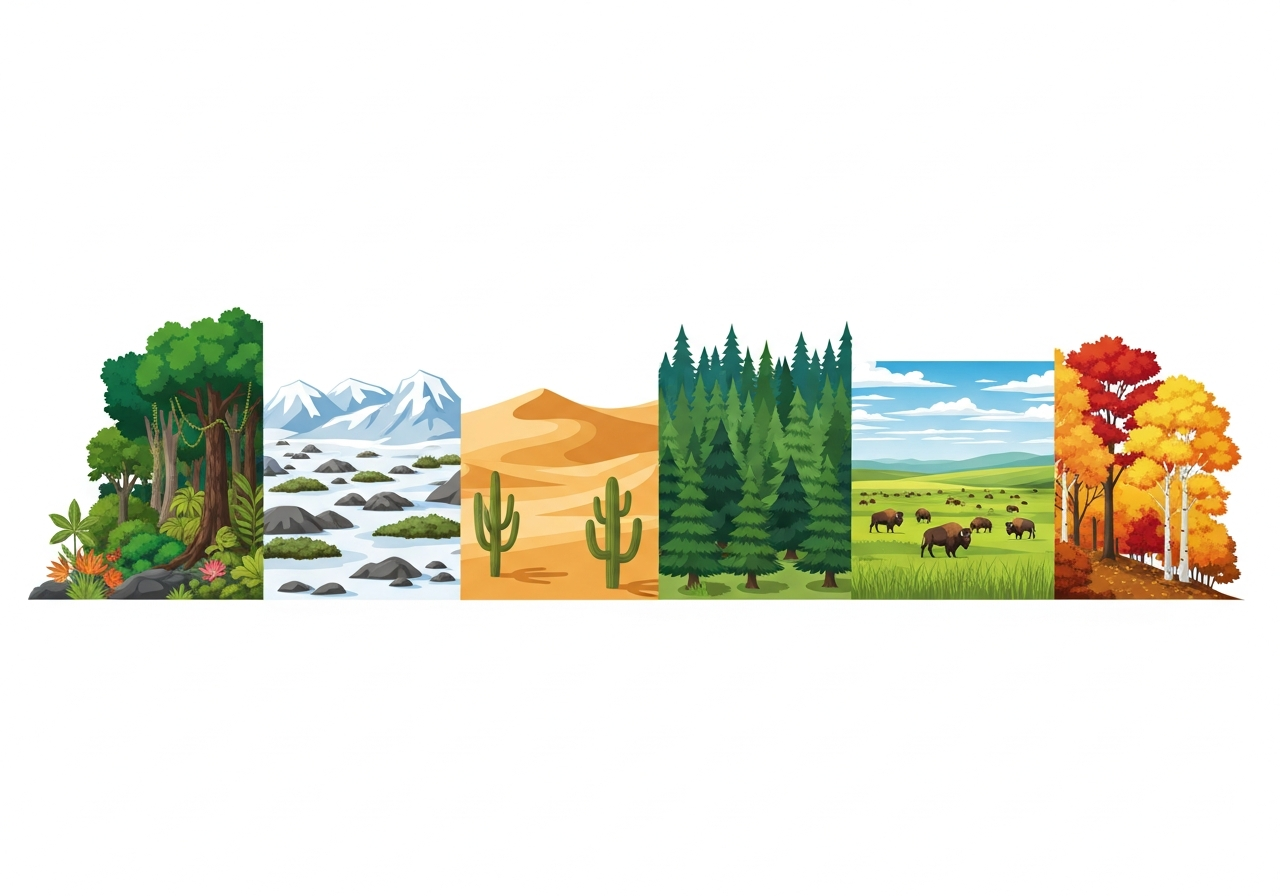
The Major Terrestrial Biomes
Tropical Rainforest
The tropical rainforest is found near the equator and receives over 200 cm (about 80 inches) of rainfall every year. It is warm all year long. This makes it the most biodiverse biome on Earth home to more species of plants and animals than any other land ecosystem. You would find toucans, tree frogs, colorful parrots, and ferns living here. The rainforest is sometimes called "the lungs of the Earth" because its billions of plants produce enormous amounts of oxygen.
The rainforest has layers. The emergent layer is the very top, where the tallest trees poke above everything else and get the most sunlight. The canopy is the thick upper layer of treetops that blocks most sunlight from reaching below. The understory is the shaded middle section, and the forest floor is the dark bottom layer. Surprisingly, rainforest soil is actually thin and poor in nutrients because heavy rains wash nutrients away the nutrients are stored in the living plants themselves.
Desert Biome
The desert biome is defined by very little rainfall usually less than 10 inches per year. Many deserts are extremely hot during the day. Desert plants like cacti have thick, waxy stems to store water and prevent it from evaporating. Cacti also have shallow, wide-spreading roots that quickly soak up rain before it evaporates. Animals like camels are perfectly adapted to survive with very little water.
Tundra Biome
The tundra is the coldest land biome, found near the North and South Poles. It has a layer of permanently frozen ground called permafrost just below the surface, which prevents deep-rooted plants from growing. Only tough organisms like lichen can grow on bare rocks. Animals like the caribou migrate to find food, while the Arctic fox uses its thick white fur to stay warm and hidden. Tundra plants like mosses and dwarf shrubs grow very low to the ground to stay out of the freezing wind.
Taiga Biome
The taiga, also called the boreal forest, is the world's largest land biome. It stretches across northern Canada, Russia, and Europe. The taiga is dominated by conifers trees that stay green all year and produce cones. Their needle-like leaves are coated in wax to prevent water loss in cold, dry air. Large animals like the moose, wolves, and lynx are well suited to the taiga, and many smaller animals survive winter through hibernation.
Grassland Biome
Grasslands are wide open areas covered mostly by grasses and low-growing wildflowers. There are not enough trees because rainfall is moderate enough for grasses but not enough for large trees. Temperate grasslands, like the American prairies, have hot summers and cold winters. Tropical grasslands, called savannas, are found in warm regions like the African Serengeti, where zebras, lions, and elephants live among scattered trees.
Temperate Forest Biome
The temperate forest has four distinct seasons spring, summer, fall, and winter with moderate rainfall and temperatures. It is home to deciduous trees, which lose all of their leaves during autumn and winter to conserve energy and water. In spring, new leaves grow back. Animals like many birds migrate south in winter because food sources disappear in the cold. The giant panda lives in temperate forests in China where bamboo grows abundantly.
Key Terms and Definitions
Biome: A biome is a large region on Earth with a similar climate, similar plants, and similar animals. You can identify a biome by its temperature, rainfall, and the types of living things found there.
Permafrost: Permafrost is the layer of soil in the tundra that stays frozen all year long, even in summer. Because of permafrost, deep-rooted plants cannot grow in the tundra.
Lichen: Lichen is a tough organism that can grow on bare rocks in very cold or harsh environments like the tundra. It is one of the few living things that can survive in such extreme conditions.
Caribou: The caribou is a large deer-like animal that lives in the tundra. It migrates meaning it travels long distances to find food during different seasons.
Arctic fox: The Arctic fox is a small animal that lives in the tundra. It has thick white fur that keeps it warm and helps it blend into the snowy landscape.
Taiga: The taiga, also called the boreal forest, is the world's largest land biome. It is found in cold northern regions and is filled with evergreen conifer trees.
Boreal forest: The boreal forest is another name for the taiga. It covers vast areas of northern Canada, Russia, and Scandinavia.
Conifer: A conifer is a type of tree that produces cones and keeps its needle-like leaves all year long. Conifers are the main trees of the taiga biome.
Moose: The moose is a very large animal that lives in the taiga. It is well adapted to cold temperatures and feeds on plants found in and around forests and wetlands.
Hibernation: Hibernation is when an animal goes into a deep sleep-like state during winter to survive the cold and lack of food. Many taiga animals hibernate to make it through the long, cold winters.
Deciduous: Deciduous describes trees that lose all of their leaves during autumn and winter. This helps the tree save energy and water when it is cold and sunlight is limited.
Biodiversity: Biodiversity means the variety of different species of plants and animals living in a place. The tropical rainforest has the highest biodiversity of any land biome on Earth.
Canopy: The canopy is the thick upper layer formed by the tops of the tallest trees in a rainforest. It blocks most sunlight from reaching the forest floor below.
Emergent layer: The emergent layer is the very top layer of the rainforest, made up of the tallest trees that poke above the canopy and receive the most direct sunlight.
Savanna: A savanna is a tropical grassland with warm temperatures, a wet and dry season, and scattered trees. The African Serengeti is a famous savanna where lions, zebras, and elephants live.
Practice What You Know
You can practice identifying biomes by thinking about their key features. Ask yourself: How much rain does this place get? How hot or cold is it? What kinds of plants and animals live there? These three questions will help you match any description to the correct biome.
Try connecting what you know about Structural Adaptations Physical Features for Survival and Behavioral Adaptations Actions That Aid Survival to the animals and plants in each biome. For example, a cactus storing water in its thick stem is a structural adaptation for the desert biome.
You can also think about Food Webs and Interconnected Food Chains within each biome. Every biome has its own food web made up of producers, consumers, and decomposers that are all adapted to that environment.
Building on What You Already Know
Before exploring terrestrial biomes, you built important knowledge in several areas. You learned about Weather Patterns and Long-Term Weather Trends, which helps you understand how climate shapes each biome. You also studied Types of Landforms Mountains, Valleys, and Plains, which explains why different biomes form in different physical locations.
Your understanding of Communities and Interaction Between Populations and Population Dynamics Groups of Organisms in an Area helps you see how living things in each biome depend on each other. You also know about Energy Transfer from Producer to Consumer and Trophic Levels Producers, Consumers, and Decomposers, which apply to every biome's food web.
Your knowledge of Resource Use and Effects on the Environment, Conservation and Protection Strategies, and Environmental Knowledge and Local Ecosystem Understanding all connect to why protecting biomes matters.
Related Topics and Connections
Terrestrial biomes connect to many other important science topics. You will explore Aquatic Biomes Water-Based Ecosystem Types as the companion topic to terrestrial biomes. While you study land biomes here, aquatic biomes cover oceans, rivers, and lakes.
Understanding Climate Regions Temperature and Precipitation Patterns helps you see exactly why each biome forms where it does on Earth. Climate is the number one factor that shapes every biome.
You will also connect biomes to Energy Flow Food Webs and Energy Transfer and Matter Cycles Water, Carbon, and Nitrogen Cycles, which show how energy and materials move through each biome's ecosystem.
Protecting biomes is covered in Habitat Protection and Conservation Methods and Sustainable Practices and Resource Management Strategies. You will learn how human actions affect biomes in Environmental Science Human Effects on Ecosystems.
Traditional knowledge about biomes is explored in Indigenous Science and Traditional Ecological Knowledge and Cultural Practices and Sustainable Resource Management. You will also study Resource Use Renewable and Non-Renewable Resources to understand how humans use biome resources.
This topic prepares you for more advanced concepts including Energy Flow Food Webs and Energy Pyramids, System Interactions Biotic and Abiotic Factors, Environmental Systems Human Effects on Ecosystems, Conservation Protection and Restoration, Environmental Knowledge and Ecological Understanding, and Resource Management Sustainable Use and Conservation.