TOPIC

Energy Flow, Food webs and energy pyramids

MY PROGRESS

Pug Score

0%

Best Streak

0 in a row

Study Points

+0

Overview

Practice

Watch

Read

Quiz

Next Steps


Get Started

Get unlimited access to all videos, practice problems, and study tools.

Unlimited practice
Full videos

Back to Menu

Topic Progress

Pug Score

0%

Videos Watched

0/0

Best Practice

No score

Read

Not viewed

Best Quiz

No attempts


Best Streak

0 in a row

Study Points

+0

Read

Energy Flow, Food Webs, and Energy Pyramids: How Ecosystems Work

You will learn how energy flows through ecosystems using food chains, food webs, and energy pyramids, and discover how producers, consumers, and decomposers are all connected.

What Is Energy Flow in an Ecosystem?

Energy flows through every ecosystem, starting with the sun. You can trace this energy as it moves from one living thing to another through a process called energy flow. Understanding this connects directly to System Interactions: Biotic and Abiotic Factors, where you learn how living and non-living parts of an ecosystem work together.

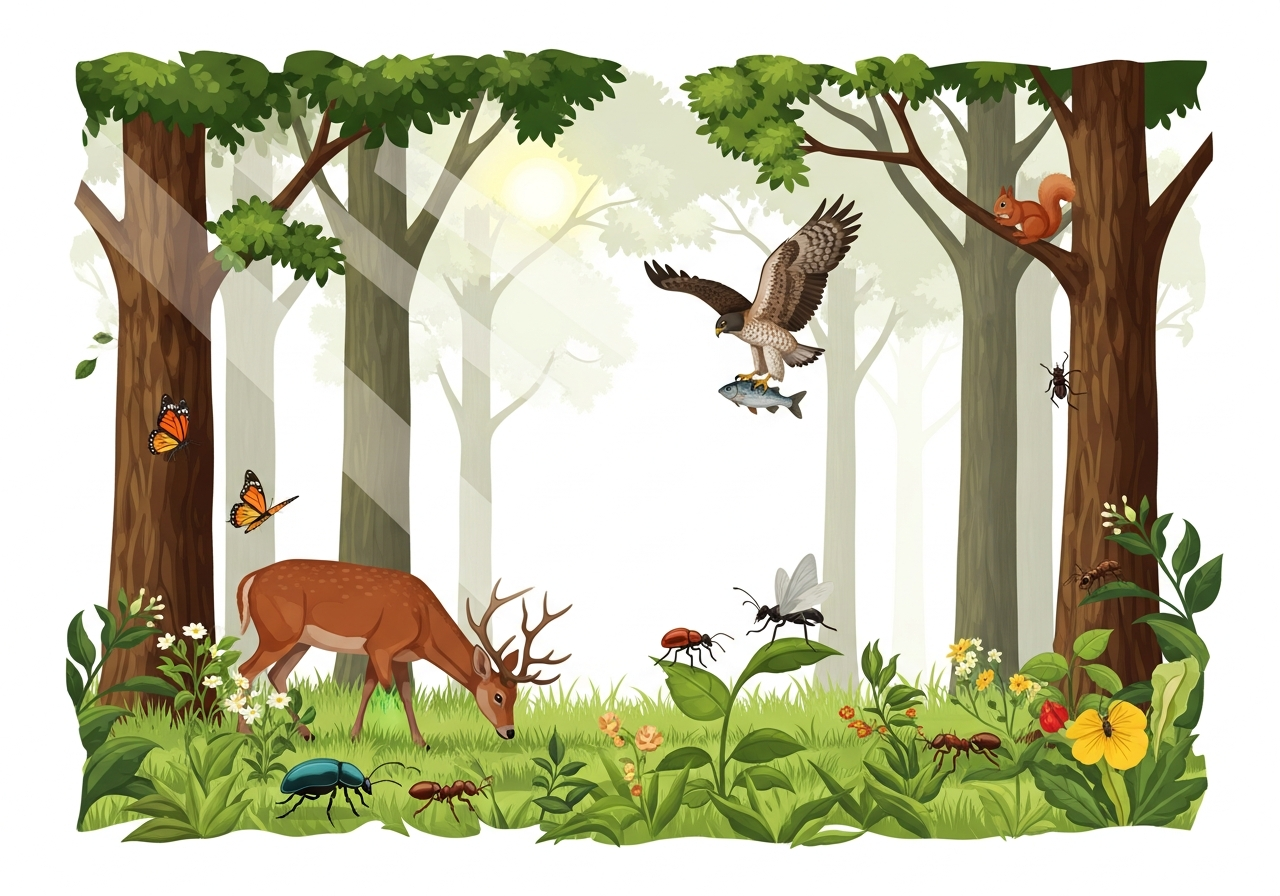
Almost all energy on Earth begins with sunlight. Plants and algae capture that sunlight through photosynthesis a process that uses sunlight, water, and carbon dioxide to make food energy. This makes them the starting point of every food chain.
Food Chains and Food Webs

A food chain is a single pathway showing how energy moves from one organism to the next always starting with a producer. For example: Sun Grass Grasshopper Frog Snake. Arrows always point toward the organism doing the eating, showing the direction energy flows.

A food web is more realistic than a single food chain. It shows many overlapping food chains connected together, because most animals eat more than one type of food. You can explore how these feeding relationships connect to Energy Flow, Food Webs and Energy Transfer as a foundation for this topic.

Energy Pyramids and the 10% Rule

An energy pyramid is a diagram that shows how much energy is available at each feeding level. It is wide at the bottom (producers have the most energy) and narrow at the top (top predators have the least). This shape exists because energy is lost as heat at every level.

Scientists have discovered that only about 10% of energy passes from one level to the next. The other 90% is used by the organism for its own life processes moving, growing, and staying warm and released as heat. This is why there are always far more plants than lions in any ecosystem.

Roles in the Ecosystem

Producers are organisms like plants and algae that make their own food using photosynthesis. They sit at the base of every food chain and have the most available energy. Without producers, no other organism could survive.

Consumers must eat other organisms to get energy. A herbivore eats only plants (like a rabbit), a carnivore eats only animals (like a wolf), and an omnivore eats both plants and animals (like a bear). In a predator-prey relationship, the predator is the hunter and the prey is the animal being hunted.

Decomposers like bacteria and fungi break down dead organisms and return nutrients to the soil. They are essential for keeping ecosystems healthy and productive. You can learn more about how nutrients cycle through ecosystems in Matter Cycles: Water, Carbon, and Nitrogen Cycles.

Key Terms and Definitions

Energy Flow: The movement of energy through an ecosystem, starting from the sun and passing from producers to consumers at each feeding level.

Food Chain: A single pathway that shows how energy moves from one organism to the next, always beginning with a producer and ending with a top predator.

Food Web: A diagram that shows many overlapping food chains in an ecosystem, representing the complex feeding relationships among many organisms.

Energy Pyramid: A diagram that shows how much energy is available at each feeding level of an ecosystem wide at the bottom with producers and narrow at the top with predators.

Producer: An organism, such as a plant or algae, that makes its own food using sunlight through photosynthesis. Producers are always at the base of a food chain.

Consumer: Any organism that must eat other organisms to get energy. Consumers include herbivores, carnivores, and omnivores.

Decomposer: An organism such as bacteria or fungi that breaks down dead plants and animals, returning nutrients to the soil for producers to use again.

Herbivore: A consumer that eats only plants, making it a primary consumer in a food chain. Examples include deer, rabbits, and caterpillars.

Carnivore: A consumer that eats only other animals. Examples include wolves, eagles, and sharks.

Omnivore: A consumer that eats both plants and animals. Bears and raccoons are common examples of omnivores.

Predator: An animal that hunts and eats other animals. The predator is the hunter in a predator-prey relationship.

Prey: An animal that is hunted and eaten by a predator. For example, a rabbit is prey to a fox.

Primary Consumer: The first animal in a food chain to eat the producer directly. For example, a grasshopper eating grass is a primary consumer.

Secondary Consumer: An organism that eats a primary consumer. For example, a frog that eats a grasshopper is a secondary consumer.

Photosynthesis: The process by which plants use sunlight, water, and carbon dioxide to produce food (glucose) and oxygen. This is how energy enters most food chains.

Trophic Level: Each feeding level in a food chain or energy pyramid. Producers are at the first trophic level, primary consumers at the second, and so on.

10% Rule: The scientific principle that only about 10% of energy at one feeding level is passed on to the next level. The remaining 90% is lost as heat.

Practice and Apply Your Knowledge

You can practice drawing your own food web by choosing five organisms from a forest or pond ecosystem and connecting them with arrows. Remember arrows always point toward the organism doing the eating, showing the direction energy flows.

Try building an energy pyramid with numbers. If producers have 10,000 units of energy, how much reaches the primary consumers? How much reaches the secondary consumers? This connects to Scientific Models: Creating and Testing Predictive Models, where you use data to make predictions about ecosystems.

You can also analyze what happens when one organism is removed from a food web. For example, if all rabbits disappeared, how would foxes and hawks be affected? This kind of thinking prepares you for topics like Biodiversity: Species Relationships and Conservation: Environmental Protection.

Building on What You Already Know

Before exploring energy flow in depth, you should be familiar with Energy Types: Potential and Kinetic Energy and Energy Conversion: Transformations Between Forms. These topics help you understand how energy changes form as it moves through a food chain.

You also build on your knowledge of Terrestrial Biomes: Land-Based Ecosystem Types and Aquatic Biomes: Water-Based Ecosystem Types, since food webs look different depending on the ecosystem. Understanding Climate Regions: Temperature and Precipitation Patterns also helps you see why different ecosystems support different food webs.

Human actions affect energy flow too. You can connect this topic to Environmental Science: Human Effects on Ecosystems and Habitat Protection: Conservation Methods to understand how protecting ecosystems preserves the energy flow that all living things depend on.

Related Topics and Connections

This topic connects to many important areas of science. As you move forward, you will explore System Interactions: Energy and Matter Flow, which builds directly on what you learn here about how energy and matter move through ecosystems.

You will also study Environmental Systems: Human Effects on Ecosystems and Conservation: Protection and Restoration to understand how human choices affect food webs and energy flow. Sustainable choices are explored further in Resource Management: Sustainable Use and Conservation and Natural Resources: Renewable and Non-Renewable.

Understanding how organisms are organized connects to Cells to Systems: Hierarchical Organization of Life. You can also use data skills from Data Collection: Precision and Accuracy in Measurements and Statistical Analysis: Basic Statistical Concepts to analyze energy data in ecosystems.

Traditional knowledge about ecosystems is covered in Indigenous Science: Traditional Ecological Knowledge and Cultural Practices: Sustainable Resource Management, showing that many communities have understood energy flow and ecosystem balance for generations. Looking ahead, you will apply these ideas in Energy Transfer: Conduction, Convection, and Radiation and Ecological Wisdom: Sustainable Practices.

You can also explore Resource Use: Sustainable Practices, Environmental Knowledge: Ecological Understanding, Environmental Science: Resource Management and Sustainable Practices, and Natural Systems: Environmental Relationships as you continue building your understanding of how ecosystems function and how you can help protect them.