TOPIC
Environmental Science, Resource Management, Sustainable practicesMY PROGRESS
Pug Score
0%
Getting Started
"Let's build your foundation!"
Best Streak
0 in a row
Study Points
+0
Overview
Practice
Watch
Read
Quiz
Next Steps
Get Started
Get unlimited access to all videos, practice problems, and study tools.
BACK TO MENU
Topic Progress
Pug Score
0%
Getting Started
"Let's build your foundation!"
Videos Watched
0/0
Best Practice
No score
Read
Not viewed
Best Quiz
No attempts
Best Streak
0 in a row
Study Points
+0
Overview
Practice
Watch
Read
Quiz
Next Steps
Read
Human Impact: Environmental Science, Resource Management & Sustainable Practices
You will learn how human activities impact the environment and how sustainable resource management practices can protect ecosystems and natural resources for future generations.
What Is Human Impact on the Environment?
Every day, human activities from driving cars to cutting down forests affect the natural world around you. Understanding human impact means recognizing how your actions and society's choices change ecosystems, deplete resources, and alter the climate.
You have already explored foundational ideas like Environmental Systems and Human Effects on Ecosystems and Natural Resources: Renewable and Non-Renewable. Now you will connect those ideas to real-world resource management and sustainable practices.
Renewable vs. Non-Renewable Resources
A natural resource is any material found in nature that humans use to survive and thrive including water, air, soil, minerals, and living organisms.
A renewable resource naturally replenishes over time, like solar energy, wind, and fresh water. A non-renewable resource like coal, oil, and natural gas took millions of years to form and cannot be replaced on a human timescale. Once you use them up, they are gone.
Fossil fuels are the most important example of non-renewable resources. Burning them releases carbon dioxide, which intensifies the greenhouse effect and drives climate change a topic you will explore further in Climate Change and Human Impact.
How Human Activities Harm Ecosystems
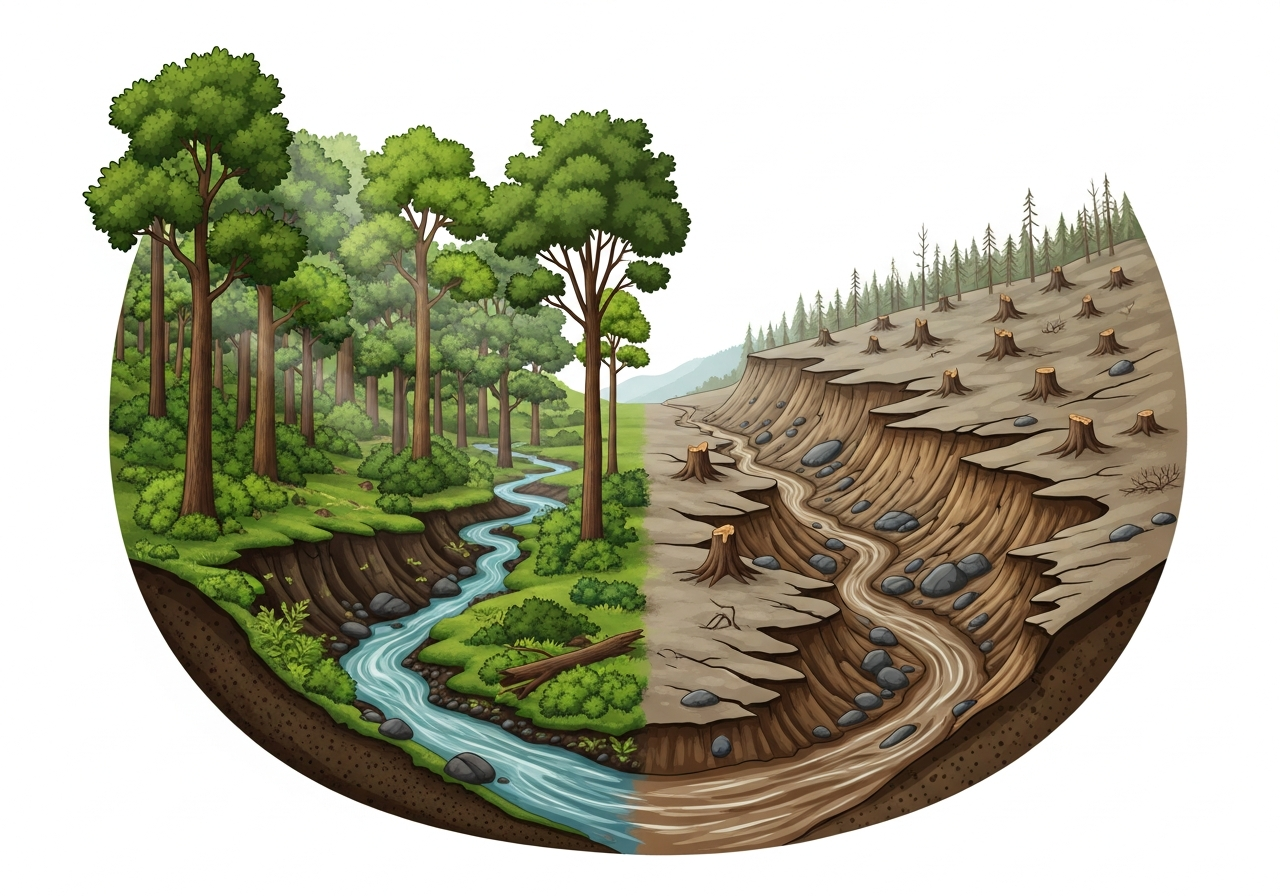
Deforestation clearing forests for farming or logging directly destroys animal habitats, reduces biodiversity, and removes trees that absorb carbon dioxide. It also leaves soil exposed to erosion by rain and wind.
Pollution introduces harmful substances into ecosystems. Water pollution occurs when factories release chemicals into rivers, killing fish and plants. Air pollution happens when smokestacks release particles and gases into the atmosphere. Fertilizer runoff can cause algae to bloom rapidly in ponds a process called eutrophication which depletes oxygen and harms aquatic life.
Overfishing removes fish faster than populations can reproduce, leading to collapse of fish stocks. Habitat loss from construction on wetlands destroys natural flood barriers and critical wildlife habitats.
Sustainable Practices and Resource Management
Sustainability means meeting your current needs without preventing future generations from meeting theirs. It is the guiding principle behind all responsible resource management.
Conservation means using resources wisely and reducing waste like turning off lights when you leave a room. Preservation goes further by protecting natural areas from human use entirely, such as national parks and wildlife reserves.
The 3 Rs of waste management Reduce, Reuse, Recycle are ranked by effectiveness. Reduce is the most powerful step: using fewer resources means no waste is created in the first place. Reuse finds a second purpose for items. Recycle transforms materials into new products, but still requires energy to collect, sort, and process which is why it ranks below reducing and reusing.
Other sustainable practices include crop rotation (rotating different crops each season to keep soil healthy), rainwater harvesting (collecting rooftop rainfall to conserve fresh water), and switching to renewable energy sources like solar panels and wind turbines.
You can explore more sustainable strategies in Ecological Wisdom and Sustainable Practices and Environmental Tech and Green Solutions.
Key Terms & Definitions
Natural Resource: Any material found in nature such as water, air, soil, minerals, and living organisms that you and other humans use to survive and thrive.
Renewable Resource: A resource that naturally replenishes over time, like solar energy, wind power, or fresh water, so it can be used without running out permanently.
Non-Renewable Resource: A resource that took millions of years to form and cannot be replaced on a human timescale, such as coal, oil, and natural gas (fossil fuels).
Conservation: The careful and wise use of natural resources to reduce waste and protect the environment for example, turning off lights or using less water.
Sustainability: The principle of using resources in a way that meets your current needs without preventing future generations from meeting theirs.
Recycling: The process of collecting and transforming used materials like paper, glass, and aluminum into new products, reducing the need to extract raw materials.
Deforestation: The large-scale clearing of forests for farming, logging, or development, which destroys habitats, reduces biodiversity, and exposes soil to erosion.
Biodiversity: The wide variety of different plant and animal species living in a particular environment. High biodiversity makes ecosystems more stable and resilient.
Pollution: The introduction of harmful substances such as chemicals, smoke, or trash into the environment, damaging ecosystems and harming living organisms.
Carbon Footprint: The total amount of greenhouse gases especially carbon dioxide produced by a person's or organization's daily activities, such as driving or using electricity.
Composting: The process of breaking down organic waste like food scraps and yard trimmings into nutrient-rich material that you can use to enrich garden soil, reducing landfill waste.
Ecosystem Services: The free benefits that healthy natural ecosystems provide to you and all humans, such as clean water filtration by wetlands, pollination by bees, and oxygen production by forests.
Habitat Loss: The destruction or degradation of the natural environment that plants and animals depend on for food, shelter, and reproduction, often caused by construction or deforestation.
Overfishing: Catching fish at a rate faster than the population can reproduce, which depletes fish populations and can cause their collapse.
Invasive Species: A non-native organism introduced to a new area where it harms the local ecosystem, often because it has no natural predators to control its population.
Wildlife Corridor: A strip of natural habitat that connects separate habitat patches, allowing animals to safely travel, find mates, and access food without crossing dangerous roads or developed land.
Greenhouse Gases: Gases like carbon dioxide and methane that trap heat in Earth's atmosphere. Burning fossil fuels releases extra greenhouse gases, intensifying the greenhouse effect and warming the planet.
Applying Sustainable Practices in Real Life
You can reduce your own carbon footprint by turning off lights and unplugging electronics when not in use, using reusable water bottles instead of single-use plastics, and choosing public transportation over personal cars.
At a community level, sustainable practices include building conservation strategies for ecosystems, installing solar panels, creating recycling centers, and protecting wetlands from development. Every action large or small contributes to a healthier planet.
Understanding environmental impact assessments is also important: before a construction project begins, scientists study how it might harm the surrounding environment so that damage can be minimized or avoided.
Building on What You Already Know
This topic builds directly on several foundational concepts you have already studied. Your understanding of System Interactions: Biotic and Abiotic Factors and Energy Flow: Food Webs and Energy Pyramids helps you see how human impact ripples through entire ecosystems.
You also draw on your knowledge of Resource Management: Sustainable Use and Conservation, Resource Use and Sustainable Practices, and Environmental Knowledge and Ecological Understanding to evaluate which human choices protect or damage the natural world.
Your earlier study of Conservation: Protection and Restoration introduced you to strategies for repairing damaged ecosystems knowledge you will now apply to broader resource management challenges.
Related Topics & Connections
This topic connects to a rich network of environmental science concepts. As you move forward, you will explore Ecosystems, Sustainability, and Conservation Strategies and Environmental Change and Ecosystem Alterations, which build directly on what you learn here about human impact.
You will also investigate Human Impact and Anthropogenic Effects in greater depth, and look ahead to Future Scenarios and Climate Predictions to understand where current trends may lead.
Traditional and technological solutions are explored in Traditional Practices and Sustainable Methods and Environmental Tech and Green Solutions. You will also examine Climate Records and Historical Knowledge to understand how past data informs present decisions.
The natural cycles that sustain life covered in Matter Cycles and Biogeochemical Cycles and Food Webs and Energy Transfer show you why protecting ecosystems matters at every level. The formation of the resources humans depend on is explained in Resource Formation: Mineral and Fossil Fuel Formation and Introduction to Mineral Resources: Formation and Extraction.
Related peer topics deepen your understanding: Conservation and Environmental Protection, Climate Change and Human Impact, Ecological Wisdom and Sustainable Practices, and Natural Systems and Environmental Relationships all connect directly to the choices humans make about resources. Energy and matter flow explored in System Interactions: Energy and Matter Flow underpins your understanding of why ecosystem disruption has such far-reaching consequences.