Topic
My Progress
Pug Score
0%
Study Points
+0
Overview
Read
Next Steps
Overview
Read
Next Steps
Read
Food Webs & Energy Transfer: How Energy Flows Through Ecosystems
This topic explores how energy flows through ecosystems via food webs, examining the relationships between producers, consumers, and decomposers and how energy is transferred and lost at each trophic level.
Food webs and energy transfer are fundamental concepts in ecology that explain how energy moves through living systems. Every organism in an ecosystem depends on energy, and understanding how that energy flows helps students grasp why ecosystems function the way they do.
Building on prior knowledge of System Interactions and Energy and Matter Flow, this topic shows how energy and matter move together through interconnected feeding relationships called food webs.
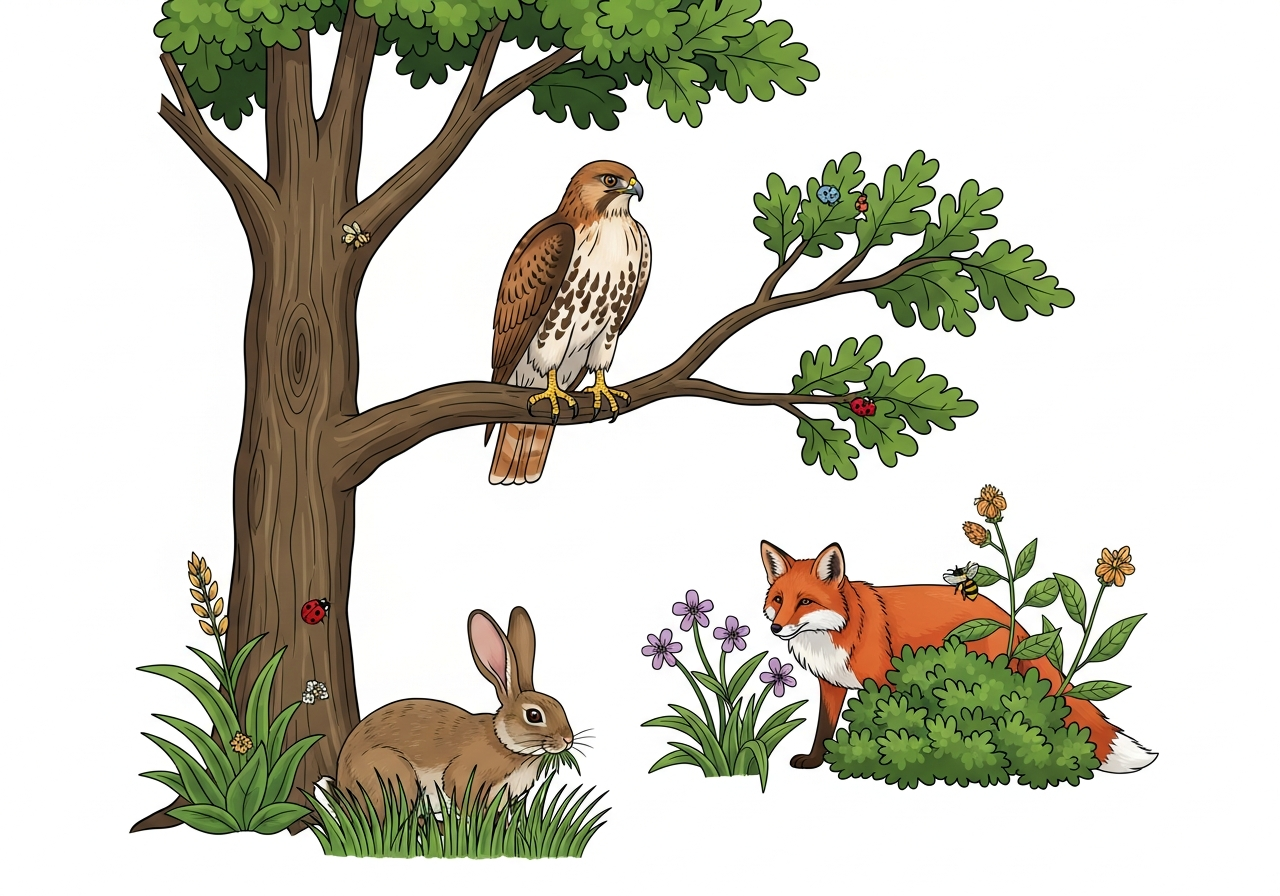
Food Chains vs. Food Webs
A food chain is a simple, linear sequence showing how energy passes from one organism to the next. A food web is a more realistic model that shows the many overlapping and interconnected food chains within an ecosystem.
Food webs reveal the complexity of feeding relationships and demonstrate how the removal or addition of one species can affect many others. This connects directly to concepts explored in Biodiversity and Species Relationships.

Trophic Levels and Energy Loss
Organisms in a food web are organized into trophic levels based on their feeding position. Producers (autotrophs), such as plants and algae, form the first trophic level by converting sunlight into chemical energy through photosynthesis, a process further explored in Energy Processes: Photosynthesis and Respiration.
Primary consumers (herbivores) eat producers, secondary consumers eat primary consumers, and tertiary consumers eat secondary consumers. Decomposers, such as bacteria and fungi, break down dead organic matter and return nutrients to the soil.
At each trophic level, approximately 90% of energy is lost as heat, meaning only about 10% is passed on to the next level. This is known as the 10% rule, and it explains why ecosystems can support far more producers than top predators.
Ecological Pyramids and Biomass
An ecological pyramid is a diagram that represents the amount of energy, biomass (the total mass of living organisms), or the number of organisms at each trophic level. These pyramids are always widest at the base (producers) and narrowest at the top (top consumers), reflecting the energy lost at each level.
Understanding energy transfer connects to broader concepts in Energy Transfer and Conservation of Energy and Energy Types: Potential and Kinetic Forms.
Key Terms & Definitions
Food Web: A diagram showing the complex network of feeding relationships among organisms in an ecosystem, made up of many overlapping food chains.
Food Chain: A linear sequence showing how energy passes from one organism to the next through feeding relationships.
Trophic Level: A feeding position in a food web or food chain, such as producer, primary consumer, or secondary consumer.
Producer (Autotroph): An organism, such as a plant or alga, that makes its own food using sunlight through photosynthesis. Producers form the base of every food web.
Consumer (Heterotroph): An organism that obtains energy by eating other organisms. Consumers are classified as primary, secondary, or tertiary based on what they eat.
Primary Consumer: An organism that eats producers directly; also called a herbivore. Examples include rabbits, grasshoppers, and deer.
Secondary Consumer: An organism that eats primary consumers. Examples include frogs, foxes, and small fish.
Tertiary Consumer: An organism that eats secondary consumers, typically a top predator in the food web. Examples include hawks, sharks, and wolves.
Decomposer: An organism, such as bacteria or fungi, that breaks down dead organic matter and recycles nutrients back into the ecosystem.
Energy Transfer: The movement of energy from one organism to another through feeding relationships in a food web.
10% Rule: The principle that only about 10% of the energy at one trophic level is passed on to the next level; the remaining 90% is lost as heat.
Biomass: The total mass of living organisms at a particular trophic level or within a defined area of an ecosystem.
Ecological Pyramid: A diagram that shows the relative amounts of energy, biomass, or number of organisms at each trophic level in an ecosystem.
Photosynthesis: The process by which producers use sunlight, water, and carbon dioxide to produce glucose (food energy) and oxygen.
Ecosystem: A community of living organisms interacting with each other and with their non-living environment, including soil, water, and air.
Applying Energy Flow Concepts
Students can strengthen their understanding of food webs by constructing their own web diagrams using local organisms, identifying producers, consumers at each level, and decomposers. Tracing the flow of energy through the web reinforces the 10% rule and the concept of energy loss.
Analyzing what happens when one species is removed from a food web helps learners connect to Environmental Change and Ecosystem Alterations and understand how ecosystems respond to disruption. These activities also prepare students for advanced study in Population Studies: Growth and Regulation and Global Change and Environmental Effects.
Building on Prior Knowledge
This topic builds on several foundational concepts. Students should be familiar with Energy Transfer: Conduction, Convection, and Radiation to understand how energy moves in physical systems before applying those ideas to biological ones. Knowledge of Natural Selection, Adaptation and Survival helps explain why organisms occupy specific roles in food webs.
Concepts from Conservation and Environmental Protection, Environmental Science and Sustainable Practices, Ecological Wisdom and Sustainable Practices, and Natural Systems and Environmental Relationships all provide important context for understanding why maintaining healthy food webs matters.
Related Topics & Connections
Food webs and energy transfer connect to a broad network of scientific concepts. Matter Cycles and Biogeochemical Cycles explains how matter, unlike energy, is recycled through ecosystems rather than lost. Ecosystems, Sustainability, and Conservation Strategies applies food web knowledge to real-world conservation challenges.
The study of Natural Selection: Survival and Reproduction and Adaptation and Environmental Pressures shows how organisms evolve to fill specific roles in food webs. Traditional Practices and Sustainable Methods and Climate Records and Historical Knowledge offer cultural and historical perspectives on how humans have understood and managed food webs over time.
This topic also prepares students for Introduction to System Dynamics and Complex Interactions and Energy Resources: Renewable and Non-Renewable, where energy flow concepts are applied to larger systems and human energy use.