Topic
Introduction, System Dynamics, Complex interactionsMy Progress
Pug Score
0%
Getting Started
Let's build your foundation!
Best Streak
0 in a row
Study Points
+0
Overview
Practice
Read
Quiz
Next Steps
Back to Menu
Topic Progress
Pug Score
0%
Getting Started
"Let's build your foundation!"
Best Practice
No score
Read
Not viewed
Best Quiz
No attempts
Best Streak
0 in a row
Study Points
+0
Overview
Practice
Read
Quiz
Next Steps
Read
Ecosystems Uncovered: System Dynamics and Complex Interactions
This topic explores how ecosystems function as complex systems, examining energy flow, species interactions, feedback loops, and the dynamic processes that maintain ecological balance.
What Is an Ecosystem?
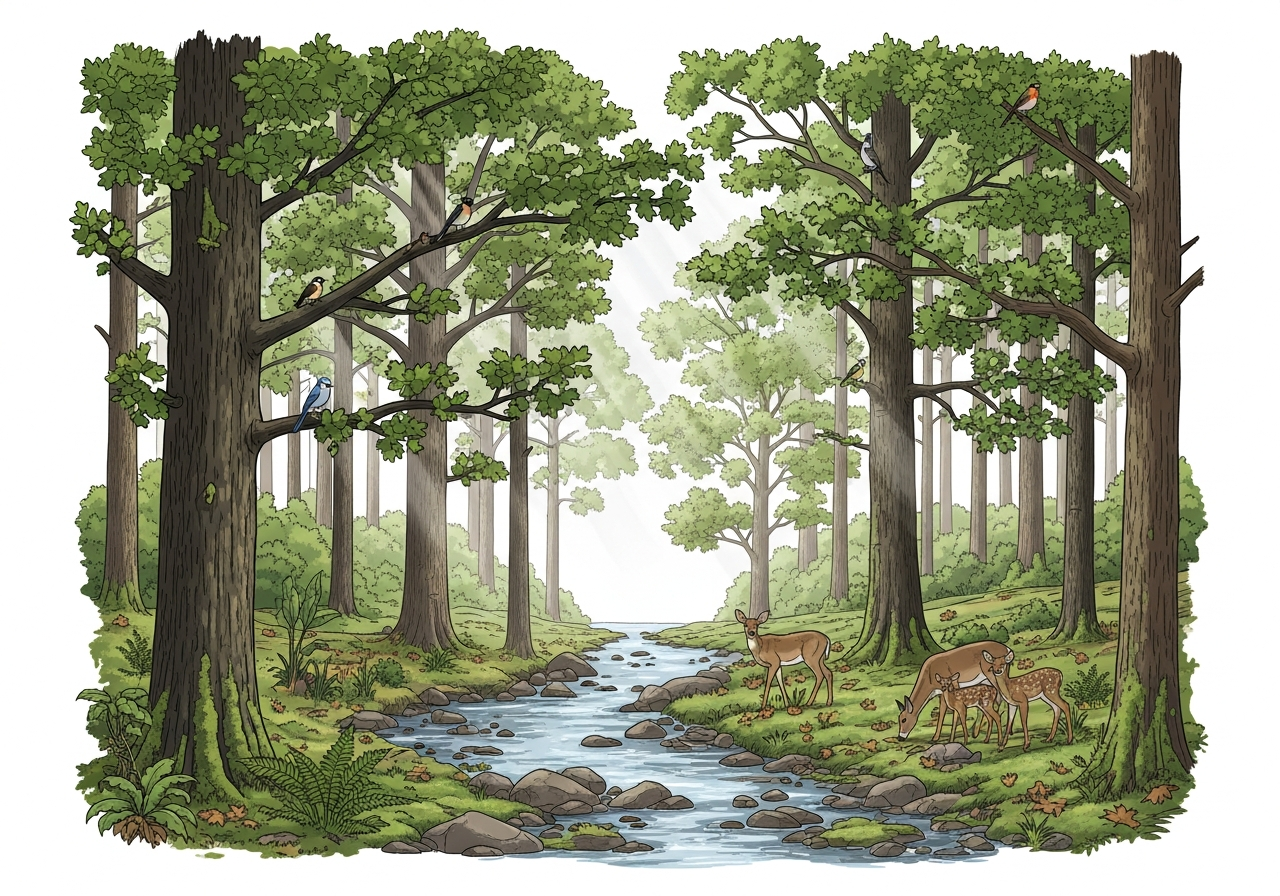
An ecosystem is a community of living organisms interacting with their nonliving environment. It includes both biotic (living) components such as plants, animals, fungi, and bacteria and abiotic (nonliving) components such as water, soil, sunlight, and temperature.
Understanding ecosystems builds directly on foundational concepts from Food Webs and Energy Transfer and Matter Cycles and Biogeochemical Cycles, which establish how energy and nutrients move through living systems.
Energy Flow and the 10% Rule
Energy enters most ecosystems through producers (plants and algae), which convert sunlight into chemical energy via photosynthesis. This energy then passes through trophic levels from producers to primary consumers, secondary consumers, and apex predators.
The 10% rule states that only about 10% of the energy stored at one trophic level is available to the next, because the remaining 90% is lost as metabolic heat. This explains why food chains are typically short and why apex predators are far less numerous than prey organisms.

System Dynamics: Feedback Loops and Trophic Cascades
Ecosystems are governed by feedback loops that either stabilize or destabilize the system. A negative feedback loop counteracts change and promotes stability for example, when prey populations decline, predator populations also decline, allowing prey to recover. A positive feedback loop amplifies change for example, melting Arctic ice exposes darker ocean water that absorbs more heat, causing further melting.
A trophic cascade occurs when the removal or addition of an apex predator triggers a chain of indirect effects throughout the food web. The classic example is wolf reintroduction in Yellowstone: wolves reduced deer grazing near riverbanks, allowing vegetation to regrow and stabilizing the banks demonstrating how one species can reshape an entire ecosystem.
This connects directly to Population Studies and Growth Regulation, which examines how populations respond to these dynamic pressures.
Keystone Species and Biodiversity
A keystone species is one whose removal causes dramatic changes throughout the entire ecosystem, disproportionate to its abundance. Sea otters, for instance, control sea urchin populations; without otters, urchins destroy kelp forests.
Biodiversity the variety of species within an ecosystem increases ecosystem resilience. Greater species diversity means more functional redundancy, so the system can better withstand disturbances. This concept is explored further in Environmental Science, Sustainability, and Conservation Strategies.
Ecological Succession and Resilience
Ecological succession describes the gradual process by which a community changes over time following a disturbance. Primary succession begins on bare rock with no existing soil, while secondary succession begins where soil remains after a disturbance making it faster than primary succession.
Resilience measures how well an ecosystem recovers after a disturbance. A forest recovering after a moderate wildfire demonstrates resilience through secondary succession. Dynamic equilibrium means the ecosystem experiences ongoing changes but maintains overall balance over time through feedback mechanisms.
Carrying Capacity and Population Dynamics
Carrying capacity is the maximum population size an environment can sustainably support given its available resources. When resources become fully limited, population growth slows and levels off. This concept is central to Population Studies and Growth Regulation.
The competitive exclusion principle states that two species competing for identical resources cannot coexist in the same niche indefinitely one will eventually outcompete the other.
Nutrient Cycling and Human Impact
Matter cycles continuously through ecosystems via biogeochemical processes. Decomposers such as bacteria and fungi break down dead organic matter, releasing nutrients like carbon, nitrogen, and phosphorus back into the soil and atmosphere.
Eutrophication occurs when excess nutrients such as nitrogen and phosphorus from fertilizer runoff cause explosive algae growth in a water body. When the algae decompose, dissolved oxygen is depleted, creating dead zones that harm aquatic life. This illustrates how human activities can trigger cascading, destabilizing effects in an ecosystem, a theme explored in Human Impact and Environmental Change and Human Impact and Anthropogenic Effects.
An invasive species is a non-native species introduced outside its native range that often lacks natural predators, allowing it to outcompete native species and unbalance the ecosystem.
Key Terms & Definitions
Ecosystem: A community of living organisms interacting with their nonliving environment, including both biotic and abiotic components.
Biotic: The living components of an ecosystem, such as plants, animals, fungi, and bacteria.
Abiotic: The nonliving components of an ecosystem, such as water, soil, sunlight, and temperature.
Trophic Cascade: A chain of indirect effects triggered by the removal or addition of an apex predator, rippling through the food web.
Negative Feedback Loop: A self-regulating process that counteracts change and promotes ecosystem stability, such as predator-prey population cycles.
Positive Feedback Loop: A process that amplifies the original change, potentially destabilizing the ecosystem, such as melting ice exposing darker water that absorbs more heat.
Ecological Succession: The gradual, predictable process by which the species composition of a community changes over time following a disturbance.
Resilience: The ability of an ecosystem to absorb disturbances and recover its basic structure and function.
Disturbance: A triggering event such as a wildfire, flood, or human activity that disrupts an ecosystem and tests its resilience.
Keystone Species: A species that has a disproportionately large impact on its ecosystem relative to its abundance; its removal causes dramatic changes throughout the system.
Biodiversity: The variety of species within an ecosystem; greater biodiversity increases resilience and functional redundancy.
Carrying Capacity: The maximum population size an environment can sustainably support given its available resources.
Dynamic Equilibrium: A state in which an ecosystem experiences ongoing changes but maintains overall balance over time through feedback mechanisms.
Mutualism (+/+): A symbiotic relationship in which both species benefit, such as bees pollinating flowers while gaining nectar.
Commensalism (+/0): A relationship in which one species benefits while the other is neither helped nor harmed, such as barnacles on whales.
Parasitism (+/): A relationship in which the parasite benefits while the host is harmed, such as a tapeworm in a host organism.
Competition (/): An interaction in which all competing species experience reduced fitness as they vie for the same limited resources.
Predation (+/): An interaction in which the predator benefits and the prey population is reduced.
Ecological Niche: The full range of an organism's role in its ecosystem, including what it eats, how it behaves, and how it interacts with other species.
Decomposers: Organisms such as bacteria and fungi that break down dead organic matter, recycling essential nutrients back into the environment.
Eutrophication: The process by which excess nutrients in a water body cause explosive algae growth, depleting oxygen and harming aquatic life.
Invasive Species: A non-native species introduced outside its native range that outcompetes native species and disrupts established ecological relationships.
Primary Succession: Ecological succession that begins on bare rock or substrate with no existing soil or organisms.
Secondary Succession: Ecological succession that begins in an area where soil and some organisms remain after a disturbance; faster than primary succession.
Climax Community: The relatively stable, self-sustaining community that represents the endpoint of ecological succession under prevailing conditions.
Competitive Exclusion Principle: The ecological principle stating that two species competing for identical resources cannot coexist in the same niche indefinitely.
10% Rule: The principle that only about 10% of the energy stored at one trophic level is available to the next, with the remaining 90% lost as heat.
Applying Ecosystem Concepts
Learners can strengthen their understanding by analyzing real-world case studies such as wolf reintroduction in Yellowstone or sea otter removal from kelp forest ecosystems. These examples illustrate trophic cascades, keystone species, and feedback loops in action.
Students can also model energy flow using the 10% rule to calculate how much energy reaches each trophic level, connecting to Energy Processes: Photosynthesis and Respiration and Energy Flow and System Dynamics.
Investigating scenarios such as fertilizer runoff causing eutrophication helps learners connect ecosystem dynamics to Global Change and Environmental Effects and Systems Thinking and Integrated Solutions.
Building on Prior Knowledge
This topic builds on several foundational concepts. Students should be familiar with Food Webs and Energy Transfer and Matter Cycles and Biogeochemical Cycles, which provide the structural framework for understanding how energy and nutrients move through ecosystems.
Knowledge of Environmental Change and Ecosystem Alterations and Ecosystems, Sustainability, and Conservation Strategies helps learners understand how ecosystems respond to disruption. Concepts from Natural Selection and Survival and Reproduction, Genetic Variation and Sources of Diversity, and Adaptation and Environmental Pressures explain why species occupy specific niches and how populations evolve in response to ecosystem pressures.
Related Topics & Connections
This topic serves as a gateway to several advanced concepts. Energy Flow and System Dynamics and Matter Connections and System Interactions extend the principles of energy transfer and nutrient cycling introduced here.
The biogeochemical cycles explored in this topic lead directly into Carbon Cycle and Carbon Movement, Nitrogen Cycle and Nutrient Cycling, Water Cycle and Global Water Distribution, and Cycle Disruption and Environmental Effects.
The human impact themes connect to Human Impact and Environmental Change, while broader environmental concerns are addressed in Global Change and Environmental Effects and Environmental Science, Sustainability, and Conservation Strategies. Systems Thinking and Integrated Solutions provides a framework for understanding how all these components interact as a unified whole.