Topic
Biodiversity, Species relationships basicMy Progress
Pug Score
0%
Getting Started
Let's build your foundation!
Best Streak
0 in a row
Study Points
+0
Overview
Practice
Watch
Read
Quiz
Next Steps
Back to Menu
Topic Progress
Pug Score
0%
Getting Started
"Let's build your foundation!"
Videos Watched
0/0
Best Practice
No score
Read
Not viewed
Best Quiz
No attempts
Best Streak
0 in a row
Study Points
+0
Overview
Practice
Watch
Read
Quiz
Next Steps
Read
Biodiversity and Species Relationships: How Life Connects in Every Ecosystem
You will discover how the variety of living things in an ecosystem and the relationships between species including mutualism, commensalism, parasitism, predation, and competition determine how healthy and stable an ecosystem is.
What Is Biodiversity?
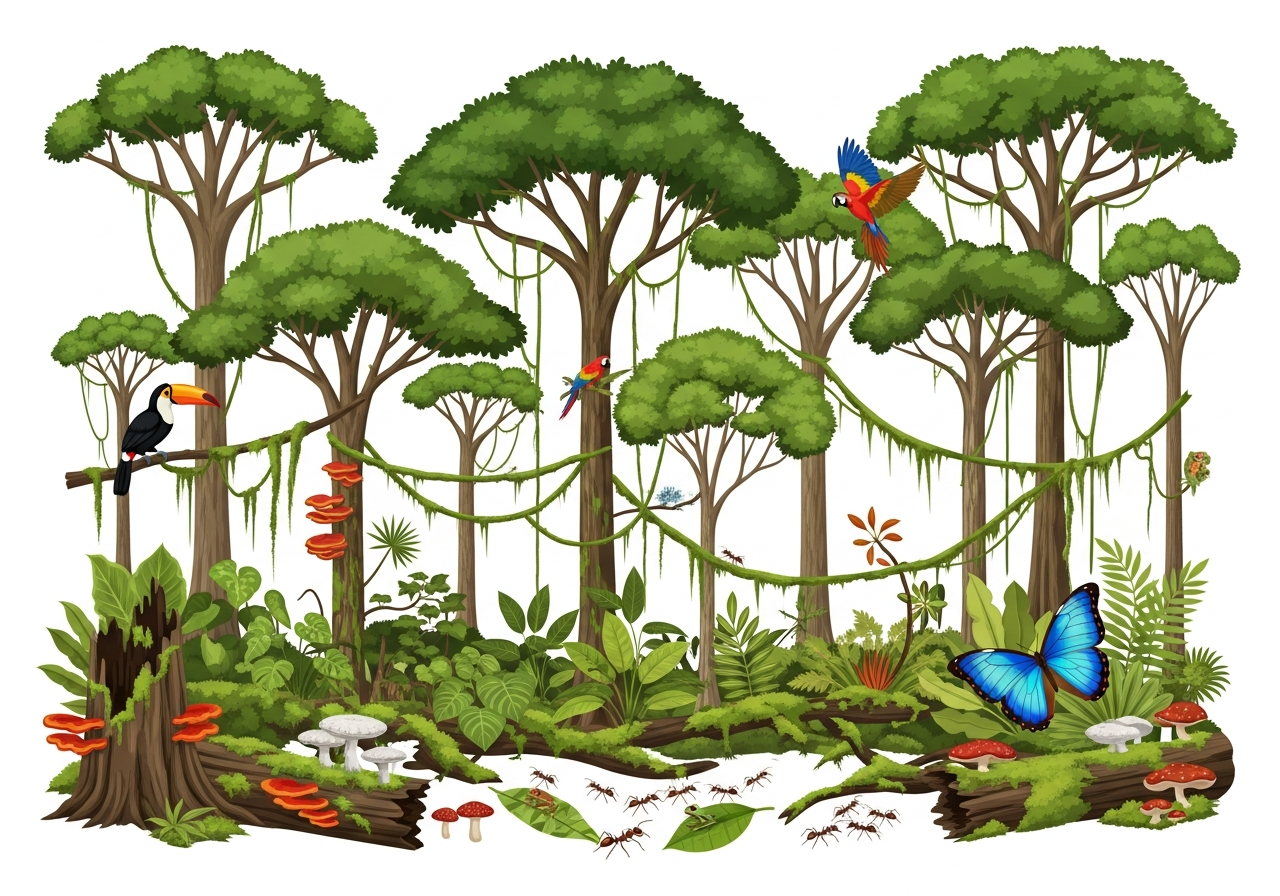
Biodiversity refers to the variety of all living things animals, plants, fungi, and microorganisms found in a given area. The more species present, the higher the biodiversity. You can think of biodiversity as a measure of how rich and varied life is in an ecosystem.
High biodiversity makes an ecosystem more stable and better able to recover from disturbances like fires, droughts, or disease. When Forest A has 25 tree species compared to Forest B's 3, Forest A recovers faster because more species fill different ecological roles nitrogen-fixers restore soil, deep-rooted species stabilise the ground, and fast-sprouting species repopulate quickly. You will explore this idea further in Species Diversity: Biodiversity Measurements.
Types of Species Relationships
Species in an ecosystem interact with each other in many ways. These interactions are called species relationships, and they affect whether organisms survive, thrive, or struggle. You will need to recognise five key types.
Symbiotic Relationships
A symbiotic relationship is a close, long-term relationship between two different species that live in direct contact with each other. There are three types of symbiosis you need to know:
- Mutualism: Both species benefit. Example clownfish live among a sea anemone's stinging tentacles. The anemone protects the clownfish, and the clownfish chases away fish that would eat the anemone.
- Commensalism: One species benefits and the other is unaffected. Example barnacles attach to a whale's skin and get carried to food-rich waters, while the whale is neither helped nor harmed. A bird nesting in a tree also shows commensalism.
- Parasitism: One species (the parasite) benefits while the other (the host) is harmed. Example a tapeworm lives inside a wolf's intestine, absorbing nutrients and causing the wolf to weaken. A tick feeding on a dog is another example.
Predation and Competition
Predation occurs when one organism (the predator) hunts and eats another (the prey). A lion eating a zebra is a classic predator-prey relationship. Predators help control prey populations, keeping ecosystems balanced.
Competition happens when two or more organisms struggle for the same limited resources food, water, space, or sunlight. When a deer and a rabbit both eat grass in the same meadow, that is interspecific competition (between different species). When two wolves of the same species compete for food, that is intraspecific competition.
Food Chains, Food Webs, and Ecological Roles
A food chain is a sequence showing how energy passes from one organism to the next for example, grass grasshopper frog hawk. A food web is more complex, showing many overlapping food chains in an ecosystem and giving a more realistic picture of energy flow.
Every organism plays a specific role. Producers (like plants and algae) capture sunlight through photosynthesis and form the base of all food chains. Consumers must eat other organisms to get energy herbivores eat only plants, carnivores eat animals, and omnivores eat both. Decomposers like fungi and bacteria break down dead organisms and return nutrients to the soil, keeping the cycle going.
A keystone species has a disproportionately large impact on its ecosystem. If a keystone species is removed, the ecosystem becomes unbalanced and many other species are affected for example, sea otters control sea urchin populations that would otherwise destroy kelp forests. You will build on this understanding in Food Webs: Energy Transfer.
Key Terms & Definitions
Biodiversity: The variety of all different living things animals, plants, fungi, and microorganisms found in a given area. High biodiversity means a healthier, more stable ecosystem.
Ecosystem: All the living (biotic) and nonliving (abiotic) things in an area that interact with each other, such as plants, animals, water, soil, and sunlight.
Species: A group of organisms that can breed with each other and produce fertile offspring. This is the basic unit of classification for living things.
Population: All the members of one species living in the same area at the same time. For example, all the wolves in a forest make up a wolf population.
Community: All the different species of living organisms sharing and interacting in one area. A community does not include nonliving factors like water or sunlight.
Habitat: The specific place where an organism lives and finds what it needs food, water, shelter, and space. A coral reef, rainforest, or grassland are all examples of habitats.
Niche: The role and position an organism fills in its ecosystem what it eats, when it is active, and how it interacts with other species. Two species cannot share the exact same niche in the same habitat for long.
Symbiosis: A close, long-term relationship between two different species that live in direct contact with each other. It includes mutualism, commensalism, and parasitism.
Mutualism: A symbiotic relationship where both species benefit. Example: bees get nectar from flowers while helping flowers reproduce through pollination.
Commensalism: A symbiotic relationship where one species benefits and the other is neither helped nor harmed. Example: barnacles on a whale's skin.
Parasitism: A symbiotic relationship where one organism (the parasite) benefits while the other (the host) is harmed. Example: a tapeworm inside a wolf.
Predation: A relationship where one organism (the predator) hunts and eats another organism (the prey). Example: a lion hunting a zebra.
Competition: When two or more organisms struggle for the same limited resources such as food, water, space, or sunlight. It can occur between different species (interspecific) or the same species (intraspecific).
Producer: An organism that makes its own food using sunlight and photosynthesis. Plants and algae are producers and form the base of all food chains.
Consumer: An organism that must eat other organisms to obtain its energy. Herbivores eat plants, carnivores eat animals, and omnivores eat both.
Decomposer: An organism such as fungi or bacteria that breaks down dead organisms and returns nutrients back to the soil for producers to use.
Food Chain: A sequence showing how energy passes from one organism to the next in a linear path, starting with a producer.
Food Web: A diagram showing many overlapping food chains in an ecosystem, giving a more complete picture of how energy moves through nature.
Keystone Species: A species whose removal causes major changes throughout the ecosystem. Its impact is much larger than its numbers suggest.
Invasive Species: A non-native species introduced to a new habitat where it spreads and harms local ecosystems, often because it has no natural predators there.
Endangered Species: A species at serious risk of becoming completely extinct because its population has declined severely.
Extinction: When every individual of a species has permanently died out worldwide and the species no longer exists anywhere on Earth.
Herbivore: An animal that gets its energy by eating only plants. Herbivores are primary consumers in a food chain.
Ecological Resilience: The ability of an ecosystem to recover from a disturbance. Higher biodiversity generally means greater resilience.
Practice Activities
You can strengthen your understanding by identifying species relationships in real-world examples. When you read about two organisms interacting, ask yourself: Who benefits? Who is harmed? Who is unaffected? This three-question method helps you classify any relationship as mutualism, commensalism, parasitism, predation, or competition.
You can also practise tracing food chains and food webs to see how energy flows through an ecosystem. Try removing one species from a food web and predicting what would happen to the others this shows you why keystone species and high biodiversity matter so much. Connect this to Ecosystems, Sustainability, and Conservation Strategies to see how protecting biodiversity helps ecosystems survive long-term.
Building on What You Already Know
Before exploring biodiversity and species relationships, you should be familiar with several foundational ideas. In System Interactions: Biotic and Abiotic Factors, you learned how living and nonliving parts of an ecosystem work together. In Energy Flow: Food Webs and Energy Pyramids, you explored how energy moves between organisms knowledge that connects directly to food chains and producer-consumer roles here.
You also built understanding through Environmental Systems: Human Effects on Ecosystems and Conservation: Protection and Restoration, which show why maintaining biodiversity matters. Your work in Resource Use: Sustainable Practices and Environmental Knowledge: Ecological Understanding also prepared you to think about how species and ecosystems depend on each other.
Related Topics & Connections
This topic connects to many other areas of science that you will explore. In Taxonomy Systems: Kingdoms and Classification Criteria, you will learn how scientists organise and name species which helps you understand what makes one species different from another. In Species Diversity: Biodiversity Measurements, you will go deeper into how scientists actually measure and compare biodiversity across ecosystems.
The concept of species relationships connects directly to Natural Selection: Adaptation and Survival organisms that form beneficial relationships are more likely to survive and reproduce. You will also see how Evidence of Change: Fossil Record and Similarities shows how species relationships have evolved over millions of years.
Understanding biodiversity prepares you for Conservation: Environmental Protection and Environmental Science, Resource Management, and Sustainable Practices, where you will explore how humans can protect the variety of life on Earth. You will also connect to System Interactions: Energy and Matter Flow and Natural Systems: Environmental Relationships to see how biodiversity supports the flow of energy and matter through ecosystems.
Looking ahead, this topic prepares you for Natural Selection: Survival and Reproduction, Genetic Variation: Sources of Diversity, and Adaptation: Environmental Pressures all of which build on your understanding of how species interact and evolve. You will also explore Matter Cycles: Biogeochemical Cycles, Environmental Change: Ecosystem Alterations, and Traditional Practices: Sustainable Methods as you continue your journey through ecology. The ideas of ecological wisdom and sustainability are further explored in Ecological Wisdom: Sustainable Practices.