Microeconomics Help: Video Lessons & Practice
Step-by-step video lessons from certified teachers — covering every topic from supply and demand to market structures. Free practice included.
Value vs. Private Tutor
Expert Microeconomics help minus tutor prices.
Multi-Subject
Master Microeconomics or switch subjects.
Build Mastery
Advance only when Microeconomics sticks.
Microeconomics Topics
1. Introduction to Economics
2. Problems of Economics
3. Demand and Supply
4. Elasticity
5. Welfare Economics
6. Consumer Choice
7. Output and Costs
8. Perfect Competition
9. Monopoly
11. Government & Inequalities
11 Chapters · 42 Topics · 453 Videos
Discover Our Learning Areas
Explore key subjects and start learning with interactive content.




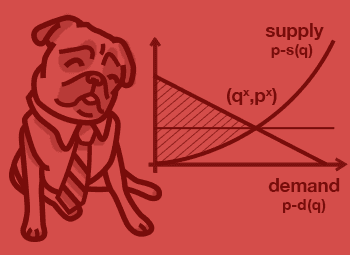
What is Microeconomics?
Microeconomics is the branch of economics that studies how individual agents — consumers, households, and firms — make choices under conditions of scarcity, and how those choices interact to determine prices and quantities in markets. Where macroeconomics concerns itself with the economy as a whole, microeconomics zooms in: why does the price of hawker centre chicken rice rise when fuel costs increase? Why does a firm produce less when competition intensifies? How do consumers decide what to buy when their budget is tight? These are microeconomic questions, and answering them requires both economic intuition and analytical tools such as graph analysis, marginal reasoning, and basic optimisation.
University Microeconomics typically begins with the mechanics of supply and demand, then builds toward consumer and producer theory, cost structures, and market structures ranging from perfect competition through to monopoly and oligopoly. Later topics introduce strategic behaviour through game theory, and examine situations where markets fail — such as externalities, public goods, and information asymmetry. The subject sits at the core of economics, business, finance, and public policy degrees, and the analytical skills it develops transfer directly to more advanced courses.
Is Microeconomics hard to pass?
Microeconomics is challenging but very learnable — the difficulty lies in applying concepts under exam conditions rather than understanding them in isolation. Students who struggle most tend to memorise diagrams without grasping the underlying logic, so they freeze when an exam question shifts the scenario slightly.
The most consistently difficult areas are: (1) elasticity calculations, especially distinguishing price elasticity of demand from income and cross-price elasticity; (2) consumer theory, particularly indifference curve analysis and decomposing price changes into income and substitution effects; (3) correctly identifying and drawing all four market structure diagrams under timed conditions; and (4) applying game theory concepts such as Nash equilibrium and dominant strategies to unfamiliar scenarios. The good news is that these are all practice-friendly topics — working through varied problem sets, not just re-reading notes, is what drives improvement.
What is the difference between Microeconomics and Macroeconomics?
Microeconomics and Macroeconomics are the two main branches of economics, and most degree programmes require both in the first year. Microeconomics focuses on individual decision-makers — a consumer choosing between goods, a firm setting output, an industry reaching equilibrium. Macroeconomics focuses on the economy as a whole — national output (GDP), the price level, unemployment, interest rates, and government policy.
In practical terms: microeconomics asks why the price of a specific good changes, while macroeconomics asks why the overall price level (inflation) changes. Microeconomics uses tools like supply-and-demand diagrams for individual markets; macroeconomics uses aggregate demand and supply, IS-LM models, and national income accounting. Both subjects use the same underlying logic of optimisation and equilibrium, but apply them at different levels of analysis. Students who grasp microeconomic reasoning first often find the transition to macroeconomics smoother.
What are the hardest topics in Microeconomics, and how do you approach them?
Consumer theory — particularly the indifference curve / budget constraint framework — is widely regarded as the most demanding topic in introductory Microeconomics. The challenge is that you must simultaneously work with utility maximisation, the tangency condition (MRS equals the price ratio), and then decompose a price change into separate income and substitution effects. Many students can draw the diagrams in isolation but lose track of the logic mid-question under exam pressure.
The most effective approach is to practise the full diagram sequence repeatedly: start with the budget line, find the optimal bundle at tangency, shift the price, find the new optimum, then apply the Slutsky or Hicks decomposition. Do this for normal goods, inferior goods, and Giffen goods until the pattern is automatic. Game theory is the second major difficulty — particularly identifying Nash equilibria in simultaneous games and understanding why dominant strategy equilibria arise. Working through payoff matrices with varied numerical values builds the pattern recognition needed for exam questions.
How is Microeconomics assessed at Singapore universities?
Assessment formats vary by institution, but a typical Singapore university Microeconomics module combines a midterm examination (30–40% of the final grade), a final examination (40–50%), and coursework elements such as problem sets, online quizzes, or a group project (15–30%). Examinations are usually closed-book and test both conceptual understanding and quantitative problem-solving — expect a mix of multiple-choice, short-answer, and structured essay or calculation questions.
GCE 'A' Level Economics (H1 or H2) is not assessed in the same way as university Microeconomics, so students fresh from the 'A' Level curriculum should note that university exams typically require more algebraic work and less essay-style application. Preparing with timed mock exams, past problem sets, and worked solutions for each topic type is the most reliable path to strong midterm and final results.
Why StudyPug for Microeconomics?
StudyPug is built for university students who need more than a textbook — they need to see the method, practise it under conditions that reflect the actual exam, and know exactly where their gaps are before the midterm.
The platform opens with a diagnostic assessment that quickly maps which Microeconomics topics you already have under control and which need work. Rather than starting from page one of a textbook, you start from your actual weak points — a significant time saving when midterms arrive quickly in a semester.
Every topic is covered through certified-teacher video lessons — not AI-generated content, but step-by-step explanations from experienced instructors who show you the reasoning behind each move. The emphasis is on understanding the method deeply, so that when an exam question changes the numbers or flips the scenario, you can still navigate it. You can watch any lesson as many times as you need until it genuinely clicks.
Adaptive practice adjusts the difficulty of questions to your current level, making the practice efficient and progressively more demanding as you improve. By the time you sit your final, you will have worked through problems at and above the difficulty level the exam requires. Mock exams and practice tests for midterms and finals are included, giving you the timed, exam-condition rehearsal that most students skip and then regret.
One subscription covers every course on the platform — Microeconomics, Macroeconomics, Statistics, Calculus, and more — so you are never paying separately for each subject you need help with.
What you learn: Microeconomics course coverage
A university Microeconomics course at the introductory level typically moves through the following topic sequence:
- Supply and demand: market equilibrium, shifts in supply and demand curves, price controls (floors and ceilings), taxes and subsidies, and their welfare effects.
- Elasticity: price elasticity of demand and supply, income elasticity, cross-price elasticity, and their applications to pricing and tax policy.
- Consumer theory: utility functions, marginal utility analysis, indifference curves, budget constraints, and consumer optimisation; income and substitution effects; deriving demand curves.
- Production and cost theory: production functions, short-run and long-run costs, average and marginal cost curves, economies of scale.
- Market structures: perfect competition (firm and industry equilibrium, long-run entry and exit), monopoly (pricing, deadweight loss, price discrimination), monopolistic competition, and oligopoly.
- Game theory: simultaneous and sequential games, dominant strategies, Nash equilibrium, the Prisoner's Dilemma, repeated games.
- Market failures: externalities (positive and negative), Pigouvian taxes and subsidies, public goods, information asymmetry (adverse selection, moral hazard), and government intervention.
StudyPug covers each of these topic areas with dedicated video lessons and practice problem sets, so no matter which point in the semester you are at, you can find and work through exactly what you need.
Using StudyPug for Microeconomics: a practical approach
The most effective way to use StudyPug is to treat it as your practice engine alongside lectures, not a replacement for them. Start with the diagnostic to get a clear picture of your current Microeconomics gaps. Then, for each weak topic, watch the relevant video lesson once to understand the method, and immediately follow it with practice problems while the steps are fresh.
Before your midterm, work through the practice test in timed conditions to simulate exam pressure. Review every question you got wrong, re-watch the relevant video section, and repeat the practice until your error rate drops. The same process applies to finals — use the mock exam to identify remaining gaps two to three weeks out, leaving time to address them properly rather than cramming the night before.
Free daily practice content is available without a subscription, so you can start building Microeconomics skills immediately. When you are ready for full access to every lesson, adaptive practice set, and mock exam, a 30-day money-back guarantee means there is no risk in upgrading. Start your free practice now.
Microeconomics FAQ
Unsure how StudyPug works? Need help with setting up? Check our frequently asked questions or contact us for help.
What do you learn in Microeconomics, and what topics does it cover?
Microeconomics studies how individuals and firms make decisions about scarce resources. Core topics include supply and demand, price elasticity, consumer theory (utility and budget constraints), production and cost theory, market structures (perfect competition, monopoly, oligopoly, monopolistic competition), game theory, and market failures such as externalities and public goods. Most university courses also cover welfare economics and basic general equilibrium. By the end, you can analyse how prices form, how firms maximise profit, and why markets sometimes fail to allocate resources efficiently.
What is the difference between Microeconomics and Macroeconomics?
Microeconomics focuses on individual decision-makers — consumers, firms, and industries — and how they interact in specific markets. Macroeconomics zooms out to the whole economy, examining GDP, inflation, unemployment, and monetary and fiscal policy. Micro asks: why does the price of a good rise? Macro asks: why does the overall price level rise? Both draw on the same core tools (models, graphs, optimisation), but apply them at very different scales. Many students take Microeconomics before Macroeconomics, though some programmes run them concurrently in the first year.
What are the prerequisites for Microeconomics, and what course comes after it?
Most university Microeconomics courses require only basic algebra and graph-reading skills. Some programmes also expect a foundational economics or 'A' Level Economics background. After introductory Microeconomics, students typically progress to Intermediate Microeconomics (which adds calculus-based optimisation), then to electives such as Industrial Organisation, Public Economics, or Behavioural Economics. In Singapore, students with 'A' Level H2 Economics will find introductory university Microeconomics overlaps strongly before stepping up in mathematical rigour at the intermediate level.
Is Microeconomics hard, and where do students struggle most?
Microeconomics is manageable if you engage with the logic rather than memorising diagrams. The most common struggle points are elasticity calculations (especially cross-price and income elasticity), drawing and shifting supply-and-demand curves correctly, understanding consumer theory (indifference curves and budget lines), and distinguishing between the four market structures under exam pressure. Game theory and Nash equilibrium also trip up many students. The key is practising problems repeatedly — seeing a dozen variations of a diagram cements the logic far better than re-reading notes.
How is Microeconomics assessed — midterms, finals, and assignments?
At most Singapore universities, Microeconomics is assessed through a combination of a midterm examination (typically worth 30–40% of the grade), a final examination (40–50%), and coursework such as problem sets, quizzes, or a group project (15–30%). Finals are usually closed-book and include both multiple-choice and structured essay or calculation questions. Some modules also use continuous assessment through online quizzes. Preparing with timed mock exams and working through past problem sets is the most effective strategy for performing well in both the midterm and final.
What is one of the hardest topics in Microeconomics, and how do you approach it?
Consumer theory — specifically deriving demand curves from indifference curve analysis — is consistently the hardest topic for students. You need to hold utility maximisation, budget constraints, and the income-and-substitution-effect decomposition in mind simultaneously. The best approach is to start with the budget line and the tangency condition (MRS = price ratio), practise drawing Engel curves and price-consumption curves step by step, and then work through substitution and income effects for both normal and inferior goods. Doing five to ten practice problems with full diagram work, rather than just reading the theory, is what makes it stick.





Written by the StudyPug Team
Last updated June 5, 2026
3 M+
students
★★★★★
4.8 average
K–12
all grades