Calculus 3 Help: Video Lessons & Practice
Step-by-step lessons on multivariable calculus, vector fields and surface integrals — watch until it clicks.
Value vs. Private Tutor
Get expert Calculus 3 help without the price tag.

Multi-Subject
Struggling in Calc 3? Switch free now.
Practice Until Perfect
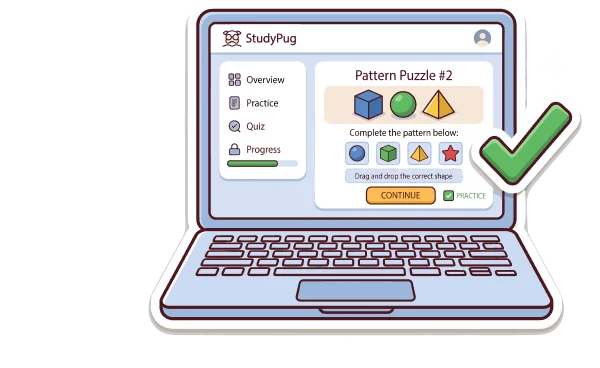
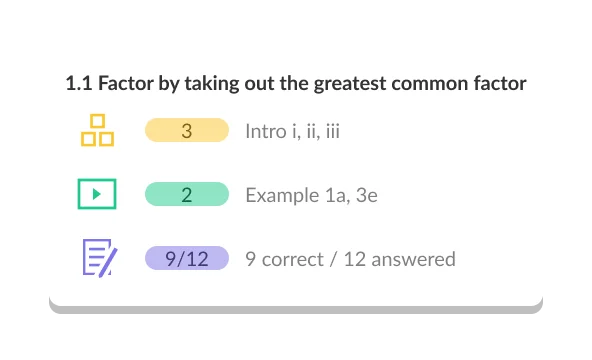
Keep practicing until it truly clicks.
Try It Now
Test your knowledge
Our approach aligns with the evidence
Exam Scores
Better Recall
Less Anxiety
Calculus 3 Topics
1. Three Dimensions
2. Vector Functions
3. Partial Derivatives
4. Partial Derivative Applications
5. Multiple Integrals
6. Multiple Integral Applications
6 Chapters · 34 Topics · 249 Videos
Discover Our Learning Areas
Explore key subjects and start learning with interactive content.


What is Calculus 3?
Calculus 3 — formally known as Multivariable Calculus — is the third course in the standard university calculus sequence and the first to extend the tools of calculus into three or more dimensions. Where Calculus 1 and Calculus 2 focus on functions of a single variable, Calculus 3 deals with functions of two or three variables, vector-valued functions, and the geometry of curves and surfaces in space. It is a core module for students of engineering, physics, data science, and applied mathematics at universities across Singapore and internationally.
The course builds directly on integration and differentiation skills from Calculus 1 and 2 and introduces entirely new geometric reasoning. Completing Calculus 3 prepares you for Differential Equations, Real Analysis, and advanced engineering mathematics — making a strong foundation here genuinely important for your degree.
What topics are covered in Calculus 3?
Calculus 3 covers a wide range of interconnected topics. The course typically opens with the geometry of three-dimensional space: vectors, dot and cross products, lines and planes, and quadric surfaces. From there it moves into multivariable functions — limits, continuity, and the chain rule for functions of several variables.
The calculus of multivariable functions follows: partial derivatives, the gradient vector, directional derivatives, tangent planes, and optimisation using Lagrange multipliers. Multiple integration then extends single-variable integration to double integrals over regions in the plane and triple integrals over three-dimensional solids, including change-of-variable techniques using polar, cylindrical, and spherical coordinates.
The final third of most Calculus 3 courses is devoted to vector calculus: vector fields, line integrals, surface integrals, flux, curl, and divergence. The course culminates in the three great theorems of vector calculus — Green's Theorem, Stokes' Theorem, and the Divergence Theorem — which unify the earlier material into a coherent framework with deep applications in physics and engineering.
How difficult is Calculus 3, and where do students get stuck?
Calculus 3 is widely regarded as the most geometrically demanding of the three calculus courses. The core difficulty is visualisation: understanding what a surface looks like in three dimensions, how a vector field flows, or where the boundary of a solid lies requires spatial reasoning that single-variable calculus does not develop. Students who rely on pattern-matching without understanding the geometry find themselves stuck quickly.
The most commonly reported difficulty areas are:
Setting up multiple integrals. Identifying the correct limits of integration for a double or triple integral over an irregular region is the single most frequent source of errors. Sketching the region before integrating — rather than jumping straight to computation — is the single most effective habit to build.
Partial derivatives and the chain rule. The multivariable chain rule looks different from its single-variable form and requires careful bookkeeping, especially in implicit differentiation problems.
Stokes' Theorem and the Divergence Theorem. These require you to choose correctly between equivalent forms of an integral — surface integral vs line integral, or volume integral vs surface integral — and to handle orientation consistently. Students who understand the underlying geometry handle these far better than those who treat them as formulas to memorise.
Regular practice with varied Calculus 3 problems — not just re-reading notes — is the most reliable way to build the spatial intuition these topics require.
How is Calculus 3 graded and assessed at Singapore universities?
Assessment structure varies by institution, but at most Singapore universities Calculus 3 is a weighted combination of coursework and examinations. Problem sets or graded assignments typically account for 20–30% of the final grade and are submitted on a weekly or bi-weekly basis. Midterm examinations — usually one or two per semester — contribute a further 20–30%. The final examination carries the largest single weight, often 40–50% of the total grade, and covers the full course syllabus.
Examinations at university level in Singapore are module-based and internally set; they are not GCE A-Level or O-Level papers. Most Calculus 3 finals are closed-book or permit a single formula sheet. Questions test both computational fluency — setting up and evaluating integrals, computing gradients and curls — and conceptual understanding, including the ability to select the correct theorem or technique for a given problem.
Consistent practice throughout the semester, rather than intensive cramming before finals, is the approach that consistently produces the best outcomes in Calculus 3.
Why use StudyPug for Calculus 3?
StudyPug is built for university mathematics students who need more than a textbook. Here is what makes it effective for Calculus 3 specifically.
Start with a diagnostic. Rather than working through material you already know, StudyPug's diagnostic assessment identifies precisely which Calculus 3 topics need your attention. You study efficiently, not exhaustively — a significant advantage when balancing multiple modules.
Certified-teacher concept videos that teach the method. Every Calculus 3 video lesson is taught by an experienced, certified instructor. The focus is on the method — how to think through a problem — not just the computational steps. That distinction matters when exam questions do not look exactly like practice examples. You leave each lesson understanding the concept deeply enough to apply it to unfamiliar problems, which is exactly what university exams require.
Adaptive practice that keeps pace with you. Once you understand a concept, StudyPug's adaptive practice system adjusts the difficulty of practice problems to match your current level. You are never stuck on problems that are too easy or overwhelmed by problems that are too hard. Each session moves you forward.
Exam preparation for midterms and finals. StudyPug includes Calculus 3 mock exams and timed practice tests designed to simulate the format and difficulty of university assessments. You can watch video solutions for every practice problem as many times as you need — until it truly clicks, not just until the session ends.
Every university course in one subscription. A single StudyPug subscription covers Calculus 1, 2 and 3, Linear Algebra, Differential Equations, Statistics, and every other course on the platform. If you are taking multiple quantitative modules this semester — as most engineering and mathematics students are — you have support for all of them without paying separately for each.
Every subscription is backed by a 30-day money-back guarantee. That is the only guarantee StudyPug makes — and it means you can try the full platform without risk.
What you learn: Calculus 3 topic coverage
StudyPug's Calculus 3 course covers every major topic in the standard university multivariable calculus syllabus. Core areas include:
Vectors and three-dimensional geometry — vectors in space, the dot product, the cross product, equations of lines and planes, and quadric surfaces. This section builds the geometric language used throughout the rest of the course.
Multivariable functions — limits and continuity for functions of two and three variables, partial derivatives, the gradient, directional derivatives, tangent plane approximations, the multivariable chain rule, and implicit differentiation.
Optimisation — local and global extrema of multivariable functions, the second derivative test, and constrained optimisation using Lagrange multipliers. These techniques appear frequently in engineering design and economics applications.
Multiple integration — double integrals in Cartesian and polar coordinates, triple integrals in Cartesian, cylindrical, and spherical coordinates, change of variables and the Jacobian, and applications including volume, mass, and centre of mass.
Vector calculus — vector fields, line integrals of scalar and vector functions, work and circulation, surface parameterisation, surface integrals, flux integrals, curl and divergence of vector fields, and the three fundamental theorems: Green's Theorem, Stokes' Theorem, and the Divergence Theorem.
Each topic is supported by concept videos, worked examples, and graded practice problems at multiple difficulty levels. Because no validated topic-level URLs are currently available for the Singapore Calculus 3 course page, visit the main StudyPug course page to browse the full topic list and jump directly to any area you need.
How to use StudyPug for Calculus 3
Step 1 — Run the diagnostic. When you first open your Calculus 3 course on StudyPug, take the diagnostic assessment. It takes around 10–15 minutes and gives you a personalised study plan that highlights your weakest areas. Start there, not at chapter one.
Step 2 — Watch the concept video for each topic. Before attempting practice problems, watch the certified-teacher video for the topic. These lessons explain the method — how to recognise what a problem is asking and how to approach it — not just the computation. Pause and rewatch any section that is unclear; there is no limit on replays.
Step 3 — Work through adaptive practice problems. After the video, move straight into practice. The adaptive system starts at an appropriate level and increases difficulty as you improve. Do not skip this step — Calculus 3 requires computational fluency that only comes from working problems, not just watching solutions.
Step 4 — Use mock exams to prepare for midterms and finals. In the week or two before an examination, switch to timed practice tests that simulate the format of a university Calculus 3 exam. Review every question you get wrong using the step-by-step video solution. Identify the pattern — is it the same type of integral limit error each time, or a gap in understanding curl? Then return to the relevant concept video and practice set.
Step 5 — Review on mobile, anywhere. StudyPug is fully mobile-optimised. Use short gaps between lectures to review a topic or attempt a few practice problems. Consistent short sessions across the semester build stronger long-term retention than a single long session the night before the exam.
Start with the free practice content to get a feel for the platform, then activate a full subscription — backed by the 30-day money-back guarantee — to unlock every video lesson, practice set, and mock exam for Calculus 3 and every other course you need this semester.
Calculus 3 FAQ
Unsure how StudyPug works? Need help with setting up? Check our frequently asked questions or contact us for help.
What do you learn in Calculus 3, and what topics does it cover?
Calculus 3 — also called Multivariable Calculus — extends single-variable calculus into three dimensions. Core topics include limits and continuity of multivariable functions, partial derivatives, the gradient, directional derivatives, multiple integrals (double and triple), and vector calculus: line integrals, surface integrals, curl, divergence, and the fundamental theorems — Green's, Stokes', and the Divergence Theorem. It is the foundation for advanced work in engineering, physics, and applied mathematics.
What is the difference between Calculus 3 and Calculus 2?
Calculus 2 covers single-variable integration techniques — integration by parts, trigonometric substitution, sequences, series, and convergence tests. Calculus 3 shifts to functions of two or more variables. You move from curves in 2D to surfaces and solids in 3D, replacing ordinary derivatives and integrals with partial derivatives, gradient vectors, and multiple integrals. If Calculus 2 is the finish line of single-variable calculus, Calculus 3 opens an entirely new dimension of the subject.
What are the prerequisites for Calculus 3, and what course comes after it?
You need a solid grounding in Calculus 1 (limits, differentiation, basic integration) and Calculus 2 (integration techniques, series, and polar coordinates). Linear Algebra is sometimes taken concurrently. After Calculus 3, most students progress to Differential Equations, Real Analysis, or advanced engineering mathematics modules. Strengthening your Calculus 2 skills — especially integration and series — before starting Calculus 3 is strongly recommended.
Is Calculus 3 hard, and where do students struggle most?
Calculus 3 is widely considered the most geometrically demanding of the three calculus courses. The jump to three dimensions makes visualisation harder. Students most often struggle with setting up limits of integration for double and triple integrals, understanding the geometric meaning of curl and divergence, and applying Stokes' and the Divergence Theorem correctly. With regular practice and clear concept videos that explain the method — not just the steps — these topics become manageable.
How is Calculus 3 assessed at university — midterms, finals, and assignments?
At most Singapore universities, Calculus 3 is assessed through a combination of graded homework or problem sets (typically 20–30% of the final grade), one or two midterm examinations, and a final examination that carries the largest weight. The final exam is usually a closed-book or open-formula-sheet paper. GCE-style examinations are not used at university level; assessment follows module-based internal grading. Practising with timed mock exams and past-paper-style problems is the most effective preparation strategy.
What is one of the hardest topics in Calculus 3, and how do you approach it?
Stokes' Theorem is consistently one of the most challenging topics. It relates the surface integral of a curl to a line integral around the boundary curve, demanding that you understand orientation, parameterisation, and curl simultaneously. The best approach is to start with concrete examples in 2D (Green's Theorem), confirm you can parameterise surfaces, and then tackle Stokes' step by step: identify the surface and boundary, compute the curl, set up the surface integral, and verify orientation. Repeated worked examples reinforce the pattern.





Written by the StudyPug Team
Last updated June 5, 2026
3 M+
students
★★★★★
4.8 average
K–12
all grades