Physics Help: Video Lessons & Practice
Work through every topic with clear solutions. Start your free practice test now!

Value vs. Private Tutor
Get expert Physics help for free.

Multi-Subject
Stuck on Physics? Try another subject.
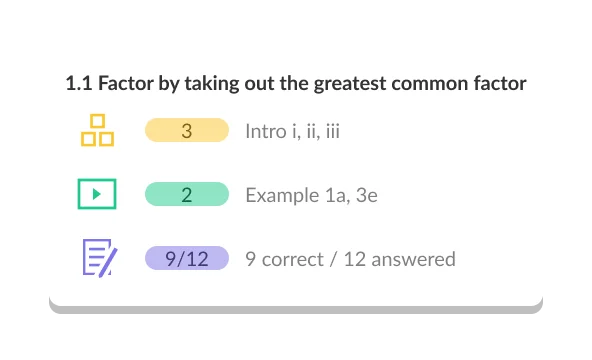
Practice Until Perfect
Practice until you truly get it.
Physics Topics
1. Scalars, Vectors and Motion
2. Kinematics
3. Forces
4. Work and Energy
5. Momentum
6. Equilibrium
7. Circular Motion
8. Gravitation
9. Electrostatics
10. Geometric Optics
10 Chapters · 33 Topics · 202 Videos
Discover Our Learning Areas
Explore key subjects and start learning with interactive content.



What is GCE A-Level Physics?
GCE A-Level Physics (H2) is a rigorous two-year pre-university course administered by SEAB in Singapore. It builds on O-Level foundations to develop a deep understanding of the physical world — from the motion of objects and the behaviour of waves to the structure of matter and the nature of nuclear reactions. Physics at this level is not just a content subject; it trains you to think analytically, apply principles to unfamiliar situations, and handle quantitative problems with precision. Those skills translate directly into engineering, medicine, and all physical sciences at university.
What topics are covered in H2 Physics?
The H2 Physics syllabus is broad and interconnected. Core topic areas include:
Mechanics — kinematics, dynamics, work, energy, power, circular motion, and gravitational fields. This is usually the starting point and provides the mathematical toolkit used throughout the rest of the course.
Thermal Physics — kinetic theory, the ideal gas model, and the laws of thermodynamics. Students apply these ideas to real-world systems like engines and refrigerators.
Waves and Superposition — progressive waves, stationary waves, diffraction, interference, and the electromagnetic spectrum. Wave concepts appear in both optics problems and later in quantum physics.
Electricity and Magnetism — electric fields, current electricity, electromagnetism, and electromagnetic induction. This is consistently the topic cluster where students need the most practice.
Modern Physics — photoelectric effect, wave-particle duality, atomic energy levels, and nuclear physics including radioactive decay. These topics require a shift in intuition from classical to quantum thinking.
All of these areas are covered on StudyPug, with certified-teacher video lessons explaining the method at every step — so you understand why the physics works, not just how to write the answer.
Why do students find H2 Physics difficult?
H2 Physics demands two things simultaneously: conceptual understanding and mathematical fluency. Many students can memorise definitions but struggle when an exam question presents a familiar concept in an unfamiliar context — which is precisely what SEAB papers are designed to do.
Common difficulty areas include electromagnetic induction (applying both Lenz's law and Faraday's law in a single problem), quantum physics (accepting wave-particle duality without a classical analogy), and circular motion (keeping track of directions and sign conventions). The practical assessment (SPA) adds another layer, requiring data handling and uncertainty analysis.
The most effective strategy is structured, consistent practice — not passive re-reading. StudyPug's adaptive practice system adjusts the difficulty of each problem to your current level, so you are always working in the zone where learning actually happens, without wasting time on questions that are too easy or too discouraging.
How does the GCE A-Level Physics exam work?
The H2 Physics assessment has three written papers set by SEAB, plus the School-Based Science Practical Assessment (SPA):
Paper 1 — 30 multiple-choice questions in one hour, testing breadth of knowledge across the whole syllabus.
Paper 2 — structured questions over two hours, requiring detailed written responses, calculations, and graph interpretation.
Paper 3 — free-response and longer structured questions over two hours, including a compulsory data-based question.
The SPA is conducted in school throughout the two years and assesses your ability to plan, carry out, and evaluate experiments. Together, the papers reward students who have practised under timed, exam-like conditions. StudyPug's mock exam tools are designed for exactly this — practising GCE-style questions with worked solutions so you understand not just the correct answer but the reasoning the examiner expects.
Why use StudyPug for Physics?
StudyPug is built for students who want to understand Physics deeply — not just pass it. Here is what makes it different:
Diagnostic Assessment: Before you start practising, a short diagnostic identifies precisely where your knowledge gaps are. You get a personalised study direction from day one, so you spend time on the topics that will move your grade, not the ones you already know.
Certified-Teacher Video Lessons: Every lesson is recorded by an experienced, certified teacher — not AI-generated. The videos explain the method behind each solution, step by step, so you develop the problem-solving approach that GCE markers reward. Watch a lesson as many times as you need until the concept clicks.
Adaptive Practice: The practice system responds to your performance in real time. Get a question right and the next one stretches you further. Struggle, and the system steps back to reinforce the underlying concept. This keeps you progressing efficiently without the frustration of working through material that is too far above your current level.
Full GCE Coverage in One Subscription: All H2 Physics topics are included — mechanics, waves, electricity, modern physics, and everything in between. And that same subscription also covers Mathematics, Chemistry, Economics, and every other subject on the platform. No per-topic fees, no extra charges.
30-Day Money-Back Guarantee: If StudyPug is not the right fit, you can request a full refund within 30 days. No complicated process, no questions that feel like a test.
What you learn: Physics topics on StudyPug
StudyPug covers the full scope of GCE H2 Physics, organised so you can jump directly to the topic you need help with right now or work through the entire course systematically. Key areas include:
Mechanics: Kinematics and equations of motion, Newton's laws, momentum and impulse, work-energy theorem, circular motion, gravitational fields and orbits.
Thermal Physics: Ideal gas laws, kinetic theory, internal energy, and the first law of thermodynamics.
Waves: Wave definitions, stationary waves, superposition, diffraction and interference patterns, the electromagnetic spectrum, and optical instruments.
Electricity and Magnetism: Coulomb's law, electric potential, current, resistance, Kirchhoff's laws, magnetic forces, electromagnetic induction, and AC circuits.
Modern Physics: Photoelectric effect, de Broglie wavelength, atomic line spectra, nuclear structure, radioactive decay, and nuclear energy.
Each topic comes with concept videos, worked-example practice problems, and quizzes — all aligned to the SEAB H2 Physics syllabus. Because validated topic page URLs are not yet available in the current sitemap for this course, individual topic links are not included here — visit the main StudyPug Physics page to browse all available topics.
How to use StudyPug for Physics
Getting started takes a few minutes. Here is the approach that works best for most students:
Step 1 — Take the diagnostic. A short set of questions across the H2 Physics syllabus maps your current knowledge. The results tell you which topic areas to prioritise and where you can afford to spend less time.
Step 2 — Watch the concept video for your first weak area. Each video teaches the underlying method, not just the answer to one problem. Pause, rewind, and re-watch as many times as you need. There is no penalty for watching a video ten times — use it until the concept is genuinely clear.
Step 3 — Do the practice problems. Apply what you have just watched. Adaptive practice will adjust to your responses, giving you more of what you need and moving you on when you are ready.
Step 4 — Use the mock papers before major assessments. In the weeks before your school common tests, prelims, or the A-Level papers themselves, shift to timed mock-exam practice. Review the detailed solutions for every question you got wrong — understanding why an answer is wrong is often more valuable than confirming why a correct one is right.
Step 5 — Keep going. Physics builds on itself. The electromagnetic induction you study in Term 3 assumes you understand the electric field concepts from Term 1. StudyPug keeps your earlier topic practice available so you can revisit any concept whenever you need a refresher — right up to your final paper.
Physics FAQ
Unsure how StudyPug works? Need help with setting up? Check our frequently asked questions or contact us for help.
What do you learn in GCE A-Level Physics, and what topics does it cover?
GCE A-Level Physics (H2) in Singapore covers mechanics, thermal physics, waves, electricity and magnetism, modern physics, and nuclear physics. You also develop practical skills through lab work and data analysis. The syllabus is set by SEAB and is assessed through structured and free-response papers, plus a practical assessment. By the end, you should be able to apply physical principles to unfamiliar problems — a skill essential both for A-Level grades and for university study in engineering or the sciences.
What is the difference between H1 Physics and H2 Physics?
H1 Physics is a one-year, lighter-load subject suitable for students who need Physics as a supporting subject, such as those in Life Sciences or Business. H2 Physics is the full two-year course taken by students intending to study engineering, physics, or medicine at university. H2 covers a wider range of topics — including electricity, magnetism, and nuclear physics — and demands stronger mathematical fluency. If you plan to study a physical science or engineering degree, H2 is generally required by local universities.
What are the prerequisites for H2 Physics, and what comes after it?
You typically need a strong O-Level result in Combined Physics or Pure Physics, plus a sound foundation in O-Level Mathematics. At junior college, H2 Mathematics is taken alongside H2 Physics to support the quantitative demands of the course. After A-Levels, Physics opens pathways to university programmes in Engineering (all branches), Physics, Computer Science, and Medicine. University courses often pick up where A-Level Modern Physics ends, so a solid GCE foundation matters well beyond the exam itself.
Is H2 Physics hard, and where do students struggle most?
H2 Physics is widely considered one of the more challenging A-Level subjects in Singapore. Students most commonly struggle with electromagnetism (particularly induced EMF and Faraday's law), quantum physics and wave-particle duality, and structured-question problem-solving under time pressure. Difficulty often comes not from memorising facts but from applying principles to novel situations — exactly what SEAB papers test. Consistent practice with past-year questions, combined with understanding the underlying method, is the most effective way to close those gaps.
How is GCE A-Level Physics assessed — papers, practicals, and grading?
H2 Physics is assessed by SEAB across three components: Paper 1 (30 MCQ, 1 hour), Paper 2 (structured questions, 2 hours), and Paper 3 (free-response and longer structured questions, 2 hours). There is also a School-Based Science Practical Assessment (SPA) which contributes to your final grade. Grades run from A to U, with universities typically expecting at least a B or higher for science-related programmes. Practising past GCE papers under timed conditions is the most direct preparation strategy.
What is one of the hardest topics in H2 Physics, and how do you approach it?
Electromagnetic induction is consistently rated the hardest topic in H2 Physics. Students must simultaneously apply Lenz's law, Faraday's law, and circuit reasoning — all in the same problem. The key approach is to work methodically: first determine the change in flux, then use Lenz's law to find the direction of induced current, and finally apply Faraday's law to find the magnitude of the EMF. Sketching field lines and working through structured practice problems step by step — rather than trying to memorise answer patterns — is the most reliable way to build genuine understanding.




Written by the StudyPug Team
Last updated June 5, 2026
3 M+
students
★★★★★
4.8 average
K–12
all grades