Macroeconomics Help: Video Lessons & Practice
Work through every topic with clear solutions. Start your free practice test now!
Value vs. Private Tutor
Expert macroeconomics help without the price tag.
Multi-Subject
One subscription covers all subjects.
Build Mastery
Master supply and demand before testing.
Macroeconomics Topics
1. Measuring GDP
2. Jobs and Inflation
3. Understanding Economic Growth
4. Finance and Loans
5. Money and Banks
6. The Exchange Rate
7. Aggregate Supply and Demand
8. The Keynesian Model
9. Inflation and Unemployment
9 Chapters · 36 Topics · 118 Videos
Discover Our Learning Areas
Explore key subjects and start learning with interactive content.













What is Macroeconomics?
Macroeconomics is the branch of economics that studies the behaviour and performance of an economy as a whole. Rather than analysing individual consumers or firms, it examines economy-wide phenomena: total output, the general price level, the rate of unemployment, and the effects of government and central bank policy. A university macroeconomics course gives you the analytical tools — models, diagrams, and quantitative reasoning — to understand why economies grow, why recessions happen, and how policymakers respond.
If you are searching for macroeconomics help, you are likely working through one of the most policy-relevant courses in any economics or commerce degree. StudyPug offers certified-teacher video lessons, adaptive practice, and mock exams that cover every topic from GDP accounting through to open-economy models.
What is the difference between macroeconomics and microeconomics?
Microeconomics examines the decisions of individual households and firms — how prices are set in specific markets, how consumers maximise utility, and how firms compete. Macroeconomics steps back and looks at the aggregate: total spending in the economy, the overall price level (inflation), national employment, and the policies governments use to steer economic outcomes.
The two fields are complementary. Microeconomic foundations underpin many macroeconomic models — for example, consumption theory draws on household decision-making. Most economics degrees require both courses, and studying them together deepens your understanding of each. If you are strong in micro but struggling with macro, the difference in focus — individual versus aggregate — is the key mental shift to make.
Is macroeconomics hard, and where do students struggle most?
Macroeconomics is considered moderately to quite challenging at university level. Introductory material — the circular flow of income, GDP measurement, and basic supply and demand — is accessible. Difficulty rises sharply when you reach multi-market models. The IS-LM framework, which links the goods market and the money market, requires you to track how a change in one variable ripples through both curves simultaneously. Open-economy macroeconomics, with exchange rates and the Mundell-Fleming model, adds another layer of complexity.
Common struggles include: confusing short-run and long-run effects; forgetting which curve shifts in response to a policy change; and misreading diagram questions under exam pressure. The best remedy is practising diagram drawing repeatedly — not just reading about it — and working through policy scenario questions from past papers. StudyPug's practice tests and step-by-step video solutions let you do exactly that, at your own pace, as many times as needed.
What are the core topics in a university macroeconomics course?
A standard first or second-year university macroeconomics course at a New Zealand institution typically covers the following areas:
- National income accounting: GDP, GNP, and the expenditure, income, and production approaches to measuring output.
- Aggregate demand and aggregate supply: The AD-AS model, price level determination, and the output gap.
- Consumption, investment, and the multiplier: Keynesian cross, the marginal propensity to consume, and fiscal multipliers.
- Monetary policy and the money market: The Reserve Bank of New Zealand, interest rate setting, money supply, and inflation targeting.
- Fiscal policy: Government spending, taxation, budget deficits, and public debt dynamics.
- The IS-LM model: Simultaneous equilibrium in goods and money markets; the effects of fiscal and monetary policy shocks.
- Economic growth: The Solow growth model, capital accumulation, and the role of technology.
- Unemployment and the labour market: Types of unemployment, the natural rate, and the Phillips curve.
- Open-economy macroeconomics: Balance of payments, exchange rates, the current account, and the Mundell-Fleming model.
Each of these topics has its own vocabulary, diagrams, and exam conventions. StudyPug covers all of them with certified-teacher lessons you can revisit as many times as you need.
Why StudyPug for Macroeconomics?
StudyPug is built for university students who need more than a textbook. Here is what makes it different for macroeconomics specifically.
Certified-teacher concept videos that teach the method: Every lesson is recorded by an experienced instructor — not generated by AI. The focus is on teaching you how to approach a problem, not just showing you the answer. That means when your exam presents a novel scenario, you have the reasoning skills to work through it. For macroeconomics, this matters enormously: the IS-LM model and AD-AS framework require you to apply logic, not memorise steps.
Diagnostic assessment: When you start, a quick diagnostic identifies which macroeconomics topics are solid and which need attention. Instead of reviewing everything from scratch, you study what actually moves the needle — a much more efficient use of the limited time before midterms and finals.
Adaptive practice: Once the diagnostic has mapped your knowledge, practice questions adjust to your performance level. If you are comfortable with GDP accounting but shaky on monetary policy transmission, the system keeps pushing you on the harder material while reinforcing your strengths.
Exam preparation aligned to your assessments: StudyPug's mock exams and practice tests are based on real exam structures. For New Zealand university students, that means practising the style of questions — extended written responses, diagram interpretation, and policy analysis — that appear in your end-of-semester examinations. You can also practise for internal assessments throughout the semester.
All courses in one subscription: Macroeconomics does not exist in isolation. A single StudyPug subscription covers Macroeconomics, Microeconomics, Statistics, Calculus, and more. If you need to brush up on the calculus behind the Solow model, or revisit the statistics for an econometrics prerequisite, it is all there.
30-day money-back guarantee: StudyPug does not offer a free trial of the paid plan. Instead, every subscription comes with a 30-day money-back guarantee — so you can start your macroeconomics study with no financial risk.
What you learn — macroeconomics course coverage
StudyPug's macroeconomics content is organised to match the progression of a university course. You begin with the foundations — how we measure economic output, what drives consumption and investment, and how the multiplier works. From there, lessons move into the core models: the Keynesian cross, the IS-LM framework, and the AD-AS model.
Monetary policy lessons cover how the Reserve Bank of New Zealand uses the Official Cash Rate to manage inflation and output. Fiscal policy lessons work through the effects of government spending and tax changes, including crowding-out effects and debt sustainability. Growth theory lessons introduce the Solow model, explain capital deepening, and connect to real-world data on economic development.
Open-economy topics cover exchange rate determination, purchasing power parity, the current account, and the Mundell-Fleming model under both fixed and floating exchange rates. Each topic includes worked examples and practice problems so you can test your understanding before the exam.
No validated internal topic links are available for this page at this time. All topic coverage is accessible directly through the StudyPug course page once you are logged in.
Using StudyPug for your macroeconomics study
The most effective way to use StudyPug for macroeconomics is to integrate it with your course schedule rather than saving it for the night before an exam.
Start of semester: Run the diagnostic assessment in the first week. It takes only a few minutes and gives you a clear picture of your starting point — which topics from prior study are solid, and which macroeconomic concepts need building from the ground up.
Week to week: After each lecture or tutorial, work through the corresponding StudyPug video lesson to reinforce the concept. Watch it once to follow the method, then attempt the practice problems. If you get stuck, rewatch the relevant section. The certified-teacher explanations are designed to make the logic clear, not just the steps.
Before midterms: Use the adaptive practice to drill the topics that have appeared on your course outline as assessment items. The system will push you toward your weaker areas. Work through at least one full mock exam under timed conditions to build exam technique alongside content knowledge.
Before finals: Re-run the diagnostic to identify any remaining gaps after a full semester of study. Focus your final revision on the high-weight topics — typically IS-LM, AD-AS, and monetary/fiscal policy interactions — and practise drawing and interpreting diagrams quickly. Watch the concept videos one more time if any model still feels uncertain.
Macroeconomics rewards students who engage with the material consistently throughout the semester. StudyPug is designed to make that consistent engagement as efficient as possible — targeted, adaptive, and taught by instructors who know the subject deeply. Start Now and build the macroeconomics skills you need for your next assessment.
Macroeconomics FAQ
Unsure how StudyPug works? Need help with setting up? Check our frequently asked questions or contact us for help.
What do you learn in Macroeconomics, and what topics does it cover?
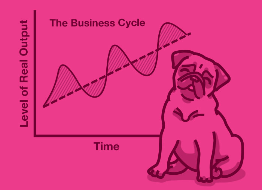
Macroeconomics studies the economy as a whole rather than individual markets. You learn how GDP, inflation, unemployment, interest rates, and government policy interact. Core topics include national income accounting, aggregate demand and supply, monetary and fiscal policy, economic growth, the business cycle, international trade, and the balance of payments. By the end of a university macroeconomics course you can analyse real-world economic events and apply models such as IS-LM and AD-AS to policy questions.
What is the difference between Macroeconomics and Microeconomics?
Microeconomics focuses on individual decision-makers — households, firms, and specific markets — examining supply and demand, pricing, and consumer behaviour. Macroeconomics zooms out to study economy-wide outcomes: total output, the price level, employment, and national policy. Both courses use economic modelling, but macroeconomics deals with aggregates like GDP and inflation rather than the price of a single product. Most economics degrees require both, and concepts from micro underpin many macro models.
What are the prerequisites for Macroeconomics, and what course comes after it?
Most universities expect students to have completed an introductory economics course (Econ 101 or equivalent) and basic calculus. Familiarity with graphs and algebraic reasoning is important. After introductory Macroeconomics, students typically progress to Intermediate Macroeconomics, Monetary Economics, or International Economics. Some programmes also lead into Econometrics, where you apply statistical methods to macroeconomic data. Checking your specific programme requirements is always advisable.
Is Macroeconomics hard, and where do students struggle most?
Macroeconomics is considered moderately challenging. Most students find the early topics — GDP measurement and the circular flow — straightforward, but difficulty increases with the IS-LM model, monetary transmission mechanisms, and open-economy macroeconomics. Keeping track of multiple interacting variables and understanding the difference between short-run and long-run effects trips many students up. Building a strong grasp of the core models early and practising diagram-based questions regularly makes the harder topics much more manageable.
How is Macroeconomics assessed in New Zealand universities?
At New Zealand universities, Macroeconomics is typically assessed through a mix of internal and final examinations. Coursework usually includes assignments, short tests, and sometimes essays or case studies worth around 40–50% of the final grade. A written final examination at the end of semester makes up the remainder. Some courses also include participation or online quizzes. Assessment details vary by institution, so checking your course outline is essential. Strong exam technique — especially interpreting and drawing economic diagrams — is critical for success.
What is one of the hardest topics in Macroeconomics, and how do you approach it?
The IS-LM model is consistently one of the most challenging topics. It links the goods market and the money market to show how interest rates and output are determined simultaneously. Students often struggle to remember which curve shifts under which policy change, and why. The best approach is to work through each curve's derivation from first principles, then practise policy scenarios — expansionary fiscal policy, a money supply increase — step by step. Drawing the diagram repeatedly while narrating the logic aloud builds the intuition needed for exam questions.





Written by the StudyPug Team
Last updated June 5, 2026
3 M+
students
★★★★★
4.8 average
K–12
all grades