Learn Grade 6 English Language Arts Online
Practice reading comprehension, grammar, and literary analysis with real teacher video lessons aligned to provincial curriculum.

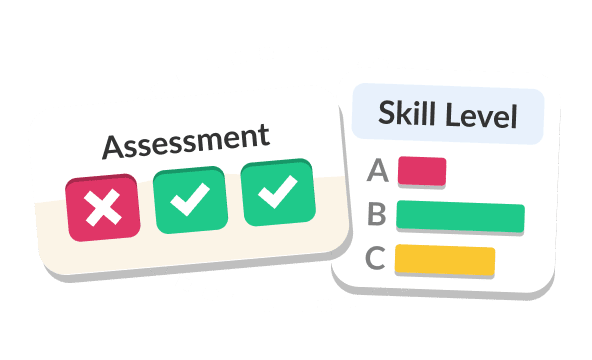
Diagnostic Finds Gaps
Know exactly what your child needs.
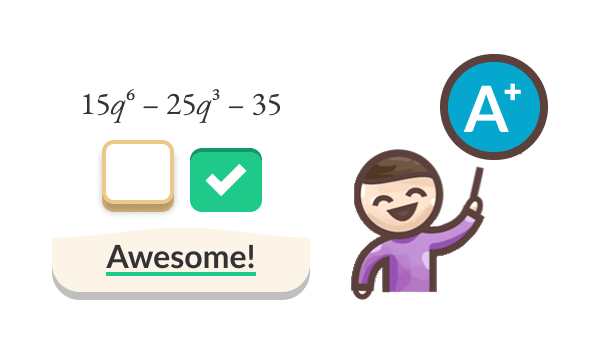
Step-by-Step Video Lessons
Child sees each step until solving alone.

Matches School Work
Matches your child's provincial curriculum.
Try It Now
Test your knowledge
Our approach aligns with the evidence
Exam Scores
Better Recall
Less Anxiety
Grade 6 English Topics
1. Text Evidence
4. Language
5. Structure
6. Point of View
7. Comparison
8. Key Ideas
9. Event Development
10. Technical
11. Information Structure
12. Purpose
13. Integration
14. Argument
15. Claims
16. Support
17. Style
18. Organization
19. Development
20. Technique
21. Planning
22. Projects
23. Evidence
24. Discussion
25. Integration
26. Claims
27. Grammar
28. Usage
29. Variation
30. Strategies
31. Safety
32. Sources
33. Analysis
33 Chapters · 33 Topics · 26 Videos
Discover Our Learning Areas
Explore key subjects and start learning with interactive content.


What is Grade 6 English Language Arts?
Grade 6 English Language Arts is the bridge between the foundational reading and writing skills of the elementary years and the more demanding analytical work that begins in junior high. At this level, students move from simply understanding what a text says to examining how and why an author says it. Provincial curricula across Canada expect Grade 6 students to read complex fiction and non-fiction texts, identify literary devices, apply consistent grammar rules, and expand their academic vocabulary — all while developing the habit of reading independently and critically.
If your child is finding Grade 6 ELA challenging, they are not alone. The jump in text complexity, the introduction of literary analysis, and the more rigorous grammar expectations catch many students off guard. The right mix of targeted practice and clear instruction makes a measurable difference.
What reading comprehension skills does Grade 6 ELA cover?
Reading comprehension in Grade 6 goes well beyond recalling plot details. Students are expected to make inferences, identify an author's purpose, compare perspectives across texts, and support their responses with evidence from the passage. Provincial assessments in Ontario, BC, and Alberta all test these skills directly.
StudyPug's Grade 6 ELA practice covers the full range of comprehension skills — from identifying the main idea in an informational article to analyzing how a character's choices drive a story's conflict. Each practice set is aligned to provincial curriculum standards, so the question types and text complexity your child encounters here closely mirror what they face on classroom quizzes and standardized assessments. The diagnostic assessment identifies which comprehension skills need the most work, so practice time is never wasted on what your child already knows.
How is grammar taught and practised in Grade 6?
Grade 6 grammar builds on the parts-of-speech knowledge from earlier grades and introduces more nuanced skills: complex sentence construction, correct use of commas and semicolons, subject-verb agreement in tricky cases, and consistent verb tense. Grammar errors that were minor in Grade 4 become significant in Grade 6, where teachers begin marking written work more strictly.
StudyPug's certified-teacher video lessons explain each grammar concept clearly — showing the rule, demonstrating it in examples, and walking through common mistakes. After watching a lesson, students move directly into adaptive practice. Questions adjust based on their answers: if comma splices are no problem, the practice moves on; if subject-verb agreement is shaky, the system stays on it until the concept is solid. This means your child builds genuine mastery rather than just passing a single quiz.
What is literary analysis and why does it matter at Grade 6?
Literary analysis means looking closely at a text to understand the choices an author made — and why those choices matter. In Grade 6, students begin identifying themes, analyzing character development, recognizing point of view, and spotting literary devices like metaphor, simile, and foreshadowing.
Many students find literary analysis confusing at first because there is rarely one single right answer the way there is in math. StudyPug's video lessons teach students a reliable process: identify the evidence in the text, name the technique or element, and explain its effect. Practising this process repeatedly across different text types builds the analytical habit that carries through Grades 7, 8, and beyond. Parents consistently report that once their child grasps the analysis framework through the video lessons, their confidence in English class climbs noticeably.
How does vocabulary instruction work in Grade 6 ELA?
Grade 6 vocabulary practice focuses on words in context rather than memorizing isolated definitions. Students learn how to use context clues, understand word relationships (synonyms, antonyms, connotations), and build the academic vocabulary that appears in subject-area reading across all their classes — not just English. A strong vocabulary at Grade 6 pays dividends in science, social studies, and eventually on provincial assessments where complex passages are the norm.
StudyPug's adaptive practice introduces vocabulary through the kinds of question formats students encounter at school: selecting the meaning of an underlined word in a passage, choosing the best word to complete a sentence, and identifying the connotation that best fits a context. Because practice questions adjust to your child's level, they are always working just beyond what they already know — the most efficient zone for building a richer vocabulary.
How does Grade 6 ELA connect to Grade 7 and beyond?
The skills built in Grade 6 are direct prerequisites for Grade 7 ELA, where literary analysis becomes more sophisticated, grammar expectations increase, and the volume of independent reading rises significantly. Students who arrive at Grade 7 with shaky comprehension strategies or inconsistent grammar typically find the transition difficult. Building a strong Grade 6 foundation is one of the best investments a family can make.
StudyPug covers the full Grade 6 curriculum so that no topic is left as a weak spot heading into Grade 7. The progress dashboard lets parents see exactly which skills have been strengthened and which still need attention — giving families a clear, objective picture well before report cards arrive.
Why StudyPug for Grade 6 English Language Arts?
StudyPug is built around a simple idea: every child learns at their own pace, and the right support should meet them exactly where they are. For Grade 6 ELA, that means three things working together.
Real teacher video lessons. Every concept — literary analysis, grammar rules, comprehension strategies, vocabulary in context — is explained by a certified teacher on video. These are not AI-generated summaries; they are structured lessons that teach the method step by step, the same way a great classroom teacher would. Your child can pause, rewind, and rewatch as many times as needed before attempting practice.
Diagnostic assessment and adaptive practice. Before your child spends time practising, a short diagnostic assessment maps their current Grade 6 ELA skill level. The adaptive practice that follows adjusts question difficulty based on their performance — always challenging enough to build skill, never so hard that it discourages. This is how gaps close efficiently.
Provincial curriculum alignment. All Grade 6 content on StudyPug is aligned to provincial curriculum standards. Whether your child is in Ontario, British Columbia, Alberta, or another province, the topics covered here match what their teacher is working through in class. For detailed curriculum mapping, see the Ontario Grade 6 ELA curriculum and the British Columbia Grade 6 ELA curriculum.
One subscription covers up to five children across all grades and subjects. The 30-day money-back guarantee means there is no risk to getting started today.
What you learn in Grade 6 English Language Arts on StudyPug
Grade 6 ELA on StudyPug covers every major strand of the provincial curriculum:
- Reading Comprehension — main idea, inference, author's purpose, text evidence, comparing texts
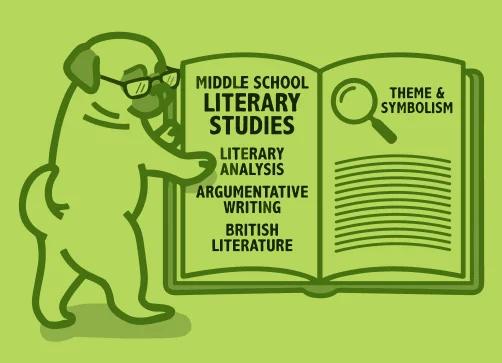
- Literary Analysis — theme, character development, point of view, literary devices (metaphor, simile, foreshadowing, imagery)
- Grammar and Mechanics — complex sentences, comma and semicolon use, subject-verb agreement, consistent verb tense, pronoun reference
- Vocabulary in Context — context clues, word relationships, connotation and denotation, academic vocabulary
- Author's Craft — how word choice, sentence structure, and text organization create effect and meaning
- Informational Text — reading non-fiction, identifying argument and evidence, evaluating sources
Every topic is covered by a video lesson and a matching adaptive practice set, so your child always has a clear path from confusion to confidence.
Using StudyPug for Grade 6 ELA: what to expect
Getting started takes a few minutes. Your child signs in, selects Grade 6 English Language Arts, and the diagnostic assessment runs automatically — identifying their current skill level across the key curriculum strands. From there, the recommended practice path focuses on the areas most in need of attention first.
A typical StudyPug session for a Grade 6 student might look like this: watch a 10-minute certified-teacher video on identifying theme in a short story, then complete an adaptive practice set of 10–15 questions on the same concept. The system tracks correct and incorrect responses in real time, adjusts the difficulty of subsequent questions, and logs the results to the parent progress dashboard. Parents receive weekly summary reports showing which skills improved, which still need work, and how overall Grade 6 ELA progress is trending.
If your child gets stuck on a homework question, Photo Search lets them photograph the question and find the most relevant lesson on StudyPug — a quick way to get unstuck without waiting for the next school day. Photo Search is a supporting tool; the core learning happens through the video lessons and adaptive practice.
StudyPug is available on any device — desktop, tablet, or phone — so your child can practise at home, on the go, or wherever it fits into your family's routine. There are no schedules to keep and no pressure: your child works at their own pace, building Grade 6 ELA skills one concept at a time.
Grade 6 English FAQ
Unsure how StudyPug works? Need help with setting up? Check our frequently asked questions or contact us for help.
What's included in the subscription?
Full access to all Grade 6 English Language Arts video lessons, practice problems, assessments, and progress tracking. One subscription covers up to 5 children and all grades, subjects, and courses on StudyPug.
Can I sign up free to try it?
Yes! You can sign up free to explore sample lessons and practice materials. When you're ready to subscribe, we offer a 30-day money-back guarantee — if it's not right for your child, we'll refund you.
How much does it cost?
Plans start with one low monthly payment, with annual options for the best value. One plan covers up to 5 children and all subjects. 30-day money-back guarantee. [See all plans →]
What does Grade 6 English Language Arts cover?
Grade 6 ELA covers reading comprehension, literary analysis, grammar, vocabulary in context, sentence structure, and author's craft — aligned to provincial curriculum across Ontario, BC, and Alberta.
Is Grade 6 ELA harder than Grade 5?
Grade 6 ELA introduces more complex texts, literary analysis, and grammar rules. It builds directly on Grade 5 skills. StudyPug's diagnostic assessment identifies any Grade 5 gaps so your child starts on solid footing.
How do the assessments help my child?
Short diagnostic assessments identify exactly which Grade 6 reading comprehension and grammar skills need work. Practice then focuses on those gaps — no time wasted on what your child already knows.




Written by the StudyPug Team
Last updated June 5, 2026
3 M+
students
★★★★★
4.8 average
K–12
all grades