Grade 9 Math Help — Step-by-Step Video Lessons & Practice
Help your child build confidence and get better at grade 9 math — one clear lesson at a time.
Expert Video Solutions
Real teachers help you solve the next alone.
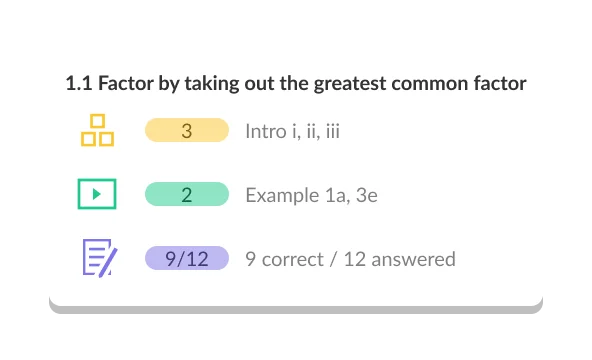
Practice Until Perfect
Practice until it truly clicks.
Real Exam Practice
Practice real exams from your curriculum.
Try It Now
Test your knowledge
Our approach aligns with the evidence
Exam Scores
Better Recall
Less Anxiety
Grade 9 Math Topics
1. Symmetry and Surface Area
2. Rational Numbers
3. Powers and Exponents
4. Scale Factors and Similarity
5. Polynomials
6. Linear Relations
7. Multiplication and Division of Polynomials
8. Solving Linear Equations
9. Linear Inequalities
10. Circle Geometry
11 Chapters · 39 Topics · 392 Videos

Ready to practice Grade 9 Math?
Try practice questions on every Grade 9 Math topic — with instant feedback and step-by-step video solutions when you get stuck.
Discover Our Learning Areas
Explore key subjects and start learning with interactive content.













What Is Grade 9 Math?
Grade 9 Math is the first year of formal high school mathematics in Canada. It bridges the arithmetic and pre-algebra students learned in grades 7 and 8 with the algebraic reasoning they will need throughout secondary school. Students move from working with numbers to working with variables, equations, and functions — a shift that forms the backbone of every math course that follows. In Ontario, grade 9 math splits into Academic (MPM1D) and Applied (MFM1P) streams; in Alberta and BC, the curriculum leads into Mathematics 10C or Foundations and Pre-Calculus 10. Wherever your child is studying, grade 9 is the year that sets the trajectory.
What Do Students Learn in Grade 9 Math?
The core strands in Canadian grade 9 math curricula include number sense and algebra, linear relations, analytic geometry, and measurement and geometry. In practice, this means your child will spend significant time writing and solving linear equations, working with polynomials (expanding, simplifying, and factoring), graphing lines and interpreting slope, exploring the difference between a relation and a function, and applying measurement skills to more complex shapes and solids. Financial mathematics — simple interest, unit rates, proportional reasoning — also appears in several provincial curricula. These topics are not isolated; each one builds directly on the next, which is why a gap in one area quickly shows up in the next unit.
Is Grade 9 Math Harder Than Grade 8?
For most students, yes — and noticeably so. The jump from grade 8 to grade 9 math is one of the most significant in the K-9 sequence. The reason is conceptual: grade 8 math is largely computational, while grade 9 math asks students to think abstractly with variables and generalize patterns into equations. Students who found grade 8 manageable sometimes find grade 9 algebra genuinely difficult at first. The most common struggle points are multi-step linear equations (especially those involving fractions or negative coefficients), factoring polynomials, understanding function notation, and interpreting slope as a rate of change rather than just a number on a graph. Identifying which of these gaps exists early — before they compound — is the most effective thing a parent can do at the start of grade 9.
What Should My Child Know Before Grade 9 Math?
A confident grade 8 math foundation is the real prerequisite. Specifically: comfortable integer arithmetic (adding, subtracting, multiplying, and dividing negative numbers), fraction operations, solving one- and two-step equations, and understanding ratio and proportion. Students who arrive at grade 9 shaky on integers or fractions will feel that immediately in the first algebra unit. If your child struggled with any of those topics in grade 8, addressing them before — or at the start of — grade 9 pays dividends for the entire year. StudyPug's diagnostic assessment is built to surface exactly these kinds of prerequisite gaps so your child starts working on the right material from day one.
How Is Grade 9 Math Assessed Across Canadian Provinces?
Assessment varies by province. In Ontario, grade 9 students in the Academic stream may write the EQAO Grade 9 Math assessment, which tests the MPM1D curriculum and is reported on the provincial record. The EQAO Grade 9 Foundations assessment covers the Applied stream. StudyPug includes dedicated EQAO practice test grade 9 preparation so students can practise on material structured like the real assessment. In Alberta, grade 9 math is evaluated through school-based assessments aligned to the Provincial Program of Studies; students and parents in Alberta can review the full grade 9 Alberta math curriculum coverage to see exactly which outcomes are addressed. In BC and other provinces, assessment is school-based and report-card driven, with no separate provincial exam at this grade level.
Why StudyPug for Grade 9 Math?
Grade 9 math requires more than answer-checking — it requires understanding the method well enough to apply it to an unfamiliar problem on a test. StudyPug's certified teachers build every video lesson around teaching the method first, working through examples step by step, and explaining the reasoning behind each move. These are not AI-generated explanations or text-based solutions — they are real teachers presenting concepts the way a good tutor would, with the patience to rewind as many times as needed.
The diagnostic assessment that begins each student's journey on StudyPug finds the specific gaps — whether that's factoring trinomials, graphing linear relations, or understanding function notation — so your child's practice time is focused, not scattered. Adaptive practice questions then adjust difficulty based on how your child is performing, keeping them challenged without overwhelming them. The parent dashboard gives you visibility into which topics have been covered, where scores are improving, and where more work may be needed — so you are never in the dark about your child's progress.
For families with more than one child, the Family Plan covers up to five children at every grade level and all four subjects under one subscription. And if the platform isn't the right fit, StudyPug's 30-day money-back guarantee means there is no financial risk in trying it.
What Your Child Will Learn — Grade 9 Math Curriculum Coverage
StudyPug's Grade 9 Math content covers the full scope of Canadian provincial curricula. Key topic areas include:
- Algebra and linear equations — solving one-, two-, and multi-step equations; equations with variables on both sides; linear inequalities.
- Polynomials — adding, subtracting, and multiplying polynomials; common factoring; factoring simple and complex trinomials.
- Linear relations and graphing — slope as a rate of change; y-intercept; graphing using a table of values and slope-intercept form; parallel and perpendicular lines.
- Functions and relations — identifying functions from graphs, tables, and equations; domain and range; function notation.
- Measurement and geometry — surface area and volume of composite figures; the Pythagorean theorem applied to real-world problems.
- Financial mathematics — simple interest; unit pricing; proportional reasoning in financial contexts (where applicable by province).
Every topic includes concept videos, guided examples, and adaptive practice. Ontario students preparing for the EQAO assessment and Alberta students working through the Program of Studies will find their curriculum topics covered directly within the platform.
How to Use StudyPug for Grade 9 Math
The most effective way to use StudyPug is alongside the school curriculum — not as a catch-up tool but as a reinforcement layer that runs in parallel. When your child encounters a new topic in class, they can find the corresponding StudyPug lesson, watch the certified-teacher video to see the method explained clearly, then complete the adaptive practice until they are confident. If a test is approaching, the practice-test feature lets them work through assessment-style questions under realistic conditions and identify any remaining gaps before the real thing.
For students who have fallen behind, the diagnostic assessment is the starting point. It identifies the specific gaps — whether they are in the current grade 9 material or back in prerequisite topics from grade 8 — and generates a focused study path. From there, 20–30 minutes of targeted video and practice per session, four or five days a week, is enough to see real progress within a few weeks.
StudyPug works on any device — desktop, tablet, or phone — so your child can access help the moment homework gets difficult, not just when they're at a desk. Photo Search lets students photograph a problem and find the matching lesson instantly, across all subjects and all grade levels. Support is available any time, which matters most at 9pm before a test the next morning.
Grade 9 Math FAQ
Unsure how StudyPug works? Need help with setting up? Check our frequently asked questions or contact us for help.
What does my child learn in Grade 9 Math, and what topics does it cover?
Grade 9 Math in Canada covers foundational algebra and number sense that students carry through high school. Core topics include linear equations and inequalities, polynomials (collecting like terms, multiplying, factoring), relations and functions, graphing linear relationships, surface area and volume, and introduction to financial mathematics. In Ontario, this aligns with the MPM1D/MFM1P streams; in Alberta and BC, the curriculum builds toward Mathematics 10C. By the end of grade 9, students should be comfortable writing and solving equations, interpreting graphs, and applying proportional reasoning.
Is Grade 9 Math hard, and where do students commonly struggle?
Grade 9 is widely considered the most significant jump in difficulty in the entire K-9 math sequence. The shift from arithmetic to formal algebra catches many students off guard. The most common struggle points are: setting up and solving multi-step linear equations, understanding what a function is versus a relation, factoring polynomials (especially trinomials), and interpreting slope in a real-world context. Students who find grade 8 fractions and integers shaky often hit a wall early. Catching these gaps with a diagnostic and targeted practice before they pile up makes a significant difference.
What should my child know before Grade 9 Math, and what comes next?
Solid grade 8 math is the real foundation: integer operations, fraction arithmetic, solving one- and two-step equations, and basic ratio and proportion. Students who struggle with those will feel it quickly in grade 9 algebra. After grade 9, the path splits by province and stream — in Ontario, into Academic (MPM2D) or Applied (MFM2P) grade 10; in Alberta and BC, into Mathematics 10C or Foundations and Pre-Calculus 10. Grade 9 is the last year before those tracks diverge, making it a high-stakes year to build confidence and address any gaps.
How does StudyPug Math map to what my child learns at school?
StudyPug's Grade 9 Math lessons are built to align with Canadian provincial curricula — including Ontario's MPM1D/MFM1P, the Alberta Program of Studies, and the BC curriculum. Every topic your child encounters in class has a corresponding lesson on StudyPug, so they're never practicing something out of context. For Alberta students preparing for provincial assessments, StudyPug also covers the EQAO Grade 9 Foundations practice material. You can explore the grade 9 alberta math curriculum coverage directly to see the topic-by-topic breakdown.
What is one of the trickiest Math concepts in Grade 9, and how is it taught?
Factoring polynomials — especially factoring trinomials of the form ax² + bx + c — is consistently the concept where grade 9 students lose the most marks. It requires students to reverse the multiplication process and recognize patterns, which is abstract if they only memorized the FOIL method. On StudyPug, certified teachers walk through factoring step by step: starting with common factoring, moving to simple trinomials, then complex ones. Each method is modelled with worked examples, followed by adaptive practice that builds from easier to harder forms so students develop genuine fluency rather than pattern-matching by memory.
How much Math practice should my child do at Grade 9?
Most educators recommend 20–30 minutes of focused math practice four to five days per week at the grade 9 level. Consistency matters more than length — shorter, daily sessions outperform cramming before tests. In practice, this means one concept video (usually 8–12 minutes), followed by a set of practice problems until the child is getting questions right with confidence. During exam preparation, adding a full practice test session in the week before the test helps identify any remaining gaps. StudyPug's adaptive practice adjusts difficulty automatically, so the 20–30 minutes is always spent at the right level.





Written by the StudyPug Team
Last updated June 5, 2026
3 M+
students
★★★★★
4.8 average
K–12
all grades