EQAO Grade 9 Math Prep: Practice Tests & Video Solutions
Pinpoint your weak areas fast, then fix them with step-by-step certified-teacher videos.
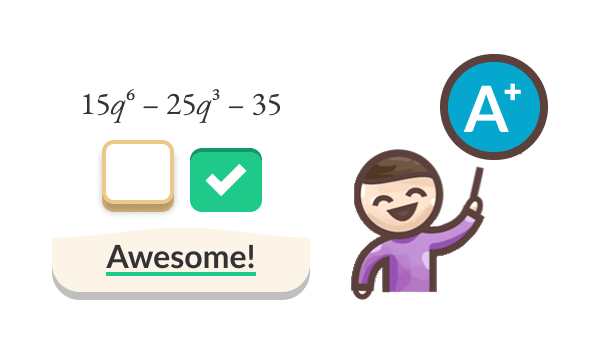
Step-by-Step Videos
Real teaching helps you solve problems alone.
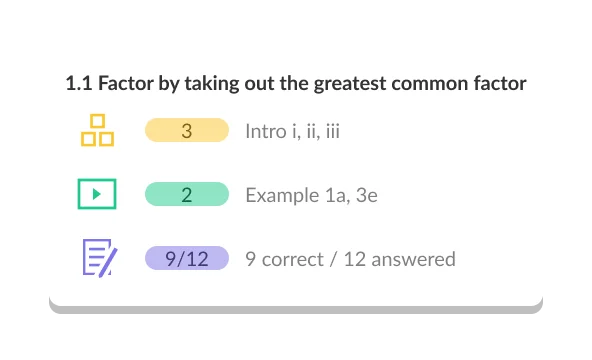
Unlimited Practice
Practice until it clicks not quits.

Real Exam Practice
Practice real EQAO questions before exams.
Try It Now
Test your knowledge
Our approach aligns with the evidence
Exam Scores
Better Recall
Less Anxiety
EQAO Grade 9 Principles of Math Topics
1. Ratios, Rates, and Proportions
2. Square Roots
3. Pythagorean Theorem
4. Rational Numbers
5. Powers and Exponents
6. Proportional Relationships
7. Linear Ralations
8. Solving Linear Equations
9. Introduction to Relations and Functions
10. Linear Functions
11. Linear Programming
12. Introduction to Polynomials
13. Multiplication and Division of Polynomials
14. Introduction to 3-Dimensional Objects
15. Surface Area and Volume
16. Circle Geometry
17 Chapters · 71 Topics · 628 Videos

Ready to practice EQAO Grade 9 Principles of Math?
Try practice questions on every EQAO Grade 9 Principles of Math topic — with instant feedback and step-by-step video solutions when you get stuck.
Discover Our Learning Areas
Explore key subjects and start learning with interactive content.















What Is the EQAO Grade 9 Math Assessment?
The EQAO Grade 9 math assessment is an Ontario province-wide evaluation administered to all students enrolled in the Grade 9 mathematics course (MTH1W). It measures achievement against Ontario's curriculum expectations and gives students, families, and schools a clear picture of where Grade 9 math skills stand. The assessment is delivered digitally, embedded within regular class time — there is no separate test day to book. Results are reported at four achievement levels, with Level 3 representing the provincial standard.
Understanding the assessment's structure, content, and scoring is the first step toward effective EQAO Grade 9 prep. The sections below answer the most common questions students and families ask, and explain how a structured practice plan can help you walk in ready.
EQAO Grade 9 Format and Sections
The EQAO Grade 9 assessment is organised around four curriculum strands drawn from Ontario's 2021 revised, de-streamed MTH1W course.
Number — proportional reasoning, fractions, ratios, rates, and financial literacy concepts. Questions test both computation and interpretation.
Algebra — linear and non-linear relations, equations, expressions, and an introduction to coding logic. This strand includes both multiple-choice and open-response questions that require students to show and explain their reasoning.
Data — collecting, organising, representing, and critically analysing data. Students may be asked to interpret graphs, identify trends, or evaluate how data is presented.
Geometry and Measurement — geometric properties, angle relationships, area, surface area, and volume. Questions often link measurement to real-world contexts.
Across all four strands, the EQAO also assesses Mathematical Processes: problem solving, reasoning and proving, communicating, connecting, representing, selecting tools and strategies, and reflecting. This means the assessment rewards understanding the why behind a method — not just arriving at a correct numerical answer.
EQAO Grade 9 Scoring: Levels Explained
EQAO results are reported on a four-level scale aligned to Ontario's achievement chart.
- Level 1 — Below the provincial standard. Performance shows limited understanding of curriculum expectations.
- Level 2 — Approaching the provincial standard. Some understanding is demonstrated but with notable gaps.
- Level 3 — At the provincial standard. This is the benchmark Ontario educators expect of Grade 9 students and is the target for most learners.
- Level 4 — Above the provincial standard. Demonstrates thorough, sophisticated understanding across curriculum expectations.
Aiming for Level 3 or Level 4 is a realistic and meaningful goal. Targeted EQAO practice — especially repeated work on the strands where you score at Level 1 or 2 — is the most direct path to moving up.
What Is the Hardest Part of the EQAO Grade 9 Assessment?
Survey data from Ontario educators and student feedback consistently point to Algebra — specifically open-response questions involving linear and non-linear relations — as the strand most students find most challenging. Unlike multiple-choice questions, open-response items require students to construct a full solution and explain their reasoning in writing. Partial marks are awarded, but only when the working is clearly communicated.
A second common sticking point is Data: questions that ask students to critically evaluate how data is collected or displayed (rather than simply read a value off a graph) require a higher order of thinking that surprises many test-takers.
The practical implication: do not only practise getting answers right — practise writing out your reasoning step by step. Certified-teacher video solutions are especially valuable here because you can watch how a teacher structures and communicates a complete mathematical argument, then mirror that approach in your own practice.
When Is the EQAO Grade 9 Assessment, and How Do Students Register?
The EQAO Grade 9 assessment is not a separately scheduled public exam — it is administered by your school as part of the MTH1W course. Students do not register individually. Your teacher or school will inform you of the assessment window, which typically falls during the semester in which you are taking Grade 9 math. Check with your classroom teacher or school office for your specific dates. Because timing varies by school and semester, starting structured prep four to six weeks before your school's scheduled window gives you the best opportunity to improve.
Why StudyPug for EQAO Grade 9 Math Prep
Effective EQAO prep requires more than reading a textbook chapter the night before. You need to know which strands to focus on, practise in the format the assessment actually uses, and understand the method behind each question — not just whether your answer was right. That is exactly what StudyPug is built to deliver.
Diagnostic assessment that pinpoints weak areas. Start with a short diagnostic and find out immediately which of the four strands — Number, Algebra, Data, or Geometry and Measurement — need the most work. Study smarter, not harder: focus your time where it matters most.
Certified-teacher video solutions. Every practice question comes with a step-by-step video solution taught by a certified teacher — not AI-generated content. You learn the method, so you can handle similar questions independently on test day. This is the difference between memorising an answer and actually understanding the mathematics.
Adaptive practice that adjusts to you. As you answer questions, the difficulty adapts to your current level. Concepts you have mastered are reinforced efficiently; areas where you are still developing get more attention automatically.
Unlimited practice tests based on real EQAO exams. Take full-length practice tests as many times as you need. Each test is structured around the real EQAO format and content areas, so the assessment itself holds no surprises. Retake individual quizzes on Algebra or Data until you are consistently confident before moving on.
For additional grade 9 math support across the full MTH1W curriculum, StudyPug's complete Grade 9 course covers every topic tested. You can also try an EQAO practice test grade 9 for the Foundations pathway if you want to compare question styles across both assessment types.
What the EQAO Grade 9 Assessment Tests: Full Coverage
StudyPug's EQAO Grade 9 prep covers all four assessed strands in detail.
Number: Integers and rational numbers; fractions, decimals, and percentages; ratios, rates, and proportional relationships; and financial literacy including simple and compound interest, budgeting, and taxation concepts introduced at Grade 9.
Algebra: Writing and evaluating algebraic expressions; solving one- and two-step equations; identifying and representing linear relations using tables of values, graphs, and equations; introducing non-linear relations; and applying algebraic thinking to real-world contexts and coding logic.
Data: Primary and secondary data collection; data organisation using frequency tables and various graphical representations; measures of central tendency (mean, median, mode); critical analysis of how data is collected, displayed, and interpreted; and the basics of probability.
Geometry and Measurement: Angle relationships (complementary, supplementary, vertically opposite, angles in triangles and quadrilaterals); properties of 2D shapes; perimeter and area including composite figures; surface area and volume of prisms and cylinders; and the Pythagorean theorem applied to problem solving.
Every one of these topics has dedicated concept lessons and practice question sets inside StudyPug, mapped directly to Ontario's MTH1W curriculum expectations.
How to Prepare for the EQAO Grade 9 Assessment: A Study Plan
The following four-to-six-week plan is a practical starting point. Adjust the timeline based on when your school's assessment window falls.
Week 1 — Diagnose and prioritise. Take a full-length EQAO practice test under timed, test-like conditions. Review your results by strand. Use StudyPug's diagnostic assessment to confirm which areas need the most attention. Build your personal priority list: most-needed strand first, strongest strand last.
Weeks 2–3 — Targeted concept review. Work through certified-teacher video lessons and adaptive practice sets for your two or three weakest strands. Do not just watch — pause, attempt the practice question yourself, then watch the solution. Write out your reasoning on open-response style questions, not just the final answer.
Week 4 — Full-strand consolidation. Cover any remaining strands you have not yet reviewed. Retake strand-specific quizzes until you achieve consistent results. At this point, you should be working across all four strands without large gaps.
Weeks 5–6 — Full-length test practice and refinement. Take at least two full-length practice tests during this phase. After each test, review every question you answered incorrectly: watch the video solution, identify where your reasoning broke down, and redo a similar question from scratch before moving on. By the end of this phase, the EQAO format should feel completely familiar.
Final days — Light review and confidence-building. Do not cram new material in the final two days. Review your notes on the methods you found hardest, retake one short quiz set on your weakest strand, and get a good night's sleep before your assessment window. Arriving knowing you have put in structured, targeted preparation is the best foundation for a strong performance.
EQAO Grade 9 Principles of Math FAQ
Unsure how StudyPug works? Need help with setting up? Check our frequently asked questions or contact us for help.
What does the EQAO Grade 9 math assessment cover, and how is it structured?
The EQAO Grade 9 math assessment is an Ontario province-wide test aligned to the Grade 9 mathematics curriculum. It covers four broad strands: Number, Algebra, Data, and Geometry & Measurement. The assessment is delivered digitally and includes multiple-choice and open-response questions. Students complete the assessment during their Grade 9 math class — it is not a separate sit-down exam day. Questions assess both procedural skills and mathematical reasoning, so understanding concepts (not just memorising steps) is essential for strong performance.
How is the EQAO Grade 9 assessment scored, and what counts as a good result?
EQAO reports results using four achievement levels — Level 1 (below provincial standard), Level 2 (approaching standard), Level 3 (at the provincial standard), and Level 4 (above standard). Level 3 is the provincial benchmark and represents solid grade-level achievement. Most Ontario high schools and post-secondary programs expect students to be working at Level 3 or above. Your school board receives aggregate results, and individual results are shared with students and families. Aiming for Level 3 or Level 4 is a realistic, meaningful target.
What specific subjects and content areas are tested on the EQAO Grade 9 assessment?
The EQAO Grade 9 math assessment tests four curriculum strands from Ontario's 2021 revised Grade 9 math course (MTH1W, the de-streamed course). These are: Number (fractions, ratios, proportional reasoning, financial literacy); Algebra (linear and non-linear relations, equations, coding); Data (collecting, representing, and analysing data); and Geometry & Measurement (geometric properties, area, surface area, volume). Questions draw on Mathematical Processes — problem solving, communicating, reasoning, and connecting ideas — across all four strands.
How should I prepare for the EQAO Grade 9 assessment, and how long does prep take?
Start by taking a diagnostic practice test to identify which strands you find hardest. Then focus your study sessions on those specific areas before broadening to full-length practice tests. Most students benefit from four to six weeks of structured prep: two to three weeks of targeted concept review, followed by two to three weeks of full-length test practice and review. Use certified-teacher video solutions to understand the method behind each question type — not just whether your answer was right — so you can handle similar questions when they appear on the EQAO.
When is the EQAO Grade 9 assessment administered, and how do students register?
The EQAO Grade 9 assessment is administered during the regular school day as part of the MTH1W course — students do not register individually. Your school schedules the assessment window, typically in the second semester or during the course in which Grade 9 math is taken. Check with your teacher or school office for your specific administration dates. Because the assessment is embedded in class time, your best preparation is consistent coursework plus targeted practice in the weeks leading up to your school's scheduled window.
What is the hardest part of the EQAO Grade 9 math assessment, and how do I tackle it?
Many students find the Algebra strand — particularly writing and interpreting equations for linear and non-linear relationships — the most challenging. Open-response questions in Algebra require students to show and explain their reasoning, not just produce an answer. To tackle this, practise working through multi-step problems step by step and narrate your reasoning as you go. Watch certified-teacher video solutions that model how to set up equations and communicate mathematical thinking clearly. Retake quiz sets on linear relations until the approach feels automatic — repeated practice is what builds the fluency EQAO questions reward.





Written by the StudyPug Team
Last updated June 5, 2026
3 M+
students
★★★★★
4.8 average
K–12
all grades