EQAO Grade 9 Math Prep: Practice Tests & Video Solutions
Step-by-step video solutions from certified teachers, plus unlimited practice tests built around real EQAO content.

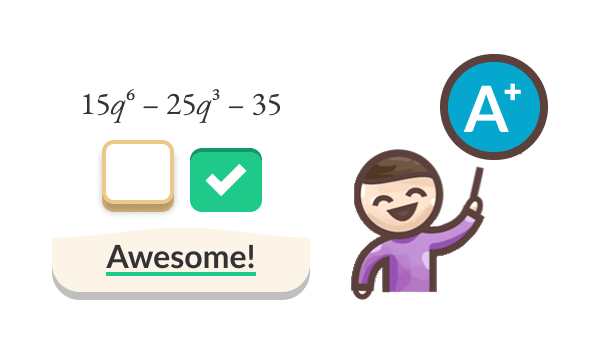
Step-by-Step Videos
Watch it solved then try it yourself.

Build Mastery
Master each topic before advancing.

Test Prep Included
Practice real EQAO-style questions here.
Try It Now
Test your knowledge
Our approach aligns with the evidence
Exam Scores
Better Recall
Less Anxiety
EQAO Grade 9 Foundations of Math Topics
1. Ratios, Rates, and Proportions
2. Scale Factors and Similarity
3. Square Roots
4. Percents
5. Rational Numbers
6. Powers and Exponents
7. Introduction to Polynomials
8. Multiplication and Division of Polynomials
9. Proportional Relationships
10. Patterns and Solving Equations
11. Linear Ralations
12. Solving Linear Equations
13. Introduction to 3-Dimensional Objects
14. Surface Area and Volume
15 Chapters · 62 Topics · 585 Videos

Ready to practice EQAO Grade 9 Foundations of Math?
Try practice questions on every EQAO Grade 9 Foundations of Math topic — with instant feedback and step-by-step video solutions when you get stuck.
Discover Our Learning Areas
Explore key subjects and start learning with interactive content.















What Is the EQAO Grade 9 Foundations of Math Assessment?
The EQAO Grade 9 Mathematics assessment is an Ontario province-wide standardized test that measures how well students have learned the Grade 9 Foundations of Mathematics curriculum. Administered online during a student's Grade 9 math class, it includes both multiple-choice and open-response questions organized across four core strands: Number, Algebra, Geometry and Measurement, and Data. Results are reported at four achievement levels, with Level 3 representing the provincial standard. Because EQAO results feed into a student's classroom mark, preparing thoroughly pays off in two ways — on the assessment itself and in the final course grade.
If you are looking for an EQAO practice test for Grade 9, StudyPug's full-length practice tests are built around real assessment content and cover all four strands. Pair them with the Grade 9 math topic library to fill any curriculum gaps before your test window opens.
EQAO Grade 9 Math: Format, Scoring, and Key Facts
Understanding the structure of the EQAO assessment before you sit down to prep saves time and reduces anxiety. Here are the questions students ask most often.
How is the EQAO Grade 9 assessment structured?
The assessment is delivered entirely online within the school setting. It contains multiple-choice questions that test procedural knowledge and open-response questions that require students to show their reasoning and communicate their mathematical thinking. There is no separate registration — your school and teacher handle all scheduling within the provincial administration window.
How is the EQAO scored, and what is the provincial standard?
Scores are reported across four achievement levels. Level 1 is below the provincial standard, Level 2 approaches it, Level 3 meets it (roughly equivalent to a B or 70%), and Level 4 exceeds it. Level 3 is the target most educators and post-secondary pathways reference. Because EQAO is a component of a student's final Grade 9 math mark, the assessment carries real academic weight.
What strands and topics appear on the EQAO Grade 9 Foundations assessment?
The four tested strands are: Number (fractions, ratios, rates, proportional reasoning), Algebra (linear relationships, expressions, equations), Geometry and Measurement (perimeter, area, surface area, volume, properties of shapes), and Data (data collection, graphing, interpretation, and introductory probability). Questions target both computational fluency and higher-order reasoning, so understanding the why behind each procedure matters as much as getting the right answer.
What is the hardest section of the EQAO Grade 9 math assessment?
Algebra — specifically linear relationships — is consistently the area where students lose the most marks. Open-response algebra questions require students to explain their thinking in writing, not just produce a numerical answer. Students who can move fluidly between words, tables, graphs, and equations tend to perform significantly better on these items. Targeted practice in this strand, combined with reviewing how to communicate mathematical reasoning clearly, is the highest-value prep activity for most Grade 9 students.
Why StudyPug for EQAO Grade 9 Math Prep
StudyPug is built for exactly the kind of focused, curriculum-aligned preparation the EQAO requires. Here is what makes it different from simply re-reading your textbook or searching for random worksheets online.
A diagnostic that shows you where to start. Before you watch a single video or attempt a practice test, the StudyPug diagnostic assessment maps your knowledge against the four EQAO strands. You find out immediately which areas need the most work — so you spend prep time where it produces the biggest gains, not on topics you already understand.
Certified-teacher videos that teach the method, not just the answer. Every concept video on StudyPug is made by a certified teacher, not generated by AI. The goal is to teach you how to solve a type of problem so that you can handle questions you have never seen before. On open-response EQAO questions — where showing your reasoning is part of the mark — understanding the method is everything.
Adaptive practice that adjusts to you. As you work through topic quizzes, the difficulty level adjusts based on your performance. If you are breezing through Number questions, the system pushes you harder. If you are struggling with Algebra, it brings in more foundational support. This keeps your study sessions productive at every stage of preparation.
Unlimited practice tests and retakes. Stamina and familiarity with the format are two factors that significantly affect EQAO performance. StudyPug lets you take full-length practice tests built based on real EQAO content and retake topic quizzes as many times as needed. There is no cap — keep going until you feel genuinely ready.
30-day money-back guarantee. Start your EQAO prep with no financial risk. If StudyPug is not working for you within the first 30 days, you get a full refund. No questions, no pressure.
What the EQAO Grade 9 Foundations of Math Covers
Effective EQAO prep means knowing the curriculum deeply, not just skimming past paper formats. Below is a breakdown of the four strands and the concepts that appear most frequently in the assessment.
Number: Fractions, decimals, integers, ratios, rates, and proportional reasoning. Students should be comfortable moving between equivalent forms and applying proportional reasoning in real-world contexts.
Algebra: Writing and evaluating algebraic expressions, solving linear equations, identifying and representing linear relationships in tables, graphs, and equations. This is the strand that typically determines a student's overall level on the assessment.
Geometry and Measurement: Calculating perimeter, area, surface area, and volume for a range of two-dimensional and three-dimensional shapes. Students also need to work with properties of geometric figures and apply measurement concepts in context.
Data: Collecting and organizing data, creating and interpreting graphs, working with mean, median, and mode, and understanding basic probability concepts. Open-response questions in this strand often ask students to draw conclusions and justify their interpretations.
How to Prepare for the EQAO Grade 9 Math Assessment
A structured six-to-eight-week plan gives most students enough time to address weak areas and build exam confidence without burning out. Here is a framework that works.
Week 1 — Diagnose. Take a full-length EQAO practice test under timed conditions to establish your baseline. Use the diagnostic assessment to identify which strands need the most attention. Prioritize Algebra and any strand where you scored at Level 1 or Level 2.
Weeks 2–4 — Concept building. Work through certified-teacher videos for each weak strand, one topic at a time. After each video, complete the associated quiz. Retake the quiz until you are consistently getting questions right before moving to the next topic. Focus on understanding the method so you can apply it to unfamiliar question formats.
Weeks 5–6 — Mixed practice. Shift from topic-by-topic quizzes to mixed practice that mirrors the variety of the actual assessment. Pay particular attention to open-response items and practise writing out your reasoning clearly — partial marks are available for correct reasoning even when the final answer is wrong.
Weeks 7–8 — Full-length tests and review. Take at least two to three full-length practice tests in test-like conditions. Review every question you get wrong, go back to the relevant concept video, and attempt similar questions again. By the final week, aim to reduce your review time and increase your confidence — trust the preparation you have done.
Consistent daily sessions of 30 to 45 minutes outperform marathon cramming sessions in the days before the assessment. Build the habit early, stay focused on your weakest strands, and use every practice test as a learning opportunity rather than just a score check.
EQAO Grade 9 Foundations of Math FAQ
Unsure how StudyPug works? Need help with setting up? Check our frequently asked questions or contact us for help.
What does the EQAO Grade 9 Foundations of Math assessment cover, and how is it structured?
The EQAO Grade 9 Mathematics assessment is an Ontario province-wide test covering the Grade 9 Foundations of Mathematics curriculum. It is administered online and includes multiple-choice and open-response questions. The assessment is organized around four broad math strands: Number, Algebra, Geometry and Measurement, and Data. Students complete the assessment during their Grade 9 math class and results are reported at the individual, school, board, and provincial levels. The assessment is designed to reflect the Ontario Mathematics curriculum introduced in 2021.
How is the EQAO Grade 9 math assessment scored, and what counts as a good result?
EQAO results are reported using four achievement levels: Level 1 (below provincial standard), Level 2 (approaching provincial standard), Level 3 (at provincial standard), and Level 4 (above provincial standard). Level 3 is the Ontario provincial standard, equivalent to roughly 70% or a B, and is the benchmark educators and universities use. Achieving Level 3 or 4 means a student is meeting or exceeding grade-level expectations. Because the EQAO contributes to a student's classroom mark in Ontario, aiming for at least Level 3 is a practical goal for most students.
What content areas and math topics are tested on the EQAO Grade 9 Foundations of Math?
The EQAO Grade 9 assessment tests four curriculum strands. Number covers fractions, ratios, rates, and proportional reasoning. Algebra covers linear relationships, expressions, and equations. Geometry and Measurement covers perimeter, area, surface area, volume, and properties of shapes. Data covers collection, representation, and interpretation of data including graphing and probability concepts. Questions test both procedural fluency and mathematical reasoning, so students need to understand the method behind each concept, not just memorize formulas.
How should I prepare for the EQAO Grade 9 math assessment, and how long does it take?
Most students benefit from six to eight weeks of structured preparation. Start with a diagnostic practice test to identify which strands need the most attention — this prevents wasting time reviewing material you already know. Then work through concept videos for your weakest areas, focusing on understanding the method rather than just the answer. Follow up with topic-specific quizzes after each concept, and complete at least two to three full-length practice tests before the assessment date. Consistent daily sessions of 30 to 45 minutes are more effective than last-minute cramming.
When is the EQAO Grade 9 assessment administered, and how do students register?
The EQAO Grade 9 Mathematics assessment is administered during the school year as part of a student's Grade 9 math class — students do not register individually. Schools schedule the assessment window in coordination with EQAO, and students write it during their regular class period. Because there is no separate registration process, students should confirm the timing with their teacher early in the semester so they can plan their preparation accordingly. Results are typically released several months after the administration window.
What is the hardest part of the EQAO Grade 9 Foundations of Math, and how should I tackle it?
Most students find the Algebra strand, particularly linear relationships and writing or interpreting equations in different forms, to be the most challenging area on the EQAO Grade 9 assessment. Open-response questions in this strand require students to explain their reasoning clearly, not just produce an answer. To tackle this, practice translating between words, tables, graphs, and equations until the connections feel automatic. Work through step-by-step video solutions for algebra problems and then attempt similar questions independently. Repeated practice with immediate feedback is the most effective way to build confidence in this strand.





Written by the StudyPug Team
Last updated June 5, 2026
3 M+
students
★★★★★
4.8 average
K–12
all grades