Year 6 Maths Help — Step-by-Step Video Lessons & Practice
Help your child understand every topic and build confidence, one lesson at a time
Step-by-Step Videos
Watch it solved then try it yourself.
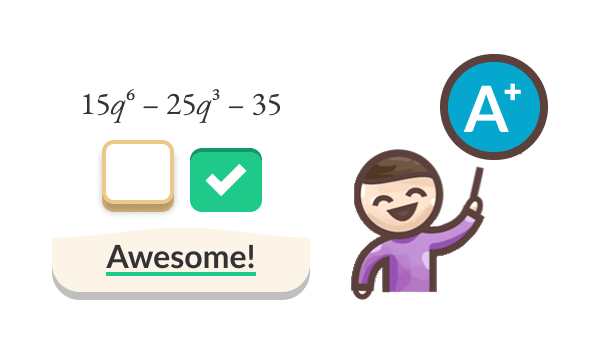
Unlimited Practice
Practice until it truly clicks.
Test Prep Included
Practice real exam questions to walk in ready.
Try It Now
Test your knowledge
Our approach aligns with the evidence
Exam Scores
Better Recall
Less Anxiety
Year 6 Maths Topics
1. Numbers and Relations
2. Number Theory
3. Introduction to Ratios, Rates, and Percentages
4. Operations with Decimals
5. Adding and Subtracting Fractions
6. Multiplying and Dividing Fractions
7. Powers and Exponents
8. Measuring Systems
9. Coordinates, Quadrants, and Transformations
10. Patterns and Solving Equations
11. Linear Equations
12. Symmetry and Surface Area
13. Properties of Triangles
14. Surface Area of 3-dimentional Objects
15. Data and Graphs
Discover Our Learning Areas
Explore key subjects and start learning with interactive content.


What Is Year 6 Maths?
Year 6 maths is the final year of Australian primary school mathematics, taught under the Australian Curriculum. It builds on five years of number, measurement, geometry and statistics work, and introduces the algebraic thinking your child will need in high school. By the end of Year 6, students are expected to work confidently with fractions, decimals and percentages; reason about shapes and measurement; and begin solving problems using variables and equations. It is a pivotal year — the concepts covered here form the direct foundation for Year 7 and beyond.
What Topics Are Covered in Year 6 Maths?
The Australian Curriculum organises Year 6 maths into three main strands: Number and Algebra, Measurement and Geometry, and Statistics and Probability.
Under Number and Algebra, children work with fractions and mixed numbers, add and subtract fractions with unlike denominators, multiply and divide decimals, find percentages of quantities, and begin exploring simple algebraic expressions and equations. This is often the strand parents notice children finding most difficult.
Under Measurement and Geometry, students calculate area and perimeter of composite shapes, find the volume of rectangular prisms, work with angles on a straight line and at a point, and explore transformations of 2D shapes including reflection, rotation and translation.
Under Statistics and Probability, children conduct chance experiments, calculate probabilities, interpret data in a range of graphs including column charts, dot plots and pie charts, and calculate the mean of a dataset.
Together these topics give Year 6 students a complete, rounded picture of primary mathematics and prepare them well for the jump to secondary school.
Is Year 6 Maths Hard? Common Struggle Points for Australian Students
Year 6 maths is considered a significant step up from Year 5, and many children — and parents — find it challenging. The most common struggle points reported by Australian primary teachers are:
Fractions with unlike denominators. Children frequently try to add or subtract the numerators and denominators separately, arriving at incorrect answers. The concept of finding the lowest common denominator is abstract until it has been demonstrated clearly and practised repeatedly.
Converting between fractions, decimals and percentages. Students must hold three representations of the same value in mind simultaneously, which is cognitively demanding for primary-age children.
Early algebra. Moving from arithmetic (where every answer is a number) to algebra (where a letter stands for an unknown) is a conceptual leap. Children who haven't been shown the underlying logic often resort to guessing.
Multi-step word problems. Australian curriculum assessments, including NAPLAN, feature multi-step problems that require children to choose the right operation, apply it correctly, and interpret their answer — all in sequence. If any one of those steps is shaky, the whole problem falls apart.
The good news is that none of these difficulty points are permanent. With clear teaching that explains the method — not just the answer — and consistent daily practice, most Year 6 students can move from confusion to confidence relatively quickly.
Why StudyPug for Year 6 Maths?
StudyPug is designed to help your child genuinely understand Year 6 maths, not just memorise steps.
It starts with a diagnostic. Rather than making your child work through topics they already know, StudyPug's diagnostic assessment quickly identifies the specific gaps in their understanding. You find out exactly where to focus — saving time and targeting effort where it matters most.
Certified teachers explain the method. Every lesson is a short, clear video made by a real certified teacher. The videos teach the concept from first principles, showing your child not just what the answer is, but why — so they can apply the same method to any similar problem, including ones they haven't seen before. These are not AI-generated explanations; they are genuine teaching.
Adaptive practice builds confidence step by step. After watching a lesson, your child practises with questions that adjust to their level. If they're finding it easy, the questions become more challenging. If they're struggling, the system steps back to consolidate. This means your child is always working at exactly the right level — never bored, never overwhelmed.
The parent dashboard keeps you informed. You can see at a glance which topics your child has covered, how they're progressing, and where they still need support. No more wondering whether the practice is actually working.
It aligns with the Australian Curriculum. Every Year 6 maths topic on StudyPug maps to the Australian Curriculum strands, so your child is always reinforcing what their teacher is covering at school.
The Family Plan covers all your children. If you have more than one child, the StudyPug Family Plan covers up to 5 children at all grade levels and subjects — for one price. Every child gets their own profile and separate progress tracking.
There is no lock-in contract, and every new subscription comes with a 30-day money-back guarantee. Free practice content is also available without a subscription, so your child can start building skills straight away.
What Your Child Will Learn: Year 6 Maths Curriculum Coverage
StudyPug covers all of the major Year 6 maths topics taught under the Australian Curriculum. Here is a summary of what your child will work through:
- Fractions and mixed numbers — comparing, ordering, adding, subtracting, and converting
- Decimals and percentages — operations with decimals, percentage calculations, real-world applications
- Multiplication and division — multi-digit operations, factors, multiples and prime numbers
- Introduction to algebra — variables, simple expressions, equations and substitution
- Measurement — area, perimeter of composite shapes, volume of rectangular prisms, converting units
- Geometry — angles, 2D and 3D shapes, transformations
- Statistics and probability — data displays, mean, chance experiments and probability
Each topic is broken into short lessons so your child can focus on exactly what they need, without sitting through content they've already understood. Topics are sequenced to build on each other logically, matching the order most Australian primary schools follow.
How to Use StudyPug for Year 6 Maths
Getting started is straightforward. When your child first logs in, the diagnostic assessment takes just a few minutes and produces a personalised starting point. From there, your child can follow the suggested learning path or jump to any specific topic they need help with right now — for example, if there's a test on fractions coming up at school.
The recommended routine for Year 6 students is 15–20 minutes of focused practice on most school days. A typical session might look like this: watch one short video lesson, attempt the follow-up practice questions, and review any answers they got wrong using the worked solution. This watch–practise–review cycle is the fastest route from confusion to confidence.
Parents find it helpful to check the dashboard once or twice a week to see which topics their child has been working on and how they're progressing. If a particular topic keeps showing low scores, that's a signal to watch the corresponding video together and talk through the concept.
StudyPug works on any device — desktop, tablet or mobile — so your child can practise at home, in the car, or anywhere else. There is no set schedule, and sessions can be as short or as long as fits your family's routine. The goal is consistency: a little maths practice every day adds up to significant improvement over a term.
Year 6 Maths FAQ
Unsure how StudyPug works? Need help with setting up? Check our frequently asked questions or contact us for help.
What does my child learn in Year 6 maths, and what topics does it cover?
Year 6 maths in Australia covers a broad range under the Australian Curriculum. Key topics include fractions, decimals and percentages; multiplication and division with larger numbers; introduction to algebra and variables; geometry including angles and 2D/3D shapes; statistics and probability; and measurement (area, perimeter, volume). Students also develop strong problem-solving and reasoning skills. By the end of Year 6, children are expected to work fluently with rational numbers and apply mathematical thinking across contexts, laying the foundation for secondary school maths.
Is Year 6 maths hard, and where do children commonly struggle?
Year 6 maths is a big step up for many children. The most common struggle points are fractions and mixed numbers, especially adding and subtracting unlike denominators; converting between fractions, decimals and percentages; early algebra (understanding variables and equations); and interpreting data in graphs and tables. Geometry also trips up children who haven't consolidated angle properties. The leap from concrete to abstract thinking is the underlying challenge — many children understand maths when it's visual but lose confidence with written problems. Targeted practice and clear concept explanations help bridge this gap effectively.
What should my child know before Year 6 maths, and what comes next?
Before Year 6, children should be confident with the four operations (addition, subtraction, multiplication, division) up to large numbers, basic fractions and decimals, and fundamental measurement and geometry from Year 5. Coming out of Year 6, they move into Year 7 maths, which introduces integers and negative numbers, ratio and proportion, more formal algebraic expressions, and the coordinate plane. A solid Year 6 foundation — particularly in fractions and early algebra — makes Year 7 significantly easier and sets children up for success in high school mathematics.
How does StudyPug maths map to what my child learns at school in Australia?
StudyPug's Year 6 maths content is aligned to the Australian Curriculum. Every topic — from number and algebra to measurement and statistics — maps to the strands and sub-strands taught in Australian primary schools. Whether your child attends school in NSW, VIC, QLD, WA or any other state, the core Year 6 content follows the national syllabus. This means your child isn't practising something different from their class; they're reinforcing exactly what their teacher is covering, in the same sequence and with the same vocabulary.
What is one of the trickiest maths concepts in Year 6, and how is it taught?
Fractions — specifically adding and subtracting fractions with unlike denominators — is consistently one of the hardest Year 6 maths concepts. Children often try to add the denominators directly, which gives a wrong answer. The correct method requires finding the lowest common denominator, converting each fraction, then operating on the numerators. On StudyPug, a certified teacher walks through this concept step by step in a short video, showing exactly where children go wrong and why. After watching, children practise with adaptive questions that build from simple to complex, reinforcing the method until it sticks.
How much maths practice should my child do at Year 6?
For Year 6, education researchers and teachers generally recommend 15–20 minutes of focused maths practice on most school days. Little and often is more effective than a long weekly session. Consistency matters most — regular short practice builds fluency and keeps concepts fresh. If your child is preparing for NAPLAN or a school assessment, it's worth increasing to 25–30 minutes in the weeks leading up to the test. StudyPug's adaptive practice adjusts to your child's level, so even a short daily session targets the exact areas where they need the most improvement.