TOPIC
Environmental Science, Sustainability, Conservation strategiesMY PROGRESS
Pug Score
0%
Getting Started
"Let's build your foundation!"
Best Streak
0 in a row
Study Points
+0
Overview
Practice
Read
Quiz
Next Steps
Get Started
Get unlimited access to all videos, practice problems, and study tools.
BACK TO MENU
Topic Progress
Pug Score
0%
Getting Started
"Let's build your foundation!"
Best Practice
No score
Read
Not viewed
Best Quiz
No attempts
Best Streak
0 in a row
Study Points
+0
Overview
Practice
Read
Quiz
Next Steps
Read
Environmental Science: Sustainability & Conservation Strategies
This topic examines how human activities affect ecosystems and explores sustainability principles and conservation strategies used to protect biodiversity and natural resources for future generations.
Environmental Science, Sustainability, and Conservation Strategies
Environmental science examines the relationships between humans and the natural world. As human populations grow and industrial activity expands, understanding sustainability meeting today's needs without preventing future generations from meeting their own becomes essential for protecting Earth's ecosystems. This topic connects directly to Global Change and Environmental Effects, which explores the broader consequences of human activity on planetary systems.
Human activities such as burning fossil fuels, deforestation, and agricultural runoff have accelerated environmental change at an unprecedented rate. Learners who have studied Human Impact and Anthropogenic Effects and Environmental Change and Ecosystem Alterations will recognize these patterns as foundational to understanding conservation needs.
Human Impact on Ecosystems
The primary driver of current biodiversity loss worldwide is habitat destruction caused by farming, logging, and urban development. When forests are cleared, species lose their homes and carbon stored in trees is released as carbon dioxide, intensifying the greenhouse effect.
Deforestation most directly affects the carbon cycle by releasing stored carbon into the atmosphere as greenhouse gas. Students who have explored Matter Cycles and Biogeochemical Cycles and Carbon Cycle and Carbon Movement will understand how this disrupts global climate regulation.
Overfishing removes fish populations faster than they can reproduce, collapsing food webs and threatening ocean sustainability. Similarly, releasing untreated wastewater into rivers causes water pollution that kills aquatic organisms and contaminates drinking water. These concepts build toward Human Impact and Environmental Change.
Eutrophication occurs when excess nitrogen and phosphorus from agricultural fertilizers run off into water bodies, triggering explosive algae growth. When algae die and decompose, bacteria consume oxygen, creating dead zones where fish cannot survive a classic sign of nutrient pollution. This process is further examined in Cycle Disruption and Environmental Effects.
The greenhouse effect occurs when atmospheric gases trap heat from the sun, warming Earth's surface. Human activities especially burning fossil fuels enhance this natural process, driving global warming and ocean acidification, as dissolved CO forms carbonic acid that harms coral reefs and shellfish.
Conservation Strategies
Conservation involves managing natural resources for sustainable use, while preservation protects areas from all human use. Both approaches are vital tools in environmental management.
Protected areas such as national parks and wildlife reserves restrict harmful human activities like logging and mining to preserve ecosystems. Wildlife corridors connect isolated habitat patches, allowing animals to travel, find mates, and maintain genetic diversity reducing the effects of habitat fragmentation. These strategies are explored further in Solutions and Sustainable Practices.
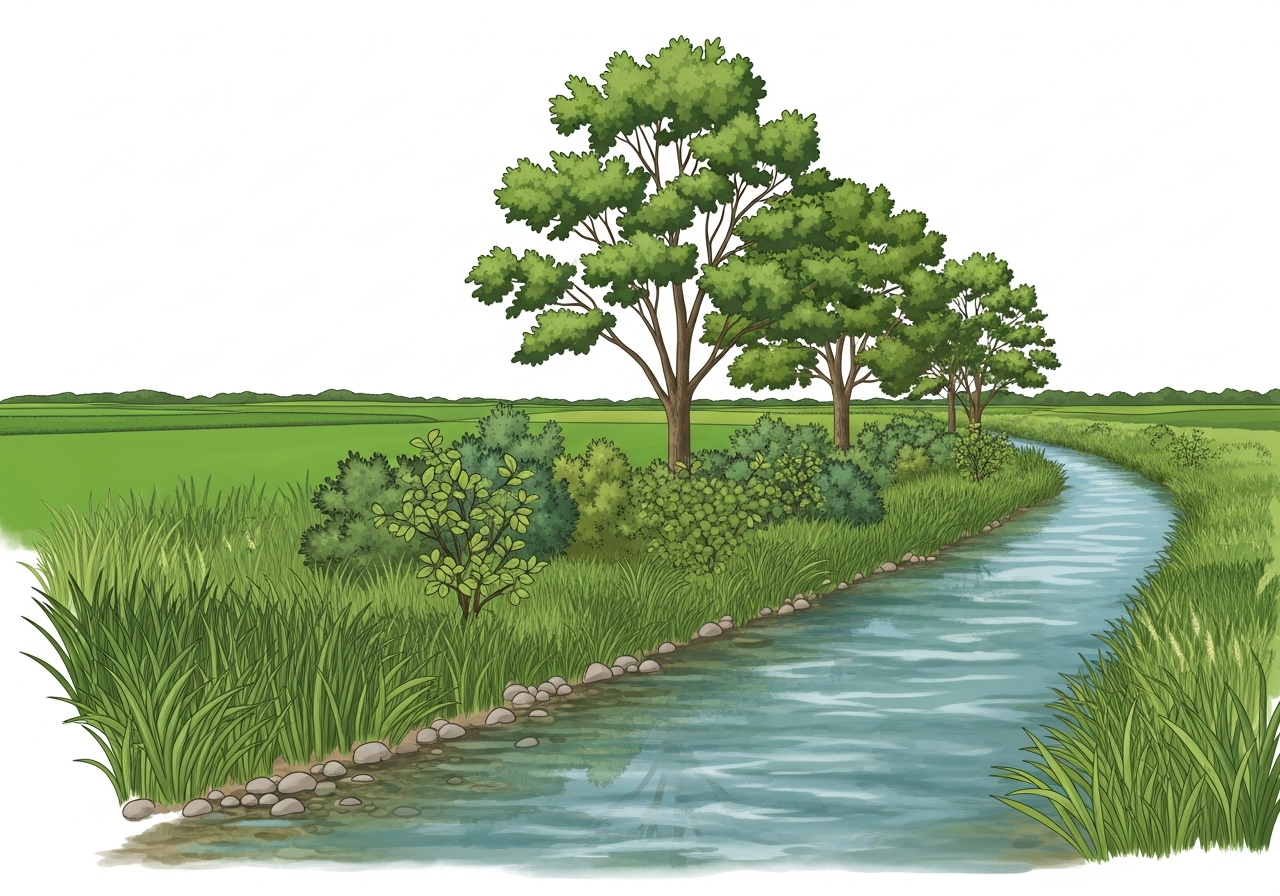
Riparian buffer strips are bands of native vegetation planted along riverbanks that intercept agricultural runoff, trapping sediment and absorbing excess nutrients before they reach waterways. This is one of the most effective watershed management strategies for protecting freshwater quality.
Sustainable forestry involves replanting trees after logging to ensure forests can regrow. Sustainable agriculture uses practices like crop rotation and composting to maintain soil health and productivity for future growing seasons. Learners can connect these ideas to Traditional Practices and Sustainable Methods.
The reduce, reuse, recycle framework is a waste management hierarchy designed to lower resource consumption and environmental pollution. Reducing use is most effective, followed by reusing items, then recycling materials into new products.
Sustainability Concepts and Measurement
An ecological footprint measures how much land, water, and resources are needed to support a person's lifestyle and absorb their waste. A large footprint indicates more resources are consumed than Earth can sustainably regenerate.
A carbon footprint measures the total greenhouse gases produced by a person, product, or activity. Burning fossil fuels for energy and transportation is the most significant contributor to increasing atmospheric CO. Transitioning to renewable energy sources such as solar panels reduces fossil fuel dependence and lowers emissions, as explored in Energy Resources, Renewable and Non-Renewable.
Carrying capacity defines the maximum population size an environment can sustainably support. Understanding population limits connects to Population Studies, Growth and Regulation and helps explain why resource overuse leads to ecosystem collapse.
Individual actions also matter: choosing to walk or bike instead of driving, reducing meat consumption (since livestock farming produces more greenhouse gases than crops), and supporting local conservation groups all contribute meaningfully to environmental sustainability.
Key Terms & Definitions
Sustainability: Meeting current needs without preventing future generations from meeting their own needs; balancing resource use wisely over time.
Biodiversity Hotspot: A region with an exceptionally high concentration of species, many of which are found nowhere else on Earth, making it a priority for conservation efforts.
Ecological Footprint: A measure of the resources a person or population uses compared to Earth's capacity to regenerate those resources and absorb waste.
Carrying Capacity: The maximum number of individuals of a species that an environment can sustainably support given available food, water, and shelter.
Keystone Species: A species that has a disproportionately large effect on maintaining the balance of its ecosystem relative to its population size; its removal causes dramatic changes to the entire community.
Bioremediation: The use of living organisms, especially microbes, to break down or neutralize pollutants in contaminated environments a biological approach to pollution clean-up.
Eutrophication: The process by which excess nutrients (nitrogen and phosphorus) from fertilizer runoff enter water bodies, causing explosive algae growth that depletes oxygen and creates dead zones.
Dead Zones: Areas in water bodies where oxygen levels are so low that most aquatic life cannot survive, typically caused by eutrophication and algae decomposition.
Bioaccumulation: The process by which toxins and pollutants build up in an organism's tissues over time, becoming more concentrated as they move up the food chain (also called biomagnification).
Riparian Buffers: Strips of native vegetation planted along riverbanks that intercept agricultural runoff, filter sediment and nutrients, and stabilize stream banks before water reaches the river.
Marine Protected Areas: Designated ocean regions where human activities such as fishing, drilling, and development are restricted to safeguard marine biodiversity and ecosystems.
Carbon Footprint: The total amount of greenhouse gases, expressed in CO equivalents, produced by a person, product, organization, or activity.
Invasive Species: A non-native organism introduced to a new ecosystem where it lacks natural predators and outcompetes, preys on, or brings disease to native species, disrupting ecological balance.
Wildlife Corridor: A strip of natural habitat connecting isolated patches of land, allowing animals to travel between areas to find food, mates, and shelter, reducing the effects of habitat fragmentation.
Greenhouse Effect: The process by which atmospheric gases (CO, methane, water vapor) trap heat from the sun and re-emit it toward Earth's surface, warming the planet.
Conservation vs. Preservation: Conservation manages natural resources for sustainable human use; preservation protects areas in their natural state with minimal or no human interference.
Sustainable Agriculture: Farming practices that produce food while protecting soil, water, and ecosystems for future use, such as crop rotation, composting, and minimizing chemical inputs.
Biodiversity: The variety of different species, genetic diversity within species, and diversity of ecosystems found within a given area; high biodiversity indicates a healthy, resilient ecosystem.
Applying Conservation Strategies
Learners can apply these concepts by analyzing real-world scenarios: evaluating which watershed management strategy best reduces agricultural runoff, or determining why a frog's disappearance from a rainforest signals ecosystem stress (amphibians are sensitive bioindicators due to their permeable skin). These analytical skills connect to Green Technology and Environmental Solutions.
Students can also calculate ecological footprints, compare renewable versus nonrenewable energy sources, and evaluate the trade-offs between economic development and ecological protection recognizing that effective environmental policy must balance both human needs and natural systems.
Building on Prior Knowledge
This topic builds on several foundational concepts. Understanding Ecosystems, Sustainability, and Conservation Strategies provides the ecological framework, while Food Webs and Energy Transfer explains how species interdependence makes ecosystems vulnerable to disruption. Knowledge of Climate Factors, Global Patterns, and Atmosphere and Future Scenarios and Climate Predictions helps contextualize why conservation is urgent.
Familiarity with Climate Records and Historical Knowledge and System Dynamics and Complex Interactions further supports understanding of how human actions accumulate into large-scale environmental change. This topic then prepares learners for advanced study of Nitrogen Cycle and Nutrient Cycling, Water Cycle and Global Water Distribution, and Cycle Disruption and Environmental Effects.
Related Topics & Connections
This topic sits at the center of a rich network of interconnected science concepts. The following related topics extend and deepen understanding of environmental science and conservation:
- Global Change and Environmental Effects examines the large-scale consequences of human activity on Earth's climate and ecosystems, directly extending the conservation strategies discussed here.
- Introduction, System Dynamics, and Complex Interactions provides the systems-thinking framework needed to understand how conservation interventions affect entire ecosystems.
- Population Studies, Growth and Regulation connects carrying capacity and overpopulation concepts to resource sustainability and conservation planning.
- Energy Resources, Renewable and Non-Renewable explores how transitioning to renewable energy reduces the human impact that makes conservation necessary.
- Solutions and Sustainable Practices the natural next step, applying conservation strategies to real-world environmental challenges.
- Green Technology and Environmental Solutions examines technological innovations that support sustainability goals introduced in this topic.
- Carbon Cycle and Carbon Movement and Nitrogen Cycle and Nutrient Cycling show how human disruption of biogeochemical cycles creates the environmental problems conservation strategies aim to solve.
- Water Cycle and Global Water Distribution connects watershed management and riparian buffer strategies to the broader movement of water through Earth's systems.