TOPIC
MY PROGRESS
Pug Score
0%
Getting Started
"Let's build your foundation!"
Best Streak
0 in a row
Study Points
+0
Overview
Practice
Read
Quiz
Next Steps
Get Started
Get unlimited access to all videos, practice problems, and study tools.
BACK TO MENU
Topic Progress
Pug Score
0%
Getting Started
"Let's build your foundation!"
Best Practice
No score
Read
Not viewed
Best Quiz
No attempts
Best Streak
0 in a row
Study Points
+0
Overview
Practice
Read
Quiz
Next Steps
Read
How Human Activities Alter Ecosystems and Drive Environmental Change
This topic examines how human activities such as deforestation, pollution, and invasive species introduction alter ecosystems and reduce biodiversity, preparing students to understand environmental change and conservation strategies.
Human activities have dramatically reshaped ecosystems around the world. From clearing forests for agriculture to releasing pollutants into waterways, the consequences of these actions ripple through entire food webs and threaten Biodiversity and Species Relationships.
Understanding how ecosystems respond to disturbance is essential for predicting future environmental conditions and developing effective conservation strategies. This topic builds directly on foundational knowledge of System Interactions and Energy and Matter Flow within ecosystems.
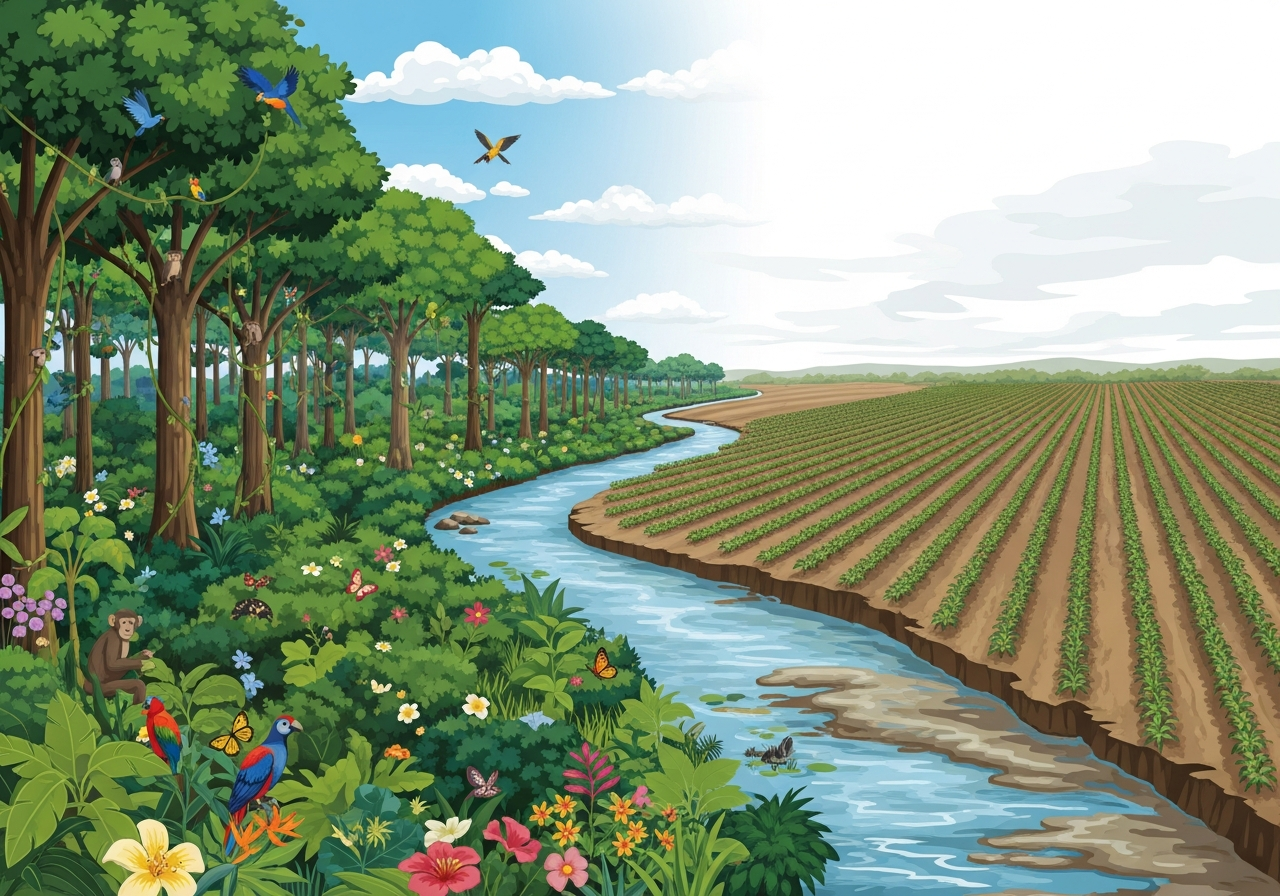
Major Human-Caused Ecosystem Disturbances
Deforestation
Deforestation is the large-scale removal of forests, primarily driven by clearing land for agriculture and cattle ranching. When forests are removed, organisms lose habitat, soil becomes vulnerable to erosion, and carbon stored in trees is released into the atmosphere as carbon dioxide.
A species found only in one small rainforest faces extinction if that forest is completely cut down, because it has no alternative habitat. Trees also play a critical role in reducing atmospheric carbon dioxide through photosynthesis.
Eutrophication and Water Pollution
Eutrophication occurs when excess nutrients often from agricultural fertilizer runoff enter lakes and rivers, causing rapid algae growth called algal blooms. When the algae die and decompose, bacteria consume dissolved oxygen, creating dead zones where fish and other aquatic organisms cannot survive.
Chemical waste dumped into rivers introduces toxic substances that poison aquatic life. Pesticides applied to crops near streams can wash into the water through runoff, harming fish and insects through a process called bioaccumulation, where chemicals build up in organisms and become more concentrated at higher levels of the food chain a process known as biomagnification.
Invasive Species and Habitat Fragmentation
Invasive Species
An invasive species is a non-native organism introduced to an ecosystem where it causes harm by outcompeting native species for resources such as food, water, and space. Because invasive species often lack natural predators in their new environment, their populations grow rapidly, causing native species to decline.
Invasive plants, for example, grow faster and use more sunlight and nutrients than native plants, reducing native plant populations significantly. This disrupts native Food Webs and Energy Transfer throughout the ecosystem.
Habitat Fragmentation
Habitat fragmentation occurs when large, continuous habitats are broken into smaller, isolated patches by roads, buildings, or agricultural land. Isolated wildlife populations experience reduced gene flow, making them more vulnerable to disease and extinction.
Wildlife corridors strips of natural habitat connecting fragmented areas allow animals to travel safely between patches to find food, water, and mates, helping to maintain genetic diversity and population health.
Keystone Species and Trophic Cascades
A keystone species is one whose presence is critical to maintaining the structure and diversity of an ecosystem, out of proportion to its own abundance. The classic example is the sea star (Pisaster ochraceus) in rocky intertidal zones: when ecologist Robert Paine removed sea stars in the 1960s, mussels took over the entire zone and species diversity dropped from 15 species to just 1.
This demonstrates a trophic cascade a chain reaction through multiple levels of a food web triggered by the removal or addition of a top predator. Understanding trophic cascades connects directly to the study of Matter Cycles and Biogeochemical Cycles and how energy flows through ecosystems.
Greenhouse Effect, Climate Change, and Coral Bleaching
The greenhouse effect occurs when gases such as carbon dioxide and methane trap heat from the sun in Earth's atmosphere, warming the planet. Burning fossil fuels for energy and transportation is the human activity most responsible for increasing carbon dioxide levels and driving global temperature rise.
Rising global temperatures cause polar ice caps to melt and drive coral bleaching a process where warming ocean water causes corals to expel the symbiotic algae they need to survive, weakening and potentially killing the reef. This connects to the broader study of Climate Factors, Global Patterns, and the Atmosphere and Future Scenarios and Climate Predictions.
Acid rain forms when pollutants from burning fossil fuels sulfur dioxide and nitrogen oxides mix with water vapor in the atmosphere, creating acidic compounds that damage forests and aquatic ecosystems.
Biodiversity, Ecosystem Services, and Sustainability
Biodiversity refers to the variety of different living organisms found within an ecosystem. High biodiversity generally produces more stable and resilient ecosystems. When habitats are destroyed, the number of different species in an area decreases, reducing ecosystem stability.
Ecosystem services are the benefits that healthy ecosystems provide to humans and other organisms. Wetlands, for example, provide natural water filtration and flood control. When a wetland is replaced by a shopping mall, these critical services are permanently lost.
Sustainability means meeting current needs without harming future generations' ability to meet their own needs. Practices such as reducing, reusing, and recycling decrease pollution and conserve natural resources, supporting long-term ecosystem health. Renewable energy sources like solar and wind power reduce carbon dioxide emissions compared to fossil fuels. These concepts connect to Ecosystems, Sustainability, and Conservation Strategies and Traditional Practices and Sustainable Methods.
Key Terms & Definitions
Deforestation: The large-scale removal of forests, primarily for agriculture and cattle ranching, which destroys habitat, accelerates soil erosion, and releases stored carbon dioxide into the atmosphere.
Eutrophication: A process in which excess nutrients typically from agricultural fertilizer runoff enter a body of water, causing rapid algae growth that depletes dissolved oxygen and creates dead zones.
Invasive Species: A non-native organism introduced to a new ecosystem where it causes harm by outcompeting native species for resources, often because it lacks natural predators in its new environment.
Habitat Fragmentation: The breaking up of large, continuous habitats into smaller, isolated patches by human development such as roads and buildings, which isolates wildlife populations and reduces gene flow.
Biodiversity: The variety of different living organisms including plants, animals, fungi, and microorganisms found within a particular ecosystem or region. High biodiversity indicates a healthy, resilient ecosystem.
Keystone Species: A species whose presence is critical to maintaining ecosystem structure and diversity, out of proportion to its own abundance. The removal of a keystone species causes dramatic changes throughout the ecosystem.
Trophic Cascade: A chain reaction through multiple levels of a food web that occurs when a top predator is removed or added, causing population changes to ripple downward through prey and plant species.
Dead Zone: An area in a body of water where dissolved oxygen levels are so low that most aquatic life cannot survive, typically caused by eutrophication and algal bloom decomposition.
Erosion: The wearing away and removal of topsoil by wind or water, which accelerates when tree roots which normally anchor soil are removed through deforestation.
Monoculture: An agricultural practice in which a single crop species is grown over a large area. Monocultures are common in industrial farming but create fragile, low-diversity systems that are vulnerable to disease and pests.
Greenhouse Effect: The process by which gases such as carbon dioxide and methane trap heat from the sun in Earth's atmosphere, warming the planet and supporting life but intensified by human emissions.
Acid Rain: Precipitation that is more acidic than normal, formed when sulfur dioxide and nitrogen oxides from burning fossil fuels react with water vapor in the atmosphere.
Coral Bleaching: A stress response in corals caused by rising water temperatures, in which corals expel the symbiotic algae that provide them with food and color, leaving them weakened and vulnerable to death.
Bioaccumulation: The buildup of toxic substances such as pesticides within the tissues of an individual organism over time.
Biomagnification: The process by which toxic substances become increasingly concentrated as they move up the food chain, causing the greatest harm to top predators.
Nonpoint Source Pollution: Pollution that comes from many spread-out, diffuse sources rather than one identifiable location for example, fertilizer runoff from farms entering nearby streams.
Ecosystem Services: The benefits that healthy ecosystems provide to humans and other organisms, such as water filtration by wetlands, flood control, pollination by bees, and carbon storage by forests.
Sustainability: The practice of using natural resources in a way that meets present needs without compromising the ability of future generations to meet their own needs.
Endangered Species: A species whose population has declined so significantly that it faces a serious risk of extinction in the near future.
Ozone Layer Depletion: The thinning of Earth's protective ozone layer in the upper atmosphere, primarily caused by human-made chemicals called chlorofluorocarbons (CFCs) that break down ozone molecules.
Applying Concepts: Real-World Scenarios
Students can apply these concepts by analyzing case studies such as Robert Paine's sea star removal experiment, which demonstrated the critical role of keystone species and trophic cascades in maintaining ecosystem diversity. Learners can also examine how honeybee population declines affect pollination and plant reproduction across entire ecosystems.
Connecting these ideas to Human Impact and Anthropogenic Effects helps students recognize that everyday choices from energy use to waste disposal have measurable consequences for ecosystems worldwide. Exploring Climate Records and Historical Knowledge further illustrates how ecosystems have changed over time in response to human activity.
Building on Prior Knowledge
This topic builds on several foundational concepts. Students should be familiar with Climate Change and Human Impact, which introduces how greenhouse gas emissions drive global temperature changes. Knowledge of Conservation and Environmental Protection provides context for why protecting ecosystems matters.
Understanding Environmental Science, Resource Management, and Sustainable Practices and Ecological Wisdom and Sustainable Practices helps students connect human choices to long-term ecosystem health. Familiarity with Natural Systems and Environmental Relationships and Natural Selection, Survival, and Reproduction also supports understanding of how species respond to environmental pressures, as explored in Adaptation and Environmental Pressures.
Related Topics & Connections
This topic connects to a broad network of environmental science concepts. Ecosystems, Sustainability, and Conservation Strategies extends the discussion of how ecosystems can be protected and restored after human disturbance. Food Webs and Energy Transfer explains how trophic cascades and invasive species disrupt the flow of energy through ecosystems.
Matter Cycles and Biogeochemical Cycles shows how deforestation and pollution interrupt the natural cycling of carbon, nitrogen, and water. Climate Factors, Global Patterns, and the Atmosphere provides the atmospheric science behind the greenhouse effect and acid rain.
Looking ahead, this topic prepares students for Global Change and Environmental Effects, Environmental Science, Sustainability, and Conservation Strategies, and Energy Resources, Renewable and Non-Renewable. It also lays the groundwork for Introduction to System Dynamics and Complex Interactions and Population Studies, Growth, and Regulation.