Macroeconomics Help: Video Lessons & Practice
Work through every topic with clear solutions. Start your free practice test now!
Value vs. Private Tutor
Get expert help without the price tag.

Multi-Subject
Switch subjects anytime beyond Macroeconomics.
Build Mastery
Master macro fully before test day.
Macroeconomics Topics
1. Measuring GDP
2. Jobs and Inflation
3. Understanding Economic Growth
4. Finance and Loans
5. Money and Banks
6. The Exchange Rate
7. Aggregate Supply and Demand
8. The Keynesian Model
9. Inflation and Unemployment
9 Chapters · 36 Topics · 118 Videos
Discover Our Learning Areas
Explore key subjects and start learning with interactive content.
















What is Macroeconomics?
Macroeconomics is the branch of economics that examines the behaviour and performance of an economy as a whole. Rather than studying individual buyers and sellers, it analyses the big-picture forces that shape national output, employment, price levels, and trade. If you are studying A-Level Economics or a university economics degree in the UK, macroeconomics is a core component — and understanding it well is essential for both exam success and building the analytical skills you will use throughout your career.
What topics are covered in a Macroeconomics course?
A typical A-Level or introductory university macroeconomics course covers a broad range of interconnected topics. You begin with national income accounting — understanding GDP, GNP, and how we measure an economy's output. From there you move into aggregate demand and aggregate supply, the core framework for analysing how the economy reaches equilibrium and why it can fall into recession or overheat.
Fiscal policy explores how government spending and taxation influence economic activity. Monetary policy examines how the Bank of England uses interest rates and other tools to control inflation and support growth. You also study inflation and unemployment in depth — including the Phillips curve and the trade-off between the two — as well as economic growth, the business cycle, international trade, the balance of payments, and exchange rate determination. More advanced modules introduce the IS-LM model and open-economy macroeconomics.
Is Macroeconomics harder than Microeconomics?
Students often find macroeconomics more conceptually abstract than microeconomics, because it requires you to track how changes in one part of the economy ripple through many others simultaneously. Microeconomics has cleaner, more contained models; macroeconomics models are larger and the real-world evidence is messier. That said, neither subject is inherently harder — it depends on whether you find systemic, big-picture thinking or detailed market-level analysis more intuitive. Many students find they struggle more with macroeconomics diagrams (particularly IS-LM and AD/AS under time pressure) than with the equivalent microeconomics diagrams.
How is Macroeconomics assessed at A-Level in the UK?
At A-Level in England and Wales, macroeconomics is examined by all the major awarding bodies — AQA, Edexcel, OCR, and WJEC. Assessment is through written papers at the end of Year 13, combining multiple-choice questions, data-response questions, and extended essay questions worth 15 to 25 marks. Examiners reward precise diagram work, accurate use of economic terminology, and structured evaluation of policy trade-offs. Knowing how to construct and explain a well-labelled AD/AS or Phillips curve diagram under timed conditions is one of the highest-yield skills you can develop. At university level, assessment typically combines in-course problem sets with midterm and final examinations.
What are the most challenging topics in Macroeconomics?
The IS-LM model consistently tops the list of topics students find most difficult. It simultaneously models the goods market and the money market, and students often lose track of which curve shifts in response to a given policy change — and in which direction. Another common sticking point is the balance of payments: understanding how the current account, capital account, and financial account interrelate and why they must sum to zero. The distinction between short-run and long-run aggregate supply is also frequently mishandled in essays, leading to lost evaluation marks. The good news is that all of these topics respond well to systematic practice with worked examples — seeing multiple policy scenarios applied to the same model builds pattern recognition quickly.
Why use StudyPug for Macroeconomics?
StudyPug is built for exactly the kind of exam-focused, concept-deep learning that macroeconomics demands. The platform begins with a diagnostic assessment that pinpoints which topics you need to work on — so you are not wasting study time on material you already know. Adaptive practice then raises or lowers difficulty based on your performance, keeping you in the right challenge zone throughout each session.
What sets StudyPug apart is the quality of its concept videos. Every lesson is made by a certified, experienced teacher — not generated by AI — and is designed to teach the method behind each topic, not just walk through a single answer. That means when you encounter an unfamiliar version of an IS-LM question in your exam, you have the underlying logic to work it out. You can watch each lesson as many times as you need until it genuinely clicks. One subscription also covers every course on the platform — so if you are studying Microeconomics, Statistics, and Macroeconomics in the same year, they are all included at no extra cost.
What you learn — Macroeconomics course coverage
StudyPug's macroeconomics content covers all the topics you need for A-Level and introductory university study in the UK. Core areas include:
- National income accounting and measuring GDP
- Aggregate demand and aggregate supply — shifts, equilibria, and policy implications
- Fiscal policy — government spending, taxation, and budget deficits
- Monetary policy — interest rates, quantitative easing, and the Bank of England's role
- Inflation and the Consumer Price Index
- Unemployment — types, causes, and policy responses
- The Phillips curve and the inflation-unemployment trade-off
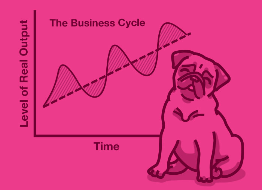
- Economic growth and the business cycle
- The balance of payments and exchange rate determination
- The IS-LM model and open-economy extensions
All content is aligned to the UK A-Level curriculum and introductory university standards. Because the internal link map currently holds no validated topic-level URLs for this course, topic-page links are omitted here — use the topic browser in your StudyPug dashboard to navigate directly to any area above.
How to use StudyPug to improve your Macroeconomics results
The most effective StudyPug workflow for macroeconomics students follows three stages. First, run the diagnostic assessment at the start of your study session. It takes only a few minutes and immediately surfaces the topics where your knowledge is weakest — those are your highest-priority areas. Second, watch the certified-teacher concept video for each weak topic. Pause, rewind, and replay as needed; there is no penalty for watching the same lesson multiple times. Third, work through the adaptive practice questions for that topic. The system will increase difficulty as your accuracy improves, so you are always being stretched without being overwhelmed.
For exam preparation specifically, use StudyPug's mock exams and practice tests in the final weeks before your A-Level papers or university finals. These are structured to mirror real exam formats — based on real exam question types — so you build both knowledge and exam technique simultaneously. Students who combine the concept-video method with regular timed practice consistently report stronger diagram accuracy and more confident essay evaluation in their actual exams. Start your free practice test today and see where your macroeconomics knowledge stands right now.
Macroeconomics FAQ
Unsure how StudyPug works? Need help with setting up? Check our frequently asked questions or contact us for help.
What do you learn in Macroeconomics, and what topics does it cover?
Macroeconomics studies the economy as a whole rather than individual markets. Core topics include national income accounting, aggregate demand and supply, fiscal policy, monetary policy, inflation, unemployment, economic growth, the balance of payments, and exchange rates. At A-Level and university level you also explore open-economy models, the Phillips curve, and policy trade-offs. By the end of the course you can analyse how government and central bank decisions shape economic outcomes at a national and international scale.
What is the difference between Macroeconomics and Microeconomics?
Microeconomics focuses on individual households, firms, and markets — examining how prices are set, how consumers make choices, and how firms compete. Macroeconomics zooms out to the whole economy, analysing output, inflation, unemployment, and trade at a national level. Both use supply-and-demand frameworks, but macroeconomics introduces tools like the IS-LM model, aggregate demand and supply curves, and central bank policy analysis that do not appear in microeconomics.
What are the prerequisites for Macroeconomics, and what course comes after it?
Most university macroeconomics modules expect A-Level Economics or an equivalent introduction covering basic supply and demand, market structures, and simple national income concepts. Some degrees require A-Level Mathematics for quantitative work. After introductory macroeconomics you typically progress to Intermediate Macroeconomics, Monetary Economics, International Trade, or Development Economics. Students pursuing postgraduate study move into Dynamic Macroeconomics and Econometrics.
Is Macroeconomics hard, and where do students struggle most?
Many students find macroeconomics conceptually demanding because it requires you to hold multiple interacting variables in mind simultaneously. The most common stumbling blocks are the IS-LM model, understanding how monetary and fiscal policy interact, interpreting balance of payments accounts, and distinguishing short-run from long-run aggregate supply. Diagram accuracy under timed conditions is another frequent weak point in A-Level and university exams. Consistent practice with worked examples helps significantly.
How is Macroeconomics assessed — exams, coursework, and A-Level format?
At A-Level in England and Wales (AQA, Edexcel, OCR, WJEC) macroeconomics is assessed through written papers combining multiple choice, data-response questions, and extended essay questions — typically at the end of Year 13. At university, assessment usually combines midterm and final written examinations with problem sets or essays. A-Level mark schemes reward precise diagram work, evaluation of policy trade-offs, and structured argument — all areas StudyPug's concept videos address directly.
What is one of the hardest topics in Macroeconomics, and how do you approach it?
The IS-LM model is widely regarded as the most challenging early topic. It links the goods market (IS curve) and the money market (LM curve) to show how interest rates and output are simultaneously determined. Students often confuse the direction of curve shifts and misapply it to policy scenarios. The best approach is to build each curve from first principles — understand why it slopes the way it does — then practise shifting each curve in response to fiscal and monetary policy changes before attempting full-model essay questions.





Written by the StudyPug Team
Last updated June 5, 2026
3 M+
students
★★★★★
4.8 average
K–12
all grades