Microeconomics Help: Video Lessons & Practice
Work through every topic with clear solutions. Start your free practice test now!
Value vs. Private Tutor
Expert teaching without the tutor price.

Multi-Subject
Study any subject and switch anytime.
Build Mastery
Know it truly before moving on.
Microeconomics Topics
1. Introduction to Economics
2. Problems of Economics
3. Demand and Supply
4. Elasticity
5. Welfare Economics
6. Consumer Choice
7. Output and Costs
8. Perfect Competition
9. Monopoly
11. Government & Inequalities
11 Chapters · 42 Topics · 453 Videos
Discover Our Learning Areas
Explore key subjects and start learning with interactive content.









What is Microeconomics?
Microeconomics is the branch of economics that studies how individuals, firms, and markets make decisions under conditions of scarcity. It provides the analytical foundations for understanding why prices rise and fall, how businesses compete, and what happens when markets fail to produce efficient outcomes. Whether you are studying at A-Level or taking a university module, microeconomics gives you a rigorous framework for analysing real-world economic behaviour — from consumer purchasing decisions to government regulation of monopolies.
At its core, microeconomics is about trade-offs and incentives. Every agent — whether a student choosing how to spend their time, a firm deciding how much to produce, or a government setting a tax — faces constraints and responds to incentives. Understanding those responses is what microeconomics is built to explain.
How does supply and demand work in Microeconomics?
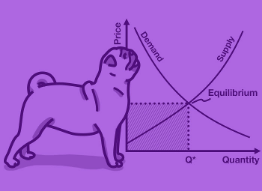
Supply and demand is the central model of microeconomics and the starting point for almost every topic that follows. The demand curve shows the quantities consumers wish to buy at different prices, all else equal; the supply curve shows the quantities producers are willing to sell. Where they intersect is the market equilibrium — the price at which the market clears.
Students need to understand not just how to draw these curves, but why they shift. Demand shifts when income, tastes, the price of related goods, or consumer expectations change. Supply shifts when input costs, technology, the number of producers, or producer expectations change. Exam questions in the UK — at both A-Level (AQA, Edexcel, OCR) and university level — frequently ask you to analyse the effect of a specific event on equilibrium price and quantity, and to evaluate the real-world implications. Practising these scenarios with worked solutions is the fastest way to build exam confidence.
What are market structures in Microeconomics, and why do they matter?
Market structures describe the competitive environment in which firms operate, and they determine how much market power a firm has over price and output. The four main structures covered in UK microeconomics courses are: perfect competition (many firms, identical products, no market power), monopolistic competition (many firms, differentiated products, some price-setting ability), oligopoly (few dominant firms, strategic interdependence), and monopoly (single seller with significant market power).
Each structure has its own model of profit maximisation — always at the output level where marginal revenue equals marginal cost — but the implications for price, output, efficiency, and consumer welfare differ substantially. A-Level students need to compare structures using diagrams; university students are often expected to derive equilibrium conditions mathematically. Understanding the intuition behind each model before working through the algebra makes the whole topic far more manageable.
What is consumer theory and why is it challenging?
Consumer theory models how rational individuals make purchasing decisions given a budget constraint and a set of preferences. The key tools are utility functions, indifference curves (showing combinations of goods a consumer is equally happy with), and budget lines (showing what a consumer can afford). The consumer maximises utility where the budget line is tangent to the highest attainable indifference curve.
This topic trips up many students because it requires switching between graphical and algebraic representations. Common struggles include constructing indifference maps correctly, distinguishing normal goods from inferior goods using income and substitution effects, and deriving demand curves from utility maximisation. The Slutsky decomposition — separating the price effect into an income effect and a substitution effect — is a frequent source of exam errors. Regular practice with diagram-based questions and step-by-step worked solutions is the most effective preparation.
How does game theory fit into Microeconomics?
Game theory enters microeconomics when analysing strategic interaction — situations where the outcome for one agent depends on what others do. It is central to the study of oligopoly, but also appears in topics such as auction design, contract theory, and public goods problems. The Nash equilibrium concept — a set of strategies where no player can benefit by changing their own strategy unilaterally — is the key solution concept you will need.
At A-Level, game theory is usually introduced through the Prisoner's Dilemma and simple two-player games. At university, it extends to repeated games, mixed strategies, and Bayesian games. The best approach is to build up from simple payoff matrices, practise identifying dominant strategies, and only then work through the conditions for Nash equilibrium. Understanding why equilibria emerge — not just how to compute them — is what examiners reward in extended answers.
Why use StudyPug for Microeconomics?
StudyPug is built around the understanding that knowing the answer is not the same as understanding the method. Every microeconomics video lesson is taught by a certified, experienced instructor who walks through the reasoning at each step — not just the final result. That means when you encounter a variation of a question in your A-Level papers or university finals, you have the conceptual foundation to adapt, not just a memorised procedure.
The platform starts with a diagnostic assessment that quickly identifies which microeconomics topics you have already grasped and which need more work. Instead of spending revision time on topics you already know, you are directed to your actual gaps — whether that is cost curves, market failure analysis, or the mathematics of consumer optimisation. From there, adaptive practice adjusts the difficulty of problems to your current level, challenging you appropriately as you improve.
All university-level economics courses — Microeconomics, Macroeconomics, Econometrics, and beyond — are included in a single StudyPug subscription. You can switch between courses, revisit earlier material, and watch any lesson as many times as you need until it genuinely clicks. For students preparing for A-Level exams or university assessments, the mock exams and practice tests are built around exam-style questions, giving you realistic preparation for the format and challenge of your actual papers.
What topics and skills will you build in Microeconomics?
A complete Microeconomics course covers a wide range of topics that build progressively on one another. You will develop skills in the following core areas:
- Supply, demand, and equilibrium analysis — shifts, elasticities, and applications
- Consumer theory — utility maximisation, indifference curves, income and substitution effects
- Producer theory — production functions, short-run and long-run costs, profit maximisation
- Market structures — perfect competition, monopoly, oligopoly, monopolistic competition
- Market failure — externalities, public goods, information asymmetry, and government intervention
- Game theory — Nash equilibrium, Prisoner's Dilemma, strategic behaviour in oligopoly
- Welfare economics — consumer and producer surplus, efficiency, and distributional considerations
By the end of the course, you will be able to apply these frameworks to analyse real-world policy questions — from environmental taxes and price controls to competition policy and public goods provision. StudyPug covers every one of these areas with step-by-step lessons and practice problems, so no topic is left unaddressed when your exams arrive.
How to use StudyPug effectively for Microeconomics
The most effective StudyPug workflow for microeconomics starts before you begin revising topic by topic. Take the diagnostic assessment first — it takes only a few minutes and gives you a clear map of your strengths and weaknesses across the full course. Use that information to build a revision priority list.
For each topic, watch the concept video once through to understand the method and the reasoning. Then immediately attempt the practice problems while the approach is fresh. Use the step-by-step solutions to check not just whether your answer was correct, but whether your method was right — economics examiners award marks for the process, not only the conclusion.
In the weeks before your A-Level exams or university finals, shift to the mock exams and timed practice tests. These simulate the pressure and format of your actual assessments, and the detailed solutions help you refine your exam technique. Watch any lesson again whenever a concept is not yet secure — there is no limit on replays, and returning to a video with fresh context from practice often makes it land differently. StudyPug is designed to work alongside your lectures and seminars, filling in the gaps and reinforcing the understanding you build in your course.
Microeconomics FAQ
Unsure how StudyPug works? Need help with setting up? Check our frequently asked questions or contact us for help.
What do you learn in Microeconomics, and what topics does it cover?
Microeconomics studies how individuals, households, and firms make decisions about allocating scarce resources. Core topics include supply and demand, elasticity, consumer theory (utility and indifference curves), producer theory (costs and production), market structures (perfect competition, monopoly, oligopoly, monopolistic competition), market failure, externalities, public goods, and basic game theory. At university level, courses extend into general equilibrium, welfare economics, and information economics, giving you the analytical tools to understand real-world markets and policy.
What is the difference between Microeconomics and Macroeconomics?
Microeconomics examines decisions made by individual agents — consumers, firms, and industries — and how prices are determined in specific markets. Macroeconomics takes the economy-wide view, analysing aggregate output (GDP), inflation, unemployment, and monetary and fiscal policy. Many economics degrees cover both: Microeconomics builds the foundational models of behaviour and markets, while Macroeconomics uses those foundations to study national and global economic dynamics. A strong grasp of microeconomic principles is essential before tackling advanced macroeconomic theory.
What are the prerequisites for Microeconomics, and what course comes after it?
At A-Level or introductory university level, no formal prerequisites beyond basic algebra are required, though familiarity with graphs and percentages is helpful. For intermediate or advanced microeconomics, calculus (differentiation and optimisation) becomes important. After introductory Microeconomics, students typically progress to Intermediate Microeconomics, then Advanced Microeconomics or specialist modules such as Industrial Organisation, Behavioural Economics, or Public Economics. A solid foundation in micro also supports courses in Econometrics, Game Theory, and Development Economics.
Is Microeconomics hard, and where do students struggle most?
Microeconomics is considered moderately to quite challenging, especially when the content moves beyond intuitive supply-and-demand diagrams into mathematical optimisation. Students most commonly struggle with indifference curve analysis and budget constraints, cost curve relationships (marginal, average, and total costs), game theory (Nash equilibrium and strategic interaction), price discrimination, and welfare analysis involving consumer and producer surplus. The key difficulty is translating economic intuition into formal models. Regular practice with worked examples and revisiting the underlying logic of each concept is the most effective approach.
How is Microeconomics assessed — and how does it relate to A-Level and university examinations in the UK?
At A-Level in England, Wales, and Northern Ireland, Microeconomics is assessed through written exam papers set by boards such as AQA, Edexcel, and OCR — typically two or three papers combining multiple choice, short answers, and extended essays, sat at the end of Year 13. At university, assessment usually combines coursework essays or problem sets with unseen written exams at the end of each semester (finals). Some modules also include in-class tests or group presentations. Revision should cover both analytical diagram questions and evaluative essay writing, reflecting the dual demand of UK economics assessment.
What is one of the hardest topics in Microeconomics, and how do you approach it?
Game theory — particularly the concept of Nash equilibrium — is widely regarded as one of the most challenging topics in microeconomics. It requires you to think simultaneously about your own strategy and the rational responses of other players. The best approach is to start with simple two-player, two-strategy games (the Prisoner's Dilemma), learn to construct payoff matrices, and identify dominant strategies before moving to mixed-strategy equilibria. Worked examples are essential: understanding the logic of each step matters far more than memorising outcomes. Practice problems with full solutions build the pattern recognition needed to handle exam questions confidently.





Written by the StudyPug Team
Last updated June 5, 2026
3 M+
students
★★★★★
4.8 average
K–12
all grades