College Statistics Help: Video Lessons & Practice
Work through every topic with clear, step-by-step solutions. Start your free practice test now!

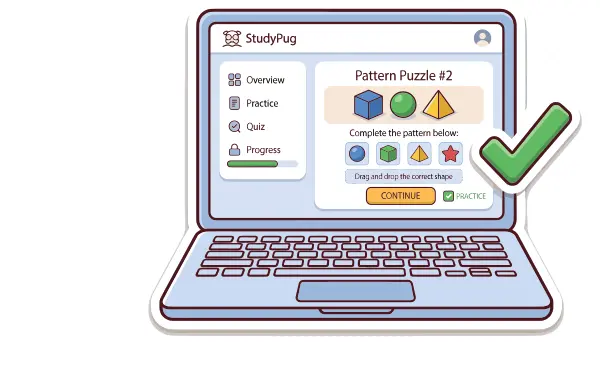
Value vs. Private Tutor
Expert help without the tutor price tag.

Multi-Subject
Switch to any subject whenever you need.
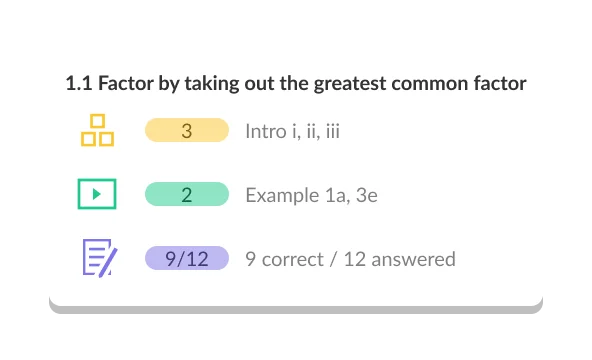
Build Mastery
Don't move on before you get it.
Try It Now
Test your knowledge
Our approach aligns with the evidence
Exam Scores
Better Recall
Less Anxiety
College Statistics Topics
1. Basic Concepts
2. Data Representation
3. Data Interpretation
4. Probability
5. Set Theory
6. Discrete Probabilities
7. Normal Distribution and Z-Scores
8. Confidence Intervals
9. Hypothesis Testing
9 Chapters · 54 Topics · 423 Videos
Discover Our Learning Areas
Explore key subjects and start learning with interactive content.










What Is College Statistics?
College Statistics is the study of how to collect, organise, analyse, and interpret data to draw reliable conclusions. It is a core module across university programmes in Ireland — from business and psychology to science and engineering — and provides the quantitative foundation for research, decision-making, and further study in data-driven fields. The course bridges everyday reasoning and rigorous mathematical method, teaching you to move from raw numbers to meaningful insight.
What Topics Are Covered in College Statistics?
A standard Irish university statistics course progresses through several interconnected topic areas:
Descriptive statistics comes first — measures of centre (mean, median, mode), spread (range, variance, standard deviation), and data visualisation through histograms and boxplots. This gives you a language for summarising data before you begin to analyse it.
Probability theory follows, covering sample spaces, probability rules, conditional probability, independence, and Bayes' theorem. You then move into common discrete distributions (binomial, Poisson) and continuous distributions (normal, t, chi-square, F) that underpin inferential statistics.
Sampling and estimation covers how samples relate to populations, the Central Limit Theorem, and how to construct and interpret confidence intervals — one of the most practically important skills in applied statistics.
Hypothesis testing is the core of the course: formulating null and alternative hypotheses, choosing the correct test (one-sample t-test, two-sample t-test, paired t-test, chi-square test, ANOVA), calculating a test statistic, interpreting a p-value, and stating a conclusion in plain language.
Regression and correlation closes most introductory courses — simple linear regression, the least-squares line, residuals, R², and an introduction to multiple regression for more complex relationships.
Is College Statistics Hard? Where Do Students Struggle?
College Statistics surprises many students. It looks like a practical, applied subject — and it is — but the conceptual difficulty is real. The challenge is not arithmetic; modern statistics is done with software. The challenge is statistical reasoning: knowing which test to use, understanding what the output actually means, and interpreting results in context rather than mechanically.
The topics students find hardest, consistently, are hypothesis testing (especially choosing the right test and interpreting p-values without confusing them with the probability of the null hypothesis being true), confidence intervals (many students misread them as probability statements about the parameter), and regression diagnostics (spotting when a model's assumptions are violated). The good news is that these are learnable with deliberate, structured practice — not by rereading lecture slides, but by working through problems, checking each step, and understanding each mistake.
How Is College Statistics Assessed in Ireland?
At most Irish universities, College Statistics is assessed through a blend of continuous assessment and end-of-year examination. Continuous assessment — typically worth 30–40% of the overall grade — may include weekly assignments, computer lab reports using R or SPSS, a group data project, or in-class progress tests. The end-of-year written examination (60–70%) usually covers the full curriculum and includes both short calculation questions and longer interpretation exercises where you must explain what your results mean in context.
Preparation strategy matters here. Students who practise with timed mock exams and worked examples under exam conditions consistently perform better than those who only revise notes. Understanding the marking scheme — examiners award marks for method and reasoning, not just the final number — is also crucial.
Why StudyPug for College Statistics?
StudyPug is built around the way university students actually learn statistics — by doing problems, watching solutions explained step by step, and identifying gaps before they become exam-day surprises.
The platform begins with a diagnostic assessment that quickly maps which statistics topics you have a solid grip on and which need focused attention. Rather than working through the entire course from the beginning, you go straight to where the work is needed. This is especially valuable mid-semester, when time is short and the exam is approaching.
Certified-teacher concept videos teach the reasoning behind each method — why you choose a t-test over a z-test, what a confidence interval is actually telling you, how to read regression output — not just the mechanical steps. These are experienced instructors explaining statistics clearly, not AI-generated content. You can rewatch any lesson as many times as you need until the concept genuinely makes sense, not just until the exam is over.
Adaptive practice adjusts difficulty based on your performance. Get a few questions right and the system moves you towards harder applications. Struggle and it brings you back to reinforce the foundation. This keeps practice sessions productive rather than frustrating.
For exam preparation specifically, StudyPug provides mock exams and practice tests that reflect the structure of university statistics papers — timed, covering multiple topic areas, and requiring you to interpret as well as calculate. One subscription covers College Statistics alongside every other university-level course on the platform, including Calculus, Linear Algebra, and Differential Equations.
What You Learn: College Statistics Course Coverage
College Statistics on StudyPug covers the complete standard curriculum taught at Irish universities:
- Descriptive statistics: mean, median, mode, variance, standard deviation, data displays
- Probability rules, conditional probability, Bayes' theorem, independence
- Discrete distributions: binomial, Poisson
- Continuous distributions: normal, t-distribution, chi-square, F-distribution
- Sampling distributions and the Central Limit Theorem
- Confidence intervals for means and proportions
- Hypothesis testing: one-sample and two-sample tests, paired tests, ANOVA, chi-square tests
- Simple linear regression, correlation, R², residual analysis
- Introduction to multiple regression
- Non-parametric tests (Mann-Whitney, Wilcoxon, Kruskal-Wallis) where applicable
Because no validated topic-level URLs are currently available in the StudyPug sitemap for this page, topic links are not included here. Browse the full College Statistics topic list directly on the platform once you are logged in.
Using StudyPug for College Statistics: A Practical Guide
The most effective way to use StudyPug for College Statistics is to pair it with your weekly lecture schedule rather than saving it for the week before exams.
Start with the diagnostic. Even if you feel confident in some areas, the diagnostic often surfaces a gap — a specific test type or a probability concept — that is worth addressing early. Knowing what you do not know is the most efficient starting point.
Watch the concept video before attempting practice problems. Statistics builds on itself: a gap in your understanding of the normal distribution will create problems when you reach hypothesis testing. The certified-teacher videos give you the conceptual grounding so that practice problems feel instructive rather than random.
Use adaptive practice regularly, not just before exams. Short, frequent sessions are more effective than marathon cramming. Adaptive practice keeps each session productive by tracking your performance and adjusting accordingly.
Use mock exams to simulate exam conditions. Irish university statistics papers reward students who can work under time pressure and interpret results clearly. Practising with timed mock exams builds that readiness. Review every question you get wrong — not just to find the right answer, but to understand why your approach missed the mark.
StudyPug is available on any device, so you can fit practice into your schedule wherever you are. Every subscription includes the full platform — no topic is gated separately. And if you decide within 30 days that it is not the right fit, the money-back guarantee means you can start without any financial risk.
College Statistics FAQ
Unsure how StudyPug works? Need help with setting up? Check our frequently asked questions or contact us for help.
What do you learn in College Statistics, and what topics does it cover?
College Statistics covers the core methods used to collect, analyse, and interpret data. You will study descriptive statistics (mean, median, standard deviation), probability theory, discrete and continuous distributions, sampling methods, confidence intervals, hypothesis testing (t-tests, chi-square, ANOVA), simple and multiple regression, and correlation. Applied courses may also include non-parametric tests and introductory data visualisation. The goal is to build a toolkit that supports evidence-based decision-making across business, science, psychology, and engineering disciplines.
What is the difference between College Statistics and a Probability course?
Probability is the mathematical study of likelihood and random events — it underpins statistics but focuses on theorems, distributions, and proofs. College Statistics uses probability as a foundation and shifts the emphasis to real-world data analysis: designing studies, estimating population parameters, testing hypotheses, and drawing conclusions from samples. Statistics courses prioritise interpretation and application; probability courses prioritise mathematical rigour. Many programmes offer both, and taking probability first can strengthen your statistics performance significantly.
What are the prerequisites for College Statistics, and what course comes after it?
Most Irish colleges require Leaving Certificate Mathematics (Ordinary Level minimum, Higher Level recommended) or an equivalent foundation module. Calculus is not always required for introductory statistics, though it helps for probability density functions. After College Statistics, students typically progress to Applied Statistics, Econometrics, Research Methods, or Biostatistics depending on their programme. A strong performance in College Statistics opens the door to data-focused electives and postgraduate study in data science or quantitative research.
Is College Statistics hard, and where do students struggle most?
College Statistics is challenging for students who expect it to be straightforward arithmetic. The most common struggles are understanding when to apply which test, interpreting p-values and confidence intervals correctly, and setting up hypothesis tests without mechanical errors. Many students also find regression output confusing at first. The difficulty lies less in the calculations and more in statistical reasoning — understanding what a result actually means. Consistent practice with worked examples is the most effective way to build confidence and accuracy.
How is College Statistics assessed in Ireland — continuous assessment and end-of-year exams?
At most Irish universities, College Statistics is assessed through a combination of continuous assessment (assignments, lab reports, or in-class tests worth roughly 30–40%) and a written end-of-year examination (60–70%). Some programmes use a project component involving real data analysis. The end-of-year paper typically includes short-answer questions, interpretation exercises, and full hypothesis-test workings. Preparing with mock exams and timed practice tests under exam conditions is one of the most effective strategies for the final paper.
What is one of the hardest topics in College Statistics, and how do you approach it?
Hypothesis testing consistently ranks as the most difficult topic. Students often confuse the null and alternative hypotheses, mis-select the test statistic, or misinterpret the p-value. The best approach is to follow a fixed five-step framework every time: state the hypotheses, choose the significance level, calculate the test statistic, find the p-value or critical region, and state the conclusion in context. Working through many practice problems — not just reading solutions — builds the pattern recognition that makes exam questions feel manageable.





Written by the StudyPug Team
Last updated June 5, 2026
3 M+
students
★★★★★
4.8 average
K–12
all grades